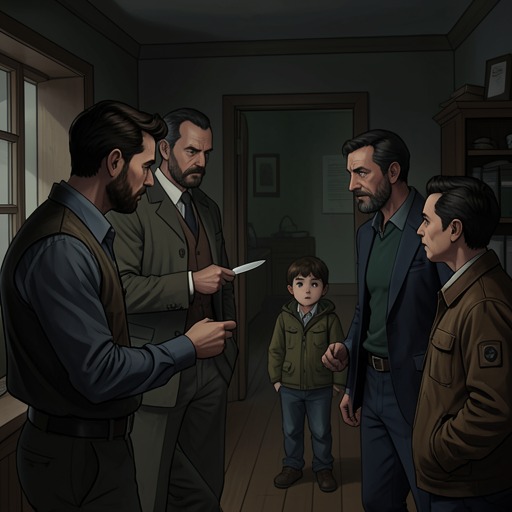
Nash's grief-driven nihilism
Hold TightNash’s grief-driven nihilism is the collapse of the fragile restraint he had maintained against a longstanding pleasure in harming others. Cassandra’s death leaves him convinced that love and faith cannot make life meaningful or shield anyone from destruction; in its aftermath, he stops fighting the violent impulse he had once tried to contain. The novel presents this change not as grief inventing a new self, but as grief stripping away the reason Nash had found to hold his existing nature back.
An Intellectual Frame for Meaninglessness
Nash’s outlook is both philosophical and intensely personal. He recalls studying John Locke’s state of nature in college: the idea that the least government is closest to the condition God intended. But Nash draws a bleak conclusion from the concept. Without civilization’s comforting stories, he sees human beings as animals, no more elevated than their appetites. Love and friendship, in this view, are inventions of an intelligent mind trying to distract itself from life’s futility.
That account of the world does not make Nash merely a detached observer. He wonders whether he is sane for seeing its darkness or whether everyone else is self-deceived. The question remains unsettled, but his own history gives the philosophy a dangerous force: he has not only doubted human meaning; he has found pleasure in injuring other people. His nihilism joins an abstract claim about the universe to an appetite with direct consequences for those around him.
Nash had once wanted normalcy. A gifted student with straight As and nearly perfect SAT scores, he attended Williams College and majored in philosophy while trying to keep what he calls the crazy at bay. His intelligence and academic success coexist with a persistent inner struggle; neither makes the violent inclination disappear. Before he meets Cassandra, restraint is an effort he continues to make, not evidence that the impulse has been resolved.
Cassandra as Counterforce
Nash describes Cassandra as a catalyst, the small addition that changes the character of a clear liquid. Her importance to him is not an abstract belief in love but a particular shared life. After returning to Williams for homecoming and reunions, they stay in North Adams at the Porches Inn. In his memory, Cassandra rests her head on his stomach while he strokes her hair and they talk. The quietness of this image matters: their bond is represented through ordinary closeness, the very kind of human attachment his philosophy will later dismiss as an illusion.
He loves Cassandra and, on their wedding day, understands what it means to feel blessed. That experience briefly complicates his conviction that love is only a comforting fiction. The novel does not suggest that Cassandra cures him, however. Her presence gives him a reason to try to contain his nature; it does not erase that nature. The distinction makes her loss a decisive rupture rather than a sudden transformation from an otherwise harmless man into a violent one.
Loss and the Release of Violence
Cassandra becomes sick, is diagnosed with cancer, undergoes treatment, and dies. Nash’s memory turns on the contradiction between her warmth and the material finality of her illness: what the cancer and chemotherapy do not take is left to decay in the ground. Against consolations about an afterlife, he insists inwardly on the body’s disappearance. For him, the promise that Cassandra is elsewhere does not soften the fact of her death; it makes religious reassurance seem like a refusal to face it.
Her family tries to comfort him with faith, fate, and the promise of an eternal reunion. Nash sees how those beliefs can help people explain loss, but cannot accept them as true. The family has already endured the death of Cassandra’s oldest brother, Curtis Lewiston, who was killed three years earlier in a robbery gone bad. Nash recalls that Cassandra grieved for Curtis for days. At the time, he wanted to release his own violent side in order to ease her pain. Curtis’s troubled life could at least be fitted into a story about a grand plan; Cassandra’s loving nature makes her death, to Nash, impossible to justify in the same way.
He concludes that people mourn because, beneath the language of faith, they know the promised consolation is false. At Cassandra’s funeral, talk of fate and plans sharpens rather than resolves his doubt. He wonders whether he could have maintained peace within himself if she had lived, or whether he was always destined to return to destruction. He cannot know. What he does know is that after her death he no longer has the strength to keep fighting the impulse. He lets it out, and the narration makes the change irreversible: once released, the violence cannot simply be put back.
Grief Without Consolation
Nash’s account makes grief the point at which his ideas become a license for action. If human lives are insignificant and love cannot protect even someone as warm as Cassandra, he sees no compelling reason to preserve the restraint he had practiced for her sake. This is his reasoning, not a neutral judgment the novel asks the reader to accept. The gap between his claim that other people are mere background and the particular tenderness of his memories exposes what his nihilism suppresses: Cassandra mattered profoundly to him, and her loss is precisely what makes his violence feel newly permissible.
The novel places this response alongside other forms of mourning without suggesting that they are equivalent. Betsy Hill encounters her son Spencer’s memorial page, created by his classmates on MySpace a few days after his death. It displays a flickering candle, photographs, and a slideshow; the page also plays Jesse Malin’s Broken Radio, one of Spencer’s favorite songs. Betsy notices how little recent or heartfelt public mourning there seems to be, and how little comes from Spencer’s close friends, including Adam. She wonders whether people who truly grieve keep their pain private, then watches the photographs and cries. Her response remains attached to Spencer’s images and memory rather than turning his death into proof that human bonds are meaningless.
Later, Betsy sits on Spencer’s bedroom floor holding his old cell phone, its battery long dead. She had stopped Ron from packing away the room, distinguishing what could be endured from what would break her. She wants to know what really happened on the night Spencer died, even though she understands that answers will not bring him back or necessarily make her feel better. When a boy’s tearful voice tells her he saw her and his mother on the roof, she recognizes Adam and hears his apology. These scenes offer a counterpoint to Nash: grief can keep a person painfully bound to the dead and compel a search for truth, while Nash’s grief becomes bound to the conviction that nothing is worth protecting. His nihilism is therefore not simply sorrow intensified; it is sorrow joined to an already present capacity for violence and turned against the possibility of restraint.