Yasmin Novak's bullying and social isolation
Hold TightYasmin Novak’s bullying and social isolation grow out of a school incident that turns a comment about her facial hair into a lasting peer stigma. Joe Lewiston apologizes, but the apology does not undo the classmates’ cruelty or restore the activities Yasmin abandons. Her story distinguishes a change to her appearance from a change in the social conditions that have made school painful.
The incident and its aftermath
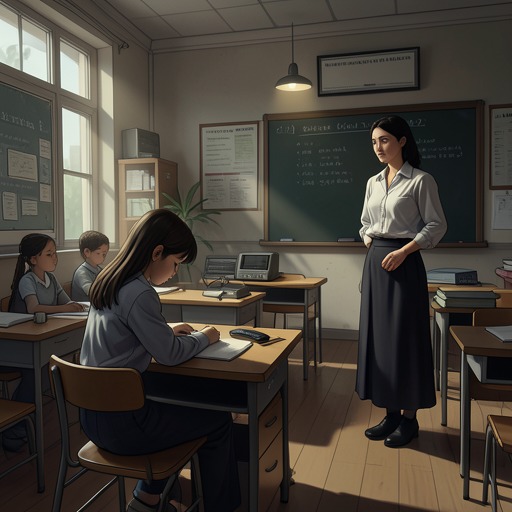
A few months before the events recalled by Mike Baye, Joe Lewiston, Yasmin’s teacher, made an inappropriate comment about her facial hair. Mike remembers the details only imperfectly, but he knows that Lewiston apologized. The apology came after the remark had already exposed Yasmin to her classmates’ attention; the harm in the account lies not only in what a teacher said, but in the way the comment became material for other children to use against her.
Her classmates called her XY, invoking the chromosomes, or shortened the mockery to Y under the pretense that it stood for Yasmin. The apparent excuse did not make the label affectionate: it gave the children a way to keep targeting the feature that had already singled her out. The name attached her identity to the trait and made it a recurring social distinction.
Yasmin stopped going to dance and, more broadly, withdrew from nearly every activity. This retreat is a concrete measure of the incident’s reach: the consequences extend beyond the classroom and into the ordinary pursuits through which a young person might take part in school and friendship. The account does not suggest that an apology, by itself, could reverse that withdrawal.
Friendship and attempted repair
Jill Baye stays beside Yasmin. She works to keep her friend included, even as Yasmin leaves dance behind and Jill continues to enjoy it. Mike and Tia Baye are proud of Jill’s loyalty. Their different responses to the same activity make the friendship visible in action: Jill does not require Yasmin to return to dance in order to remain her friend.
Yasmin’s mother later takes her to a specialist’s office for electrolysis. The treatment removes the small mustache that had provoked the original incident, but it does not make school less horrible. The distinction is central to the episode: altering the feature does not repair the relationships or school environment in which the teasing has taken hold. The narrative records the treatment and its limited result without claiming that Yasmin’s appearance alone caused her isolation.
In a later scene, the two girls sit at the kitchen table while Beth, whom Yasmin calls her mother’s girlfriend of the week, offers an omelette, sausage, and her celebrated pancakes. The girls choose frozen Eggos with chocolate chips instead. The breakfast is an ordinary, companionable setting, not a cure for the situation at school. As the conversation continues, Yasmin notices Beth smoking behind a tree. This small exchange establishes the girls’ shared attention to their surroundings before their talk turns to something much more serious.
What Yasmin confides to Jill
Yasmin asks Jill not to tell anyone, and Jill promises. Yasmin then discloses that she has imagined using a gun against Joe Lewiston. She describes having thought about bringing it to school or going to his home, and even about acting in front of other students; she also distinguishes those thoughts from a plan, saying she will not do it. The account presents violent ideation, not an attack or a confirmed intention to carry one out.
The detail of the disclosure matters because it complicates any simple account of Yasmin as merely withdrawn. She has privately rehearsed ways of making Lewiston pay, while also recognizing a boundary she does not want to cross. Jill does not dismiss what she has heard. She tells Yasmin that Lewiston should face consequences, and Yasmin agrees. The exchange gives her grievance an attentive witness, though it does not resolve the threat or the underlying bullying.
When a car arrives and Yasmin’s father comes home, Yasmin calmly returns the gun to a drawer and arranges the contents. The scene ends without a confrontation: her father calls to the girls, while the earlier disclosure remains unspoken to him. The contrast between her composed handling of the moment and the seriousness of what she has told Jill leaves the danger unresolved rather than presenting a dramatic act of violence.
Family response and the limits of repair
A later confrontation gives the damage a family scale. One speaker recalls that Yasmin was once a happy child and says she was picked on every day; the same exchange rejects the idea that the effect on her is melodramatic and argues that what happened was worse than a slap. The passage frames the bullying as a sustained loss of childhood ease, not a single unpleasant remark. It also shows that adults around Yasmin disagree about the weight to give that harm.
Her mother’s intervention addresses the visible feature, while Jill’s loyalty addresses Yasmin’s immediate need for companionship. Neither is shown ending the school hostility. Taken together, the episodes separate practical support from social repair: treatment can change appearance, and friendship can resist exclusion, but the evidence does not show the school restoring Yasmin’s sense of safety or belonging.
A separate absence
Later, investigator Loren Muse questions Yasmin carefully about her mother. Yasmin knows nothing about her mother’s situation and says she had not seen her; she did not know her mother had returned to town and thought she was in Los Angeles. This later exchange concerns her mother’s whereabouts rather than the school bullying, and it does not establish that the bullying caused the distance between them. It does, however, place Yasmin in another moment of uncertainty, with little information about an absent parent.
Across these scenes, Yasmin’s isolation is not presented as a single fixed condition. It is produced through repeated peer labeling, followed by withdrawal from activities, and partly countered by Jill’s steadfast presence. The failed promise of cosmetic repair and Yasmin’s guarded disclosure show the gap between changing what others can see and changing the treatment that has made her feel exposed.