Allison Argent
Holding Out for a Hero ▸ Stiles Stilinski (2)Allison Argent is the youngest member of the Argent family, a family of hunters who respond to supernatural danger by attempting to eliminate it. That inheritance makes her relationship with Scott McCall inherently dangerous: Scott is a werewolf, while Allison is the daughter and granddaughter of people committed to hunting creatures like him. Her importance lies in the way she inhabits both sides of that division. She is not merely the hunter family’s daughter or Scott’s girlfriend; she is the person repeatedly forced to decide whether family loyalty, secrecy, and inherited doctrine can outweigh friendship and personal judgment.
Identity and Background
Allison’s position in the story is established through her family before it is fully defined through her own choices. The Argent family represents the human response to the unknown: when something is believed capable of harming humanity, hunters appear to destroy the threat. Allison therefore enters the supernatural conflict carrying a social identity that has already been assigned to her. She is beautiful, young, and the youngest member of the family, but those apparently ordinary qualities exist inside a tradition organized around weapons, surveillance, and the removal of supernatural beings.
Her connection to the ordinary world remains visible even when the supernatural plot closes around her. At Kate Argent’s funeral, her clothing is kept in a plastic garment bag, and Allison tries to force a smile while taking out the dress. The gesture exposes the strain between public composure and private grief: Kate was her aunt, yet Kate had also killed people. Allison must mourn a family member without being able to separate family affection from the violence attached to the Argent name. Her grief is consequently part of the same moral conflict that defines her larger arc.
Love, Secrecy, and Divided Loyalties
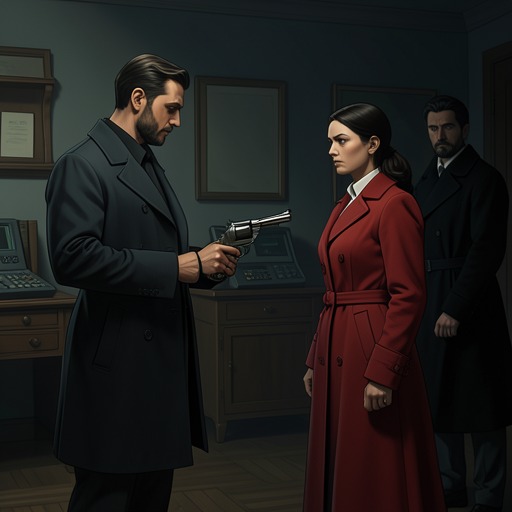
Scott and Allison’s relationship turns the hunter-werewolf conflict into an intimate problem. After the Alpha confrontation, seeing each other becomes difficult, so they begin meeting secretly. The secrecy is not simply romantic concealment; it is a survival strategy inside a family that has discovered the relationship. Mr. Argent eventually follows them, holds a gun to Scott’s head, and forces Allison’s newest friend to break up with him. The scene makes clear that Allison’s family can convert her private affection into a weapon against both of them.
The pressure does not end with the breakup. After Gerard Argent takes over as principal, the couple has barely enough freedom even to look at each other because their movements are tracked. Scott and Allison therefore send their affectionate messages through Carson Bradley and Stiles Stilinski, whom they regard as the only people they can trust. Their friends become intermediaries in a relationship that cannot safely speak for itself, while the school becomes an extension of Argent surveillance. Allison’s romance with Scott is thus also an ongoing negotiation over autonomy.
Allison’s loyalty to Scott remains emotionally complicated. During the Rave warehouse crisis, she tells her family where the Kanima is, and that disclosure causes serious trouble for Scott and the others. Scott responds by lashing out at her, after which the two stop speaking normally. Yet the surrounding group recognizes that Allison’s heart was in the right place and waits for Scott to apologize. The episode shows why her position cannot be reduced to betrayal: she is attempting to use the resources of her family to address a threat, but the family’s methods and priorities make even a well-intended disclosure dangerous.
Skills, Weapons, and Participation in the Conflict
Allison is not a passive witness to the supernatural events. When the group needs a weapon, she reaches into her bag and produces a device that extends when snapped down: Allison’s miniature crossbow. The object condenses her inheritance into something portable and practical. It is an emblem of the Argent family’s training, but in Allison’s hands it can serve the friends who stand outside the family’s official boundaries.
Her effectiveness also depends on her ability to recognize danger and act under pressure. When the giant reptilian creature appears inside the school, Carson Bradley and Stiles Stilinski encounter it climbing along the indoor balcony’s metal fencing before it drops to the floor on its hind legs and then falls to all fours. Allison is part of the group responding to the creature’s repeated attacks, placing her directly within the same threat her family claims authority to eradicate. The conflict is therefore not abstract for her: it is an immediate physical danger shared with the people her family may classify as enemies.
Allison also participates in the group’s attempts to restrain Derek Hale’s werewolf pack. During the confrontation with Erica Reyes, Erica’s hand becomes covered in Kanima venom; Allison and Carson recognize what is happening, and Erica soon collapses when the paralysis takes effect. Allison’s presence in this scene places her alongside the group’s defensive efforts rather than outside them. Her knowledge and readiness are used against supernatural violence, but the target is not treated as an anonymous monster: the scene is embedded in the strained relationships among adolescents who are repeatedly forced to fight one another.
Family Conflict and the Cost of the Middle Ground
Allison’s most dangerous position is the space between the Argent family and her friends. The family knows the group’s plans because Allison believes she can trust them. She is described as trying to walk the line between family and friends, but the arrangement cannot hold indefinitely. The conflict’s crossfire is expected to catch someone, and the crucial reversal is that Allison, rather than Scott, is the person placed in greatest danger. Her attempt to preserve both affiliations does not neutralize the war; it makes her vulnerable from both directions.
The hostility between Carson and Allison’s family further clarifies the stakes. When Mrs. Argent enters Allison’s room, Carson responds with an immediate glare because Mrs. Argent tried to kill Scott’s best friend. Allison remains connected to a household that Carson regards as terrifying, even while Allison herself is treated as part of the trusted circle. This contrast allows Allison to function as a bridge without making the bridge safe. Her family name opens access to weapons and information, but it also carries the memory of attempted murder.
The presence of Gerard’s jacket becomes part of another plan involving Allison. Carson notices that Allison has the jacket wrapped around her, a detail that signals the group’s attempt to use the Argent family’s authority, clothing, or access for its own purposes. Allison is consequently both a person making choices and a conduit through which the group navigates the family’s power. The jacket’s significance rests in that reversal: an object associated with the hunters can be repurposed by those resisting their control.
Relationships and Moral Recognition
Scott and Allison’s relationship gives the supernatural conflict its clearest romantic form. Scott’s love for her does not erase the danger created by their families; instead, it forces both characters to confront the contradiction between inherited identity and chosen allegiance. Their eventual reunion in the warehouse, where they are seen holding hands while Allison’s father remains behind them in silence, presents a temporary alignment rather than a simple restoration of normality. Allison’s father’s silence and later change of heart show that family opposition can shift, but only after the crisis has made the cost of that opposition undeniable.
Allison’s friendships broaden her role beyond the romance. Carson and Allison are allies despite Carson’s distrust of the Argent adults. Carson’s anger is directed at the people who tried to kill her friends, while Allison continues to move through the same family structure. Their friendship therefore carries a productive tension between affection and judgment: Carson can trust Allison without granting automatic trust to the Argent family.
Allison also belongs to the group that helps uncover the truth about Jackson Whittemore. When Jackson’s reptilian features begin to disappear, the transformation reveals his human form beneath scales and claws; Allison is present as the group watches him return toward recognizable humanity. The scene matters because it opposes the hunters’ impulse to classify supernatural bodies as threats requiring destruction. Allison, herself shaped by a hunter tradition, is positioned among those witnessing a monster’s identity become legible as a person’s.
Change and Narrative Significance
Allison’s development is best understood as a movement from inherited certainty toward conflicted responsibility. The evidence does not portray her as abandoning her family or becoming detached from its knowledge. She continues to carry a miniature crossbow, access family information, and involve her relatives in the group’s efforts. What changes is the meaning of those resources. The tools of the hunters can be placed in service of protection rather than extermination, and family access can become a means of helping friends even when it produces disastrous consequences.
Her arc also illustrates the difference between intention and outcome. Allison believes her family can be trusted and reveals the Kanima’s whereabouts, but the disclosure creates trouble for the people she means to help. Her judgment is therefore neither wholly vindicated nor condemned. The story treats her as someone learning that good intentions cannot control institutions built around threat elimination. The same family that can assist the group can also endanger it, and Allison’s effort to mediate between those functions leaves her exposed.
By the warehouse confrontation, Allison stands beside Scott, holding his hand, while her father is temporarily on their side. The image gathers the central contradiction of her character into a single arrangement: the hunter’s daughter is physically aligned with the werewolf she loves, and the family that once threatened that relationship has not disappeared but has momentarily changed position. Allison’s significance comes from making that alignment possible without pretending the underlying conflict is finished. She embodies the story’s insistence that loyalty is chosen through action, tested by consequence, and never guaranteed by blood.