Argent–werewolf war
Holding Out for a Hero ▸ Stiles Stilinski (2)The Argent–werewolf war is the central adversarial condition surrounding Beacon Hills after Peter Hale’s death and Derek Hale’s rise as an Alpha. What begins as a conflict between hunters and creatures regarded as threats becomes a widening struggle over identity, inheritance, secrecy, and who has the authority to decide which lives deserve protection. Its most consequential development is the transformation of the Argents from a feared hunting family into an openly aggressive force under Gerard Argent, while Derek Hale’s growing teenage pack makes the supernatural community more visible and more vulnerable.
Origins in Fear and Inherited Duty
The war is rooted in the Argent family’s longstanding tradition of hunting werewolves. The narrative presents that tradition as a response to the unknown: when a creature might harm humans, some people seek to eliminate the threat rather than understand it. The Argent family embodies that impulse as a hereditary system, making supernatural identity a cause for suspicion before any individual action has been judged.
Scott McCall becomes the immediate point at which the two worlds collide. After Scott is bitten and begins displaying greater strength, speed, and heightened senses, Carson Bradley, Stiles Stilinski, and Scott McCall identify him as a werewolf. Scott’s transformation does not remain a private medical or personal crisis, because the Argent family’s presence turns it into a matter of hunter surveillance and possible extermination. The danger is sharpened by Scott McCall’s relationship with Allison Argent, the youngest member of the hunting family. Their romance is described as a forbidden Romeo-and-Juliet relationship, binding the war’s public violence to an intimate conflict between loyalty, desire, and family obedience.
Escalation After the Alpha Showdown
Peter Hale’s death ends the murders committed during his reign as an Alpha, but it does not end the war. Derek Hale takes the helm as Alpha, and his eyes run blood red as he begins turning teenagers into werewolves at an accelerated pace. This creates a new source of danger: the hunters face not a single hidden werewolf but a growing group of young supernatural beings, while the newly made pack risks becoming both a target and an instrument of escalation.
Kate Argent’s death and burial form the second major turning point. Kate Argent is identified as a violent hunter whose end is itself violent, and her acts of arson become public enough to turn the Argent family into social pariahs. The revelation does not produce reconciliation. Instead, Gerard Argent appears as a new and more volatile representative of the family, one who does not resemble an ordinary werewolf hunter but proves more dangerous precisely because of his extremity. The narrative states that Gerard Argent declares war, converting an inherited ideology into an explicit campaign.
The funeral consequently becomes a strategic gathering rather than a private family ritual. Allison Argent is told that other relatives will explain matters after Kate Argent’s funeral, and Carson Bradley recognizes that the arriving relatives will probably be Argents who continue the hunting tradition. The family’s communication is secretive, while the teenagers attempt to infer its plans from partial information. The funeral thus exposes how kinship serves as the war’s infrastructure: knowledge, tactics, and hostility pass through the family even when Allison Argent herself is not fully informed.
Surveillance, Secrecy, and Reinforcements
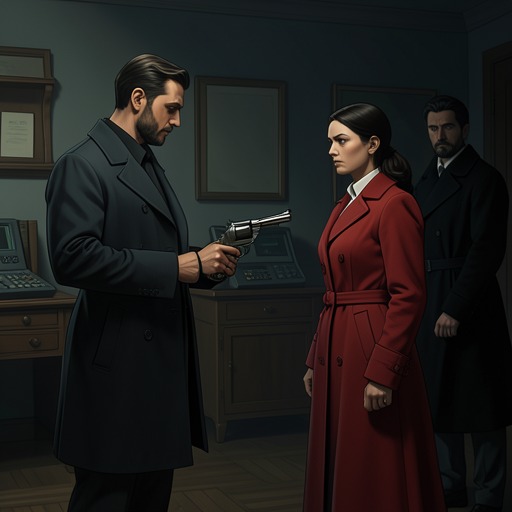
The conflict forces Scott McCall and Allison Argent to conduct their relationship in secret. After the Alpha showdown, the couple can no longer meet openly. Mr. Argent follows them, points a gun at Scott McCall, and forces Allison Argent to break up with him. They refuse to end the relationship, but respond by becoming even more careful; only Stiles Stilinski and Carson Bradley are trusted with the secret. The war therefore reaches beyond physical attacks. It regulates movement, intimacy, and speech, making ordinary teenage life impossible without concealment.
The teenagers also treat every new Argent presence as a possible military development. While observing the family, Scott McCall identifies the newcomers as reinforcements. Carson Bradley concludes that their lives are about to become significantly harder, a judgment immediately followed by Sheriff Stilinski discovering the group hiding and pulling Scott McCall, Stiles Stilinski, and Carson Bradley to their feet. The scene combines adolescent improvisation with the logic of counter-surveillance: the young investigators are not merely learning about the war, but already behaving like participants in it.
The family’s public reputation magnifies this atmosphere. Allison Argent is surrounded by relatives at Kate Argent’s funeral, while the school reacts to Lydia Martin as a public spectacle, staring at her and labeling her a town “nut job.” Although the school incident is not itself a hunter-werewolf battle, it reveals the broader social environment in which the war operates: rumor, inherited stigma, and public attention turn unusual bodies and identities into threats before the facts are known. The supernatural conflict is sustained not only by weapons but also by communal suspicion.
Knowledge as a Weapon
Because neither side fully understands the emerging threats, information becomes a contested resource. Scott McCall retrieves Gerard Argent’s flash drive after the group discovers that the book they had mistaken for the bestiary is actually a log of recipes. The genuine bestiary is stored on the drive, and its contents appear in strange non-English words, apparently Latin, forcing the teenagers to translate a tradition that the hunters have preserved but not made accessible.
Their research into the Kanima demonstrates the limits of inherited authority. Carson Bradley and Stiles Stilinski find almost nothing about the creature online: no useful sightings, stories, or legends, despite Derek Hale’s claim to have heard accounts. Searches for the Kanima, its legends, its shape-shifting nature, and a giant lizard that cannot swim produce little information. The bestiary’s Latin text remains unreadable, and even an online translator is considered unreliable. The war is therefore fought under conditions of incomplete knowledge, with hunters possessing records that the teenagers cannot immediately interpret and werewolves possessing experience that may still fail to explain the new creature.
This knowledge struggle encourages cooperation across former boundaries. Deaton assists Scott McCall, Carson Bradley, and Stiles Stilinski in preparing to confront Jackson Whittemore, and the group trusts him more than many other figures connected to the supernatural because he repeatedly helps Scott McCall in moments of crisis. His veterinary office becomes a meeting place where practical tools and supernatural guidance are combined. The group’s reliance on Deaton shows the war producing alliances that do not fit the old hunter-versus-werewolf division: survival depends on whoever can provide accurate knowledge, regardless of inherited allegiance.
Expansion, Consequences, and Meaning
The war’s immediate consequence is the multiplication of fronts. Derek Hale’s teenage werewolf brigade expands the supernatural side, while Gerard Argent’s arrival hardens the hunter side. A further enemy lurks beyond both groups, killing for reasons that initially seem unclear. Because that threat does not fit neatly into either faction, the boundaries between good and evil blur, and unlikely alliances become necessary. Carson Bradley identifies Stiles Stilinski as the one constant keeping her sane, underscoring that personal loyalty, rather than factional identity, becomes the most reliable source of stability.
The conflict also changes the young people who survive it. The original trio of Carson Bradley, Stiles Stilinski, and Scott McCall remains together, but they emerge more cautious, more grown up, and more hardened by death. Their continuity matters because the war repeatedly tries to separate private relationships from public violence: Scott McCall and Allison Argent must hide their love, the Argents interpret family loyalty as duty, and the teenagers must decide when cooperation is more important than inherited categories.
The Argent–werewolf war is therefore less a single battle than a state of permanent escalation. Kate Argent’s crimes discredit the family without dissolving its power; Gerard Argent turns that damaged inheritance into a declaration of war; Derek Hale’s Alpha status creates a larger and younger opposing force; and the appearance of the Kanima introduces a threat that makes both established sides unstable. The result is a world in which the old distinction between hunter and monster can no longer organize every danger. The war’s deepest significance lies in that collapse: survival increasingly belongs to those who can recognize the humanity of individuals on the other side, share knowledge across hostile boundaries, and maintain trust while bloodshed continues around them.