Beacon Hills Sheriff's Department
Holding Out for a Hero ▸ Stiles Stilinski (2)Beacon Hills Sheriff's Department functions as both Beacon Hills' official instrument of public order and one of the story's most important pressure points. Its officers investigate disappearances and violent deaths, coordinate emergency responses, process physical evidence, and maintain the station's holding facilities; yet the department's authority is repeatedly strained by supernatural crimes that conventional procedure cannot immediately explain. The result is an institution caught between routine bureaucracy and escalating exception, with the police station becoming a place where investigations, family loyalties, adolescent rebellion, and supernatural violence converge.
Nature and Structure
The department is organized around the sheriff's office, patrol officers, a front desk, holding rooms, cell keys, radios, surveillance systems, and the sheriff's private office. Sheriff Stilinski directs the response to urgent cases and communicates with officers in the field, while deputies assist him during investigations and arrests. The station's ordinary infrastructure is repeatedly made visible by the narrative: a password-protected lock box contains the keys to the cells, the front desk controls access, and surveillance footage can be reviewed from the sheriff's old desk. These practical details establish the department as a functioning civic institution rather than an abstract backdrop, even when its procedures are forced to accommodate events beyond normal policing.
The department also depends on communication networks that allow distant incidents to become immediate institutional knowledge. A police scanner reports a disturbance involving an ambulance on Route Five, and an officer describes blood covering the rear of the vehicle after something entered it during transport. Sheriff Stilinski repeats the report into the radio, confirming the seriousness of the incident before the teenagers can fully understand what they are hearing. The department's authority therefore begins with information: calls, radio codes, dispatches, and observations from officers at the scene.
Investigations and Emergency Response
The department's work is repeatedly shaped by cases involving missing people and unexplained violence. When Lydia Martin disappears, Sheriff Stilinski orders an APB for a sixteen-year-old redhead after Mrs. McCall reports that Lydia simply left. The response is formally appropriate but also exposes the limits of institutional description: the sheriff's chosen hair-color descriptor prompts private concern that Lydia would object to being reduced to it. The department must turn an individual disappearance into a searchable police profile, even as the people closest to Lydia understand that the case is more complicated than an ordinary runaway report.
The department responds to danger beyond the station as well. After Scott McCall runs into the woods using supernatural speed, Carson and Stiles Stilinski move closer to the ambulance scene and find police already gathered around a blood-covered vehicle. The investigation is not treated as a normal traffic disturbance; the unknown assault on the ambulance, the dead heart-attack victim, and the officer's insistence that he has never seen anything like it mark the scene as a crisis for which the department has no ready explanation. Police presence supplies order around the evidence, but it does not yet supply an account of the attacker.
At Beacon Hills High School's lacrosse field, Sheriff Stilinski arrives with two deputies after Scott and Isaac Lahey collide during practice. Within minutes, Isaac is separated from the other students and questioned by the sheriff, deputies, and Coach Finstock, while the surrounding players speculate about why the apparently quiet Isaac has attracted a police visit. Scott then tells Carson and Stiles that Isaac's father is dead and may have been murdered. The scene shows the department converting a school gathering into an investigative space, bringing public authority into the middle of adolescent life and transforming a sports practice into the first visible stage of a homicide inquiry.
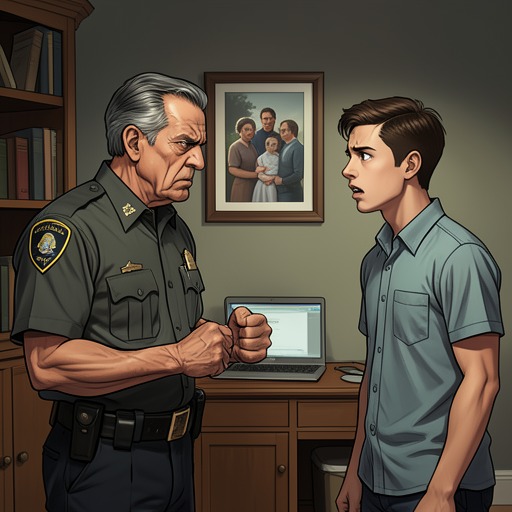
The department's authority is also challenged by people who use its facilities without permission. Carson and Stiles enter the station's holding area while attempting to deal with Isaac's situation, and Sheriff Stilinski is furious to discover them there after Isaac has been removed. Stiles's immediate attempt to identify an unconscious hunter by saying that the hunter committed the crime only intensifies the absurdity of the intrusion. Sheriff Stilinski reprimands them for interfering with police business, even though their actions arise from their concern for someone they believe is in danger. The department thus appears as a boundary between lawful investigation and improvised teenage intervention, a boundary the characters repeatedly cross.
Authority Under Pressure
The department's formal power is not always stable. Gerard Argent, newly positioned within Beacon Hills High School, announces that two students will have to accept detention so that he can support his teachers during his first day. His intervention carries the tone of institutional authority, but the teenagers recognize that the punishment is being directed toward them for reasons that remain initially unspoken. This episode places the school and the sheriff's department within a wider network of adults claiming the right to control young people, while also showing how authority can be performed through procedure even when its deeper motives are contested.
The station's physical security becomes a practical obstacle when Derek Hale and the teenagers attempt to reach the cells. Derek proposes distracting the front-desk employee, but Stiles immediately rejects the idea that Derek should enter and improvise the deception himself. Their plan depends on bypassing the station's access controls and retrieving the cell keys from the password-protected lock box in Sheriff Stilinski's office. The scene reveals how ordinary security arrangements become part of a clandestine rescue operation: the front desk, office, lock box, and cells are no longer neutral administrative features but barriers that the characters must outmaneuver.
The department's officers are similarly forced to handle supernatural manifestations without a reliable institutional vocabulary. At a mechanics garage, a clawed, scaly hand reaches down from the lift area, a tail strikes a worker's neck, and the worker collapses. The lizard creature's yellow eyes and shriek identify the attack as something outside ordinary criminal behavior, while Stiles is left barely able to move after being paralyzed. Carson calls the police using Stiles's phone, but the emergency system can do little more than receive the call as the creature and the machinery continue to endanger the scene. The department remains the expected destination for help even when the threat exceeds what its responders are equipped to understand.
That contradiction recurs at the hospital. After Carson and Allison Argent force Lydia into a room and secure the door, clear ooze drips from the open window sill, recalling the residue found at the auto shop. Carson warns Stiles that the creature is present, and the hospital becomes another site where police protection, personal warning, and supernatural pursuit overlap. The department is not shown solving the threat at that moment; instead, its absence from the immediate room emphasizes how quickly the characters must act before official help can arrive.
Evidence, Surveillance, and the Homicide Case
The department's investigative value becomes strongest when physical traces can connect apparently separate crimes. In the former sheriff's office, Stiles, Scott, and Carson review hospital surveillance footage from the night Jessica was murdered. They search through crowded images of wheelchairs and gurneys, knowing that a six-car pileup had filled the hospital and made the relevant footage difficult to isolate. The camera system offers the promise of objective proof, but the volume of ordinary movement turns that promise into uncertainty; the missing figure may be present without being easy to identify.
The search gains force when the former sheriff gathers documentary evidence. Shoeprints and tire tracks from the trailer park may match Matt Daehler, which would place him at the scenes of three murders: the trailer, the hospital, and the rave. A credit-card receipt signed by Matt at the mechanics garage could connect him to the mechanic's death as well. These records do more than confirm suspicion. They create a chain across locations and victims, allowing the department's investigative materials to transform scattered supernatural violence into a pattern that can be assigned to a human participant.
The station therefore operates as a repository of facts even when its personnel do not yet possess the whole explanation. Surveillance footage, footprints, tire tracks, receipts, radio transmissions, and witness reports coexist with gaps, confusion, and competing interpretations. The department's evidence-based methods provide the structure through which the larger mystery can be reconstructed, but the story repeatedly shows that the decisive meaning of the evidence may be recognized first by outsiders working under pressure rather than by the institution alone.
Crisis and the Suspension of Procedure
The department becomes most visibly vulnerable when ordinary legal safeguards are overtaken by emergency action. Carson and Stiles Stilinski steal a police vehicle to contain Jackson Whittemore after he has become a danger to others, placing the department's own equipment in the hands of teenagers who believe that immediate restraint matters more than authorization. The stolen van is used to hold Jackson unconscious, and Scott McCall has to strike him repeatedly to keep him from attacking anyone. This improvised detention reverses the department's normal function: instead of police officers securing a supernatural suspect, frightened adolescents appropriate police power because no accepted procedure appears fast enough.
The same tension surfaces inside the station when the investigation turns toward Jackson's history. Danny Mahealani directs Carson toward the stairs near Hamilton's room after reporting that he saw Erica Reyes with her hands on Carson's boyfriend's chest. The information redirects Carson's search through the school, but it also illustrates how official investigations depend on informal testimony, rumor, and hurried personal contacts. The department's pursuit of the truth is therefore distributed across a network of students and former officials rather than confined to formal interviews.
The station's authority is further complicated by its changing leadership. After Sheriff Stilinski's suspension, the former sheriff still has access to the department's old desk, its records, and its surveillance system, while the current institution remains a place the teenagers enter under conditions of uncertainty. Even a mundane lunch conversation underscores this distance: when Carson asks what the sheriff has found, he refuses to share confidential police work with the teenagers. The refusal preserves professional boundaries, but the plot repeatedly makes those boundaries porous, since the teenagers possess information and access that the official investigation cannot afford to ignore.
The Hostage Crisis
The department ultimately becomes the center of a direct assault on civic authority when Matt Daehler enters with a gun and forces Carson through the hallway as a hostage. Matt intends to take Carson, Stiles Stilinski, Scott McCall, and others captive, while Jackson is allowed to kill people in order to clear the way. Carson is pushed into the office at gunpoint and then moves toward Stiles, who pulls her behind himself and Scott. Sheriff Stilinski raises himself from his desk and tries to negotiate, insisting that whatever is happening must have a solution that does not involve a gun. The exchange places the department's defining promise—lawful resolution—against Matt's deliberate conversion of the station into a site of terror.
The crisis also makes the department's interior geography newly significant. The office, hallway, holding room, and cells cease to be separate administrative spaces and become a shifting map of confinement, pursuit, and rescue. Matt's gun turns the hallway into a corridor of forced movement; the office becomes the point where hostages, investigators, and the sheriff are gathered; and the holding area becomes the place where escape depends on a small mechanical lock rather than on institutional protection.
Carson attempts to free Sheriff Stilinski from his handcuffs while the entire station descends into chaos. The lights fail, alarms begin to sound, and rapid gunfire erupts from outside. The gunfire does not sound like Matt's weapon, leading Carson to identify the Argents as another force entering the crisis. The supernatural emergency consequently becomes a convergence of incompatible powers: Matt has a gun, Jackson is being used as a weapon, Scott and Derek Hale's werewolves are involved, the Kanima is part of the threat, and the hunters arrive with automatic weapons. The department's building can contain these forces only temporarily; its rooms become a pressure chamber in which policing, vigilantism, supernatural violence, and family conflict collide.
Escape, Evidence, and Institutional Meaning
In the darkness, Carson stands over Sheriff Stilinski and works at his handcuff with a pin while Melissa McCall encourages her from inside the cell. The detail gives the station's crisis a sharply material center. A place designed to secure suspects and protect officers is reduced to a lock that will not yield, a flickering yellow light, and the improvised skill of a teenager. Carson's effort does not erase the department's authority, but it shows how survival has displaced procedure: the people trapped inside must manufacture their own means of release.
Across these incidents, the Beacon Hills Sheriff's Department is neither simply effective nor simply powerless. It can issue an APB, dispatch officers, preserve surveillance, gather footprints and receipts, respond to an ambulance attack, separate a homicide suspect from a crowd, and maintain holding facilities. Yet the department repeatedly encounters events whose causes are concealed by supernatural identities and whose immediate solutions require actions outside official permission. Its evidence practices make hidden patterns legible, while its physical spaces repeatedly become vulnerable to intrusion, hostage-taking, and unauthorized detention.
The department's narrative significance lies in this unresolved contradiction. It represents the public order that the characters rely on even when they distrust or evade it, but it also marks the limits of a world in which conventional institutions must confront the Kanima, werewolves, unexplained disappearances, and manipulated murder scenes. The police station is consequently more than a setting for investigation: it is a threshold between ordinary civic life and the supernatural crisis beneath Beacon Hills, a place where authority is tested, borrowed, suspended, and sometimes rebuilt through the actions of those whom the institution is supposed to protect.