Carson Bradley's House
Holding Out for a Hero ▸ Stiles Stilinski (2)Carson Bradley's House is the principal domestic space associated with Carson Bradley's private life, but its apparent security is repeatedly unsettled. It is where Carson returns from emotional and supernatural upheaval, where her relationship with Stiles Stilinski becomes intimate, and where an ordinary night at home turns into a confrontation with a tall, predatory lizard creature. The house therefore functions not simply as a residence but as a threshold: the boundary between Carson's protected personal world and the violent supernatural dangers that follow her home.
Domestic Refuge and Private Intimacy
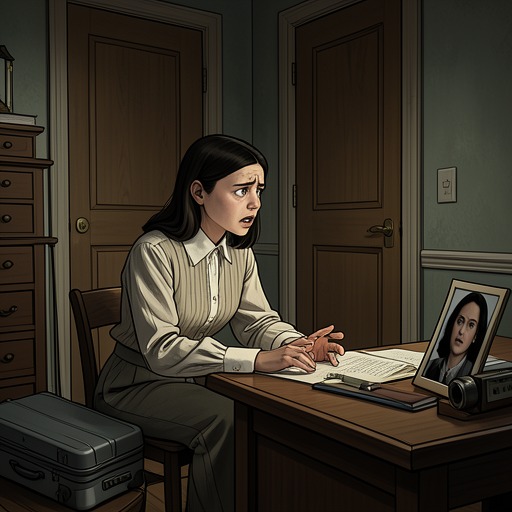
Carson Bradley's House first appears as a place of return and emotional contrast. After leaving Stiles Stilinski, Carson unlocks the door and enters with a smile still fixed on her face, while Stiles's Jeep rumbles away from the curb. The happiness of the departure does not survive the threshold intact. Carson's smile falls when she sees her father, whose attempt to question where she has been makes the house feel less like an uncomplicated refuge than a site of strained family authority. Her movement toward the stairs, and her father's interruption halfway up, turn the familiar interior into a space where privacy is contested.
The house also contains Carson's relationship with Stiles Stilinski at its most openly affectionate. With her father absent, Carson recognizes that she and Stiles are alone behind her closed bedroom door. She tells him that she loves him, and his expression changes immediately from sexual frustration to delight before he answers that he loves her too. The bedroom becomes a protected pocket within the larger house, a place where the couple can acknowledge the speed and seriousness of their attachment without the interruptions that govern their lives elsewhere. Carson's playful attempt to earn some of the relationship's imagined years of permanence continues that movement from declaration toward physical intimacy, although Stiles responds by joking that such years cannot be attained in a single night.
A House Surrounded by Supernatural Crisis
Carson's return home follows an extraordinary accumulation of danger. She has learned about a grave robbery, taken part in interrogations, waited for Stiles to leave detention, crashed a funeral, been placed in a police car, escaped from it, and helped find her best friend after four days of wandering naked through the woods without knowing what had happened. She also suspects that the day's turmoil has cost her a Chemistry test. When she falls onto her bed and reflects that all of this occurred in less than twenty-four hours, the house becomes the place where the day's events are temporarily gathered and measured.
That domestic pause is not equivalent to safety. Carson remarks that saving the town alongside werewolves has become an everyday burden and that she can scarcely remember the last time she went to bed at a decent hour. The house offers sleep, a shower, and the possibility of ordinary routine, yet the strain of supernatural responsibility has already entered that routine. Its protective function is therefore fragile: home is where Carson tries to recover, but it is also where the consequences of her outside life arrive without warning.
The Bedroom, Hallway, and Threshold of Fear
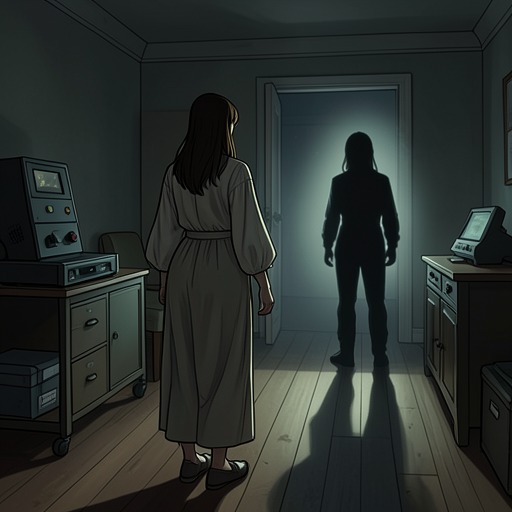
The most developed sequence in Carson Bradley's House begins after Carson showers and changes into plaid pajama pants and a tank top. She unwraps her wet hair, shakes it out, and goes to the vanity, where she opens a drawer for the hair dryer. These small actions establish the room as an intimate, recognizably domestic environment. The interruption comes as a thump from the hallway. Carson freezes, turns toward the closed door, and initially persuades herself that the noise is merely the sound of an old house.
A second thump destroys that explanation. Carson's heartbeat rises as she looks toward the metal bat propped against the door frame. The object carries its own memory: it recalls the earlier night when Stiles Stilinski and Scott McCall broke into the house and Carson followed them downstairs with the same bat. The bat is both a practical weapon and a material record of previous fear, connecting an earlier intrusion to the new threat before Carson even crosses the doorway.
Carson talks herself toward the threshold by recalling that she runs with werewolves and helped defeat an Alpha. The self-encouragement does not erase her fear, but it gives her enough resolve to take the bat, grip its cold metal, twist the doorknob, and open the door. The bedroom light spills into the hall, briefly making the darkness legible. Her first glance to the left brings relief because that end of the hallway is empty; the glance to the right reverses the moment. Two reptilian eyes gleam in the darkness.
The Reptilian Intrusion
The creature's appearance transforms the house from private shelter into a hunting ground. Carson can barely distinguish its shape before it lunges forward, bringing scaly skin into view. It resembles an overgrown lizard taller than Carson, with a long tail and rows of razor-sharp-looking teeth. Its eyes seem to recognize her, and its advance continues despite her scream. The threat is not an indistinct household noise but a physically imposing creature that has crossed into the most private part of her home.
The scene's force comes from its reversal of familiar spatial expectations. The closed bedroom door, the hallway, the vanity, the hair dryer, and the bat all belong to a world of ordinary domestic objects and habits. Yet the hallway becomes the passage through which the supernatural enters, while the bat provides only the courage to face the danger rather than proof that Carson controls it. The house's internal geography—bedroom to doorway, left side to right side, light to darkness—organizes the discovery as a movement from reassurance into exposure.
Narrative Significance
Carson Bradley's House holds opposing forms of vulnerability. Behind the bedroom door, Carson and Stiles Stilinski can exchange love and imagine permanence; beyond it, Carson's father can challenge her independence, and an unidentified reptilian creature can emerge from the darkness. The same building thus shelters romance, family conflict, exhaustion, memory, and physical threat without allowing any one of them to remain separate.
Its importance lies in the collapse of the boundary between Carson's ordinary and supernatural lives. The house is where she tries to sleep after a day of extraordinary events, but it is also where those events acquire a new shape and confront her directly. By placing the giant lizard creature in the hallway of Carson's home, the narrative makes clear that danger is no longer confined to forests, funerals, police cars, or other public sites. Carson's private refuge has become part of the supernatural world, and the threshold she crosses with the metal bat marks the point at which home itself can no longer guarantee safety.