Chris Argent
Holding Out for a Hero ▸ Stiles Stilinski (2)Chris Argent is Allison Argent’s father and one of the principal representatives of the Argent family’s hunter tradition. His decisive significance lies in the contradiction he embodies: he can be attentive to his daughter and her friends while also treating the supernatural world as a threat that must be monitored and controlled. Through Chris, family protection becomes inseparable from secrecy, pursuit, and the pressure to obey an inherited code.
Identity and Family Position
Chris is established through his family authority rather than through a separate personal history. He stands beside Allison and other members of the Argent family at Kate Argent’s funeral, where the family gathers under intense public attention from photographers and journalists. His presence places him within a powerful hunting household whose private conflicts are surrounded by ceremony, scrutiny, and guarded behavior. The gathering also includes an elderly white-haired man protected by two men resembling secret-service agents, reinforcing the impression that the family event carries political or institutional weight beyond ordinary mourning.
Chris’s relationship with Allison is visibly paternal and supervisory. At Allison’s house, he appears at her bedroom door while Carson, Allison, and Lydia Martin are together, asks whether they are going out, and gestures for Allison and Carson to step aside with him. His manner is controlled rather than openly aggressive, but his authority is unmistakable: he moves the girls away from the room and directs the conversation. When Carson questions why she needs to remain present, Chris explains that he wanted to know how Lydia was doing and assumes Allison will tell Carson what happened. His concern is therefore expressed through information gathering and management of the people around his daughter.
Surveillance of Allison and Scott
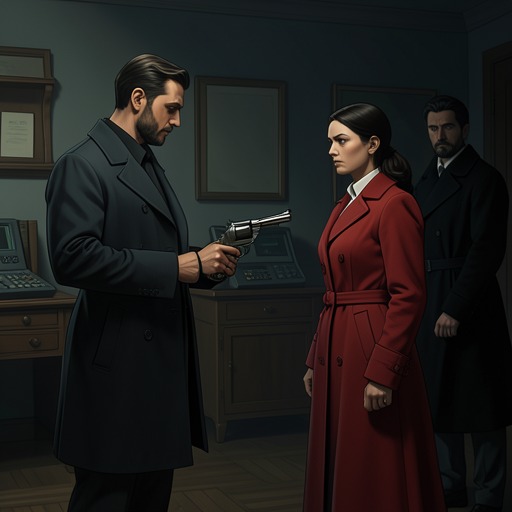
Chris becomes a direct obstacle to the relationship between Allison and Scott McCall after the Alpha confrontation makes it harder for them to meet openly. The two begin seeing each other in secret, but the Argents discover enough to intervene. Mr. Argent follows them, holds a gun to Scott’s head, and forces Allison’s newest friend to break up with him. The threat transforms a family objection into a physical act of coercion: Scott’s safety is used to enforce Chris’s authority over Allison’s romantic life.
The pressure does not end the relationship. Allison and Scott continue their forbidden romance, choosing greater caution rather than separation, while only Carson and Stiles Stilinski are trusted with the secret. A hospital parking lot becomes dangerous precisely because it offers no reliable privacy. When Allison reports seeing Chris and three other men leave her house in two sport-utility vehicles, Scott recognizes the group as a search party, while Carson interprets it more ominously as a hunting party. The distinction captures Chris’s function in the story: an organized search under the language of family concern can become a hunt when the target is a werewolf and the hunter’s authority is backed by weapons and inherited doctrine.
Authority, Secrecy, and the Supernatural Conflict
Chris’s conduct belongs to a larger system in which the Argent family monitors supernatural activity and protects its own knowledge from public exposure. The teenagers, by contrast, learn through improvised investigation, private alliances, and incomplete information. Their work includes searching online for the Kanima, consulting the bestiary on Stiles’s laptop, and relying on Deaton, who is trusted because he repeatedly helps Scott in moments of supernatural crisis. Chris represents a different form of expertise: organized, familial, armed, and suspicious of the people the teenagers are trying to understand.
That contrast is sharpened by the book’s repeated movement between ordinary adolescent spaces and supernatural emergencies. Lunch-table arrangements, school sports, secret meetings, and romantic encounters coexist with werewolf transformations and the search for a murderous lizard creature. Even the playful language of games and pop-culture references—Carson’s comparison of her intuition to a Jedi mind trick, for example—sits beside rules of danger that have real consequences. Chris’s world treats those supernatural rules as grounds for threat elimination, while Carson’s group tries to interpret them in order to protect people, including people who may be dangerous because they have lost control of themselves.
Relations with Carson and Lydia
Chris’s interaction with Carson shows that his authority extends beyond Allison. He expects Carson to participate in a conversation about Lydia’s condition and treats her as someone already inside the circle of consequences surrounding the Argent household. Carson resists being positioned passively, asking why she must be involved and pointing out that Chris cannot simply keep everyone there depending on how the conversation develops. Her challenge does not dissolve the hierarchy, but it makes the hierarchy visible: Chris controls access, information, and movement, while Carson insists on her own right to understand the situation.
His concern for Lydia also complicates a purely hostile reading of him. Lydia is entangled in the supernatural crisis, and Chris’s question about how she is doing indicates that he is not indifferent to the teenagers affected by it. Yet the concern remains filtered through supervision. He does not approach the group as an equal participant in their improvised network; he enters as an adult authority whose questions can expose secrets and whose family has already demonstrated its willingness to pursue Scott.
Narrative Role and Significance
Chris serves as the human face of the boundary separating the teenagers from the adult institutions that claim the right to manage the supernatural. He is not presented merely as a distant hunter: he is a father, a family member at a public funeral, and an adult who asks after Lydia. Those recognizable roles make the danger of his methods more immediate. A father’s watchfulness can become a search party; a family’s defense can become a hunting party; and a demand for loyalty can threaten the relationship Allison and Scott refuse to abandon.
The book’s wider arc repeatedly asks whether identity should be determined by category or by conduct. Jackson Whittemore is treated as a Kanima while the group investigates the creature’s limits, including its inability to swim and its fear of its own identity. Carson later argues that Jackson remains a good person underneath the harm he has caused, and that Lydia is the person he has truly cared about. Chris stands on the opposite side of that unresolved question: his behavior is shaped by a tradition that makes the supernatural category itself sufficient reason for suspicion. His narrative importance comes from keeping that conflict active, even when the teenagers’ loyalties begin to cross the boundaries his family tries to enforce.