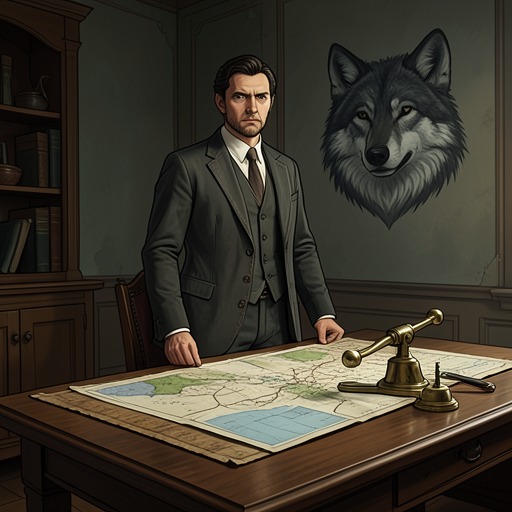
Deaton
Holding Out for a Hero ▸ Stiles Stilinski (2)Deaton functions as Beacon Hills’ veterinary professional and as an informal guide to its supernatural crisis. Although the characters admit that they know little about him, his repeated assistance to Scott McCall has made him more trustworthy than many people connected to the supernatural. He occupies a distinctive middle ground: he is not presented as a member of Derek Hale’s werewolf pack or the Argent family, yet he understands enough about werewolves, Kanima, protective materials, and supernatural records to give the group practical help when ordinary explanations fail.
Identity and Position
Deaton’s public role is connected to the Beacon Hills veterinary office, but his narrative role extends far beyond animal care. Carson Bradley describes him as a strange, riddle-speaking guide who helps Scott McCall whenever the boy is in trouble. The joking image of a sign advertising both veterinary services and supernatural guidance captures the double structure of his character: the mundane workplace remains visible, while the supernatural expertise operating behind it is treated as an established, if not fully explained, part of his identity.
That trust is relational rather than institutional. The group does not possess a complete account of Deaton’s history or affiliations, and Carson specifically notes that none of them really knows much about him. Nevertheless, his consistent willingness to aid Scott has given him authority among the teenagers. In a town crowded with werewolves, hunters, Kanima, and masters, Deaton’s value comes from being a reliable interpreter of danger without demanding that the group first understand every mystery surrounding him.
Knowledge and the Bestiary
Deaton helps redirect the investigation toward the Argent family’s records. He tells Scott McCall that Allison Argent’s family may keep a record of the different creatures they have hunted, a collection that could amount to a book. The suggestion identifies the Argent bestiary as a concrete source of supernatural knowledge rather than merely a family artifact. It also links Deaton’s guidance to the group’s attempt to understand threats that cannot be solved through ordinary police or medical procedures.
His contribution is therefore investigative as well as medical. The bestiary represents accumulated classification: a way of placing the Kanima within a larger history of supernatural creatures. Deaton does not simply offer a weapon or a quick answer; he points the group toward a record capable of explaining what they are facing. In this sense, he makes knowledge itself an instrument of survival, connecting the teenagers’ immediate crisis to the older systems of hunting and documentation maintained by the Argent family.
Preparing for the Kanima
Before the group goes to the rave warehouse to find Jackson Whittemore, Deaton prepares equipment intended to restrain rather than kill. He provides a small bottle and a spring-loaded syringe containing ketamine. The substance is the same kind used on dogs, but in a higher dosage, and Deaton explains that it should slow Jackson down long enough for the group to gain time if someone can get close enough to inject him. The advice is precise, conditional, and tactical: the drug is useful only if the teenagers can reach the Kanima, and its purpose is to create an opening rather than end the threat by itself.
This preparation shows Deaton translating veterinary practice into supernatural crisis management. His knowledge of animal sedation becomes a means of confronting a creature whose body and behavior exceed ordinary categories. The equipment also reflects the group’s precarious position. They need to stop Jackson, but the plan depends on proximity, coordination, and timing; Deaton can supply a tool, not remove the danger surrounding its use.
Mountain Ash and the Power of Belief
Deaton also gives the group a jar of black sand marked with a strange symbol. He identifies it as material from the Mountain Ash tree, believed across many cultures to protect against the supernatural. He further explains that the Beacon Hills veterinary office is lined with ash wood, which makes it difficult for someone such as Scott McCall to cause him trouble. The office is thus both a workplace and a defensive environment, its construction quietly incorporating supernatural safeguards into an apparently ordinary building.
The Mountain Ash is not portrayed as a simple automatic barrier. When Stiles Stilinski doubts that a small handful can be spread across the necessary distance, Carson Bradley urges him to believe that he can make it cover sixty feet and that he is capable of succeeding. Her encouragement explicitly connects the material’s effectiveness with confidence. Deaton’s instruction therefore enlarges the group’s idea of what protection means: the barrier requires not only a substance associated with safety but also a person willing to act as though that safety is possible.
Deaton’s explanation also establishes a contrast between technical knowledge and faith. He can identify the tree, describe its protective function, and reveal the ash construction of his office, but the eventual use of Mountain Ash still demands an act of conviction from Stiles Stilinski. The scene makes belief practical rather than abstract. In a town where impossible creatures have become part of daily reality, Carson’s insistence that the group has no choice but to believe turns trust into a survival skill.
Narrative Function and Significance
Deaton serves as a mentor figure without becoming a conventional commander. He gathers the three teenagers in the back room of the Beacon Hills veterinary office, lays out the tools, explains their functions, and leaves the dangerous execution to them. His method preserves their agency: he does not take over the hunt for Jackson Whittemore, but he gives Scott McCall, Carson Bradley, and Stiles Stilinski a framework within which their own courage and cooperation can operate.
His guidance is especially important because the group is repeatedly forced to move between incompatible worlds. Police accounts describe unexplained violence, hunters preserve records of creatures, veterinarians possess materials that protect against supernatural attack, and teenagers improvise plans with whatever knowledge is available. Deaton stands at the intersection of those worlds. He converts hidden lore into objects that can be carried, injected, or spread across a building, making the supernatural tangible without making it simple.
The character’s restrained presentation is part of his significance. The narrative gives him considerable practical authority while withholding a full explanation of his background. That combination makes him less a fully disclosed source of answers than a controlled threshold into the larger supernatural order. He is trusted because his actions repeatedly help the group, yet the limits of what the characters know about him preserve an element of uncertainty. Deaton’s decisive contribution is not merely that he knows more than the teenagers; it is that he teaches them how knowledge, preparation, protective materials, and belief can be combined into a chance of resisting the Kanima.