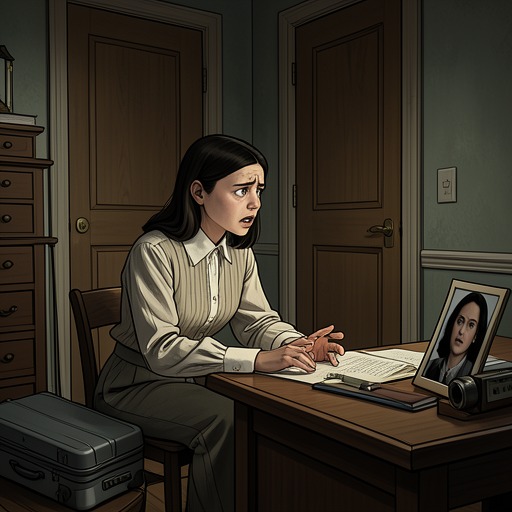
Elizabeth Bradley
Holding Out for a Hero ▸ Stiles Stilinski (2)Elizabeth Bradley is Carson Bradley’s estranged mother and one of the most powerful absences in Carson’s life. She leaves without a note, without taking forgotten belongings, and without offering Carson an explanation; years later, her image returns not as a source of comfort but as an accusing hallucination. Elizabeth therefore matters less as a continuously present character than as the unresolved event around which Carson’s ideas of blame, belonging, and abandonment organize themselves.
Identity and Disappearance
Elizabeth’s departure occurs when Carson is twelve. While Carson’s father is working the graveyard shift at the office, Carson goes to Stiles Stilinski’s house to play video games with Stiles and Scott McCall. Elizabeth is still at home when Carson leaves, baking cookies; when Carson returns, the only trace of her is a plate of chocolate cookies. There is no note, no abandoned personal item, and no immediate indication of where she has gone. Carson initially explains the absence innocently, imagining that Elizabeth has been called into work or has gone next door to help an elderly neighbor.
The disappearance becomes clear only through its silence. Elizabeth does not come home before Carson falls asleep, despite having previously left Carson alone only briefly and usually returning within an hour. The child Carson does not yet understand that the missing arrival is the first decisive evidence that her mother has chosen not to return. The detail of the untouched domestic scene, especially the cookies left behind, gives the departure an unsettling shape: ordinary maternal labor remains visible after the mother herself has removed herself from the household.
The Mother as an Absent Presence
Elizabeth’s vanishing parallels another disappearance that Carson witnesses in the supernatural crisis: Lydia Martin is found missing from her hospital room even though the running shower suggests that she could not have gone far. Carson recognizes the emotional force of such an absence because Elizabeth had also vanished without a note or belongings. The comparison links Carson’s personal history to the book’s wider pattern of people becoming unreachable without warning, turning uncertainty itself into a recurring threat.
The family wound also helps explain why Carson reacts so strongly to distance in her relationships. Ms. Morrell observes that Carson and Stiles are exceptionally close and suggests that Carson may fear the same thing happening again: that someone important will leave and that Carson will interpret the loss as her own fault. Carson resists the language of abandonment, insisting that she feels alone rather than abandoned, but the distinction cannot fully conceal how Elizabeth’s disappearance continues to structure her expectations of intimacy.
Hallucinated Return at Lydia Martin’s Party
Elizabeth reappears four years after leaving, during Lydia Martin’s birthday party, when Carson notices a petite, dark-haired figure moving through the crowd. The sight produces dizziness and nausea as Carson follows the figure upstairs. The party space seems to warp around her, and her vision clouds before she sees the woman waiting alone at the end of the hall. The encounter initially appears to be a literal reunion, but its dreamlike distortions and Elizabeth’s impossible, hostile presence reveal that Carson is experiencing a hallucination.
The face is described as extremely similar to Carson’s own, making Elizabeth both a family likeness and a threatening mirror. Elizabeth stands before Carson as she did the last time Carson saw her, but instead of greeting her as a mother might greet a daughter, she sneers. When Carson identifies her as her mother, Elizabeth responds with contempt, treating Carson’s life as a mess and implying that Carson’s existence is the reason she left.
Elizabeth’s accusations give verbal form to Carson’s most damaging fears. She calls Carson a mistake, says that Carson ruined her life, and insists that everyone would be better off without her. The hallucinated mother thus does not simply remember the past; she speaks the self-condemning interpretation Carson has been carrying through the present. Her cruelty makes the apparition psychologically precise: Elizabeth returns as the voice that confirms Carson’s belief that she is unnecessary among the people around her.
Recognition, Fear, and Vanishing
Carson cannot answer Elizabeth immediately. Four years without seeing, hearing, or speaking to her leave Carson too shocked to produce a witty response or escape through ordinary defiance. The encounter becomes an intrusion of unresolved grief into a crowded social setting, where the presence of friends and celebration cannot protect Carson from the private nightmare attached to her mother.
Carson eventually recognizes that the scene is unreal. After Elizabeth continues to taunt her, Carson shuts her eyes, pulls at her hair, and declares that Elizabeth is not real. The room abruptly stops warping, the silence changes, and Elizabeth disappears. Carson is left with the knowledge that the apparition was false and the more frightening knowledge that Elizabeth remains one of her worst nightmares. The distinction between physical absence and psychological presence is central to Elizabeth’s role: leaving removed her from Carson’s household, but it did not remove her from Carson’s inner life.
Relationships and Narrative Significance
Elizabeth’s relationship with Carson is defined by abandonment, unanswered questions, and the transfer of blame from parent to child. The available account gives no reconciliation, explanation, or later maternal care. Instead, Elizabeth’s only direct return is antagonistic, and the version of her that Carson encounters weaponizes the daughter’s insecurity rather than repairing the original loss.
Carson’s bond with Stiles provides the clearest contrast. Stiles remains physically present and emotionally close during the wider crisis, including moments when Carson is frightened, traumatized, or separated from ordinary safety. The possibility of permanence that Stiles expresses in their relationship stands against Elizabeth’s abrupt departure. It also makes Carson’s fear more intelligible: the hope of staying with someone forever exists beside the memory of a mother who left through a single open window and never explained why.
Elizabeth’s disappearance also belongs to the book’s larger structure of trauma. Carson is later held hostage, blacks out for at least half an hour during the police-station crisis, and receives medical attention for a mild concussion; afterward, the school arranges a meeting with Ms. Morrell. Against these overt supernatural and criminal threats, Elizabeth’s most lasting violence is quieter. She has become an internal measure of what loss means, so that later danger repeatedly activates the fear that people can vanish and that Carson will be left to interpret the silence alone.
Elizabeth Bradley is consequently significant as both character and haunting narrative force. Her absence motivates Carson’s sensitivity to separation, her hallucinated return exposes the self-blame beneath that sensitivity, and her disappearance remains unresolved even after the apparition vanishes. The mother is gone from the physical story, but the damage of her leaving continues to speak through Carson’s fear, relationships, and struggle to believe that the people who love her will remain.