Gerard Argent
Holding Out for a Hero ▸ Stiles Stilinski (2)Gerard Argent is Allison Argent’s grandfather and the principal human antagonist of the story’s second phase. He arrives after Kate Argent’s death and the collapse of her public standing, presenting himself as an elderly werewolf hunter while quietly transforming family influence, school authority, and supernatural knowledge into instruments of war. His decisive significance lies in the way he makes violence institutional: unlike the creature attacking from the shadows, Gerard can summon students, inspect their files, command a school, recruit allies, and issue threats while appearing to occupy a legitimate position of authority.
Identity and Introduction
Gerard first appears at Kate Argent’s funeral as an unfamiliar elderly man with snow-white hair, accompanied by two men who resemble secret-service guards. The Argent family is surrounded by photographers and journalists, and Gerard stands apart as the one figure Carson Bradley cannot identify. Scott McCall explains that the stranger is Allison’s grandfather and that his name is Gerard. The setting makes his entrance public, ceremonial, and politically charged: Kate is being buried after her acts of arson have come to light, the Argent family has become socially disgraced, and Gerard steps into the vacuum left by her death.
His appearance is deliberately misleading. The narrative describes him as unlike an ordinary werewolf hunter, yet also as the most volatile of them all. The danger is not announced through an immediate transformation or visible weapon; it is carried by the contrast between his age, formal presentation, and the declaration that he has begun a war. Gerard therefore enters the plot as both family elder and returning threat, a figure whose authority derives from lineage but whose methods promise a more aggressive escalation than Kate’s.
Seizing Institutional Power
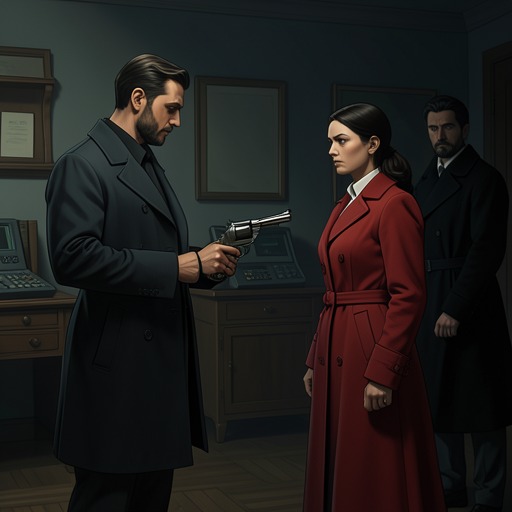
Gerard’s threat becomes concrete when he appears at Beacon Hills High School as the new principal. Carson Bradley, Stiles Stilinski, and Scott are in the school office area when an unfamiliar voice calls them inside. The voice belongs not to Principal Stevens but to Gerard Argent, producing immediate surprise and fear. Carson grips Stiles’s hand as the three follow Gerard into the office, a small gesture that places Gerard’s new administrative position against the students’ need for mutual protection.
Once seated behind the principal’s desk, Gerard conducts the meeting like an interrogation disguised as routine administration. He removes three files and begins with Scott, noting that Scott is not academically accomplished but has become a prominent athlete. He then turns to Carson and comments on her unusual name. The files establish that Gerard has access to personal information and intends to use the school’s records and procedures to classify the teenagers before him. His power is therefore bureaucratic as well as physical: the principal’s office becomes a controlled space in which the students are reduced to documents, achievements, and vulnerabilities.
The same authority later places Gerard at the center of the school’s public rituals. Before the state championship, Gerard emerges from an office while Coach Finstock addresses the team. He praises the coach’s speech, then directs a more sinister look toward Scott and Carson. When Gerard tells the players that he is both their principal and a fan, he urges them not merely to defeat their opponents but to “murder them.” The language is ostensibly athletic encouragement, yet Carson recognizes it as an underlying message. Gerard’s command turns the ordinary rhetoric of competition into a threat, demonstrating how easily he can hide violent intent inside institutional ceremony.
War Against the Supernatural
Gerard’s rise occurs amid several overlapping crises. Peter Hale is dead, but his death has allowed Derek Hale to assume the Alpha position and begin turning teenagers into werewolves. Kate Argent has also died, leaving behind the consequences of her arson and the public disgrace of the Argent family. Gerard enters at the intersection of those developments and treats the supernatural conflict as a war rather than as a problem requiring restraint or balance.
His strategy is broader than simply hunting werewolves in the field. The story places him inside Beacon Hills High School, in the middle of its athletic culture, and near the teenagers whose identities are most vulnerable. He uses social visibility and official power while a separate reptilian creature carries out killings in secret. This contrast blurs the expected division between monster and hunter: the creature’s violence is bodily and nocturnal, while Gerard’s violence proceeds through surveillance, command, coercion, and the deliberate mobilization of other people.
The threat becomes still more urgent when Scott tells Carson that Gerard is apparently controlling Jackson Whittemore. Jackson is scheduled to play in the championship, meaning that Gerard has placed a dangerous supernatural weapon directly on the lacrosse field. The game consequently becomes more than a school event: it is a public arena in which Gerard can deploy Jackson while the students and their allies struggle to prevent casualties. Gerard’s control of Jackson also reveals the reach of his influence. He does not need to confront every enemy personally when another person’s transformed body can be made to carry out his plan.
Abduction and Coercion
Gerard’s methods reach a personal and openly violent stage through his abduction of Stiles. Carson initially avoids the state championship, despite knowing that Gerard has a plan and that Scott needs help stopping Jackson. She remains in her room wearing Stiles’s lacrosse hoodie, torn between the danger unfolding at the game and her unwillingness to face Stiles after their estrangement. When she eventually arrives, she notices that Sheriff Stilinski is searching through the crowd in panic and asking where his son is. Gerard is absent as well, and the missing pieces lead Carson to the conclusion that Gerard has taken Stiles.
The abduction is confirmed by Stiles’s condition when Carson reaches him. He is lying on his bed, with a split lip, dried blood, and a bruised, bloody cheek. The injuries make Gerard’s violence undeniable; Stiles has not merely been questioned or detained but beaten. Carson responds by throwing her arms around him, and her protective attachment gives the scene an emotional counterpoint to Gerard’s treatment of the boy. Gerard’s power is shown most clearly not in his physical presence but in the damage he leaves behind and the fear that damage produces.
The attack also changes Carson’s response to Gerard. Her anger becomes explicitly murderous as she sees what has happened to Stiles, even though the narrative has otherwise positioned her as someone trying to survive a world of werewolves, hunters, and killings without losing her sanity. Gerard’s coercion thus transforms a political conflict into an intimate one. By attacking Stiles, he forces Carson and the others to experience his war not as an abstract struggle between supernatural factions but as direct violence against their closest relationships.
Manipulation, Secrecy, and Reversals
Gerard’s control over Jackson Whittemore remains partly concealed, making the championship threat depend on withheld knowledge as much as on force. Scott’s messages indicate that Jackson is still alive and able to move, despite the group’s earlier understanding that he had died. The apparent contradiction exposes the instability Gerard has created: death, transformation, and obedience no longer remain separate conditions. Jackson becomes both victim and weapon, while Gerard’s plan forces Scott, Carson Bradley, Stiles Stilinski, and their allies to act without knowing the full extent of the danger.
The reversal also complicates Gerard’s position within the Argent family. At first, the family appears gathered under the shadow of Kate Argent’s funeral and her violent legacy, with Gerard presented as the volatile elder who has declared war. Later, however, Allison Argent’s father, Chris Argent, is reported to be temporarily on the group’s side. The change does not erase the family’s history or Gerard’s influence, but it shows that his campaign can fracture the hunter tradition from within. His authority is powerful precisely because it is contested: he inherits the language of the Argent family while pushing its conflict toward a more ruthless form.
The Championship and the Missing Principal
At the state championship, Gerard’s words acquire their most sinister force. His instruction that the players should “murder them” sounds like exaggerated sports rhetoric to Coach Finstock, who simply orders the team onto the field. To Scott McCall and Carson, however, the phrase carries the unmistakable implication of a planned attack. Gerard can speak in the same language as a school administrator, a sports fan, and a hunter, allowing each audience to hear something different in the command.
His disappearance from the crowd immediately afterward is as consequential as his earlier public appearance. Sheriff Stilinski searches for Stiles in a state of panic, while Gerard is nowhere to be found. Carson recognizes the pattern before anyone can explain it: Gerard’s absence and Stiles’s absence are connected. The principal’s official visibility has become a disguise for covert action. He can stand before the school community, address the team, and then vanish into a private act of kidnapping without surrendering the appearance of institutional legitimacy.
The Final Confrontation with Jackson
Gerard’s plan ultimately converges with Jackson’s Kanima transformation. When Jackson confronts the group, he speaks of the people who murdered him and identifies himself as the victim of that violence. The revelation is followed by the return of his reptilian body: his eyes become fiery orange, green scales spread across his hands, claws emerge, and paralytic venom drips from him. The scene connects Gerard’s campaign to the deeper cycle of murder and vengeance surrounding the Kanima, but it also prevents Jackson from being treated as a simple monster. The creature is visibly and painfully continuous with the teenager beneath it.
Lydia Martin’s key interrupts the transformation’s momentum. When she holds it out, the Kanima stops and stares as though it remembers the object. Jackson’s reptilian features begin to recede; the scales and claws remain for a time, but his eyes lose their fully animal surface and he takes the key from her. Gerard’s control is therefore confronted not by a stronger display of institutional power but by memory and recognition, forces that his manipulation cannot completely erase.
Jackson then falls into Lydia’s arms, and the remaining scales disappear from his face. Carson witnesses him die as a boy rather than as a monster, a distinction that exposes the human cost of the conflict Gerard has helped intensify. The group has already seen Jackson die once, but this second death feels real rather than theatrical. The change in perception is crucial: Gerard’s strategy turns young people into weapons, yet the aftermath returns them to the status of injured teenagers whose deaths cannot be dismissed as the removal of supernatural threats.
Disappearance and Narrative Significance
After Jackson falls, Allison asks where Gerard is while staring at a dark black stain on the warehouse floor. Chris answers that Gerard cannot be far away. The stain and the uncertainty surrounding his location leave his fate unresolved in the immediate aftermath. He is absent, but not conclusively defeated; his disappearance preserves the sense that the war he initiated has not been contained by Jackson’s collapse.
Gerard’s narrative role is consequently defined by conversion: he converts grief over Kate Argent’s death into war, family inheritance into militant authority, a school into a surveillance structure, a championship into a field of potential violence, and Jackson Whittemore into a weapon. Yet the story repeatedly places his systems of control beside forms of recognition that resist them. Carson Bradley and Stiles protect one another through intimacy; Lydia recalls Jackson through the key; and Chris’s temporary alignment with the protagonists interrupts the idea that every Argent must serve Gerard’s campaign. The elderly hunter’s danger lies not merely in his willingness to kill, but in his ability to make violence appear organized, legitimate, and inevitable.