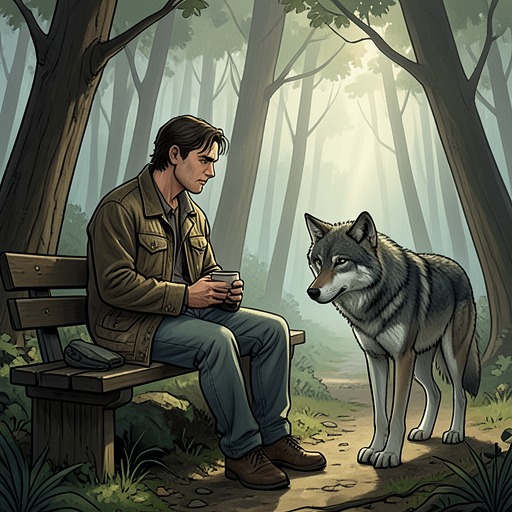
Imagination is more important than knowledge
Holding Out for a Hero ▸ Stiles Stilinski (2)“Imagination is more important than knowledge” is not merely a decorative quotation in the scene. Encountered on a bumper sticker during an apparently impossible supernatural crisis, it becomes the phrase that changes Stiles Stilinski’s posture from doubt to belief and helps make a protective act possible. Its significance lies in the way an ordinary piece of public language enters an extraordinary situation and supplies the mental movement that knowledge alone cannot provide.
Appearance and Immediate Context
The expression appears when Carson Bradley urges Stiles Stilinski to believe in a plan involving “magic fairy dust.” Carson acknowledges how farfetched the situation sounds, but argues that belief is necessary because their town is overwhelmed by werewolves, hunters, Kanimas, masters, and the unexplained nature of Lydia Martin. The surrounding crisis has already exceeded ordinary explanations, so the quotation arrives at the precise point where conventional certainty has become useless.
Stiles initially struggles to accept the plan. After Carson’s appeal, he repeats the need to believe to himself, showing that belief is not yet natural or secure for him. The quotation then appears as a concrete object in the environment rather than as a philosophical lecture: Carson’s eyes land on a bumper sticker reading, “Imagination is more important than knowledge. -Einstein.” The phrase is therefore discovered amid action, attached to an everyday roadside or vehicle detail, while the characters are searching for a way to make the supernatural intelligible and survivable.
From Slogan to Action
Carson immediately turns the quotation into an instruction, breathing the single word “Imagine.” That repetition narrows the maxim from a general claim about human thought into a specific demand placed on Stiles. He nods, draws breath, closes his eyes, and then begins walking forward while ash drizzles from his clenched palm. The expression consequently operates as a catalyst: it does not solve the crisis by itself, but helps Stiles perform the act on which the protective measure depends.
The passage distinguishes between two kinds of agency. Carson recognizes that belief alone is insufficient and tells Stiles that he must believe in the “magic fairy dust,” while the later narration identifies Stiles as “the spark” and the person who has to make the act happen. Carson supplies encouragement and the conceptual opening; Stiles converts that opening into movement. The quotation stands at the hinge between those contributions, joining imagination, belief, bodily action, and supernatural consequence.
Knowledge, Belief, and the Supernatural
The expression gains force because the characters live in a world where knowledge is fragmented and constantly overtaken by new threats. Carson’s catalogue of werewolves, hunters, Kanimas, masters, and Lydia’s uncertain identity presents an environment in which the ordinary hierarchy of evidence has broken down. The maxim does not reject knowledge outright; rather, the scene gives imagination the role of reaching beyond what the characters can presently verify. When the known world cannot explain or guarantee the solution, imagining it becomes a necessary form of participation.
The wording also creates a productive contrast between the mundane and the supernatural. A bumper sticker offers a familiar, almost disposable piece of popular wisdom, yet the phrase acquires material importance when it is read during an emergency. Its practical value is not that it provides technical information about ash or barriers. Instead, it changes the characters’ relation to possibility. Stiles must first imagine that the plan can work before he can act as though it might work, and that shift makes the difference between paralysis and intervention.
Narrative Function and Lasting Significance
The expression marks a small but decisive turn in the sequence. Before it appears, Carson is trying to force belief into a skeptical companion; afterward, Stiles walks forward and releases the ash. The scene thus gives the maxim a narrative function rather than leaving it as exposition. Its value is measured by the action that follows: imagination becomes the first condition of the barrier’s formation, while Stiles’s physical release supplies the corresponding material act.
The final image preserves a division of labor rather than presenting imagination as solitary genius. Carson continues repeating “imagine” internally as he walks beside Stiles, but he knows that Stiles is the one who must carry the act through. The phrase therefore names a shared mental effort with an unequal practical burden. It is Carson’s discovery and encouragement, Stiles’s belief and movement, and the ash’s visible fall that together turn an improbable idea into a protective possibility. In this context, “Imagination is more important than knowledge” becomes an emblem of survival in a world where the characters can no longer wait for certainty before choosing to act.