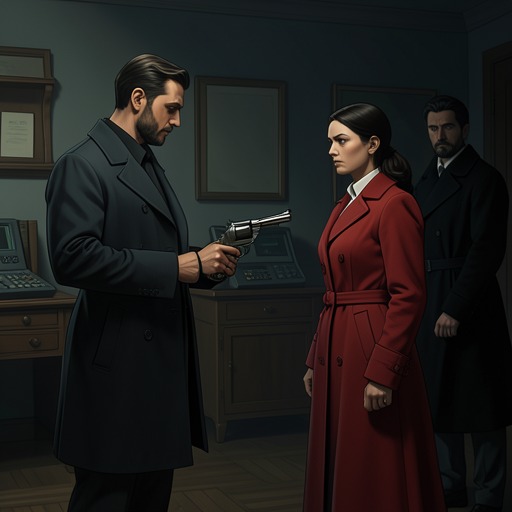
Kate Argent's death
Holding Out for a Hero ▸ Stiles Stilinski (2)Kate Argent's death is the decisive turning point between the first cycle of violence in Beacon Hills and the larger conflict that follows. Her funeral closes the immediate story of a hunter whose actions included arson and the killing of supernatural beings, but it does not restore order. Instead, her death leaves behind public disgrace, family pressure, and a new antagonist in Gerard Argent, whose response is to declare war.
Causes and Background
Kate Argent belonged to the Argent family, a dynasty of werewolf hunters that treated supernatural creatures as threats to be eliminated. That family ideology placed her in direct opposition to Scott McCall after he became a werewolf, even though Scott's relationship with Allison Argent made the conflict painfully intimate. The supernatural danger was therefore not presented as an isolated monster problem: it became entangled with a forbidden romance, family loyalty, and the hunters' determination to destroy what they considered a threat to humanity.
Her violence ultimately became impossible to separate from the threat she claimed to oppose. The account identifies Kate's acts of arson and describes her end as violent, while also emphasizing that the Argent family was left socially disgraced after those acts came to light. Her death thus follows both physical violence and moral exposure. It is not simply the removal of an enemy; it is the collapse of the public justification surrounding her conduct.
Funeral and Immediate Significance
Kate is finally laid to rest at a funeral attended by Allison Argent and the wider Argent family. Allison's preparation reveals the personal cost of the event. She tries to appear composed while taking out the dress reserved for Kate's funeral, but her grief remains visible because Kate was her aunt, despite the fact that Kate had killed people. The scene holds familial mourning and moral condemnation together instead of allowing either one to erase the other.
The funeral also becomes a gathering point for the Argent family. Kate's death draws the hunters back into a shared family space at precisely the moment when their reputation has been damaged. The ceremony therefore has a double function: it commemorates a relative and exposes the consequences of her actions. Allison must mourn a family member while facing what that family member did, and the family must confront the fact that its hunter identity no longer guarantees social legitimacy.
Consequences and Aftermath
Kate's death removes one source of immediate danger, but it creates a vacuum that Gerard Argent fills. Gerard does not resemble an ordinary werewolf hunter; he is described as the most volatile of them all, and he responds to the revelations surrounding Kate by declaring war. The event consequently changes the conflict's scale. Kate's personal violence gives way to Gerard's organized and openly announced campaign, making the Argent family itself a more prominent threat.
The death also coincides with Peter Hale's death and Derek Hale's rise as an Alpha. With Peter gone, Derek begins turning teenagers into werewolves, while Gerard mobilizes against the supernatural. The result is not peace but escalation on opposing sides: Derek builds a teenage werewolf group, and Gerard turns the disgraced hunter family toward renewed confrontation. A further enemy lurks beyond both factions, killing without an immediately understood identity or purpose, so Kate's death becomes one element in a widening crisis rather than its resolution.
Narrative and Thematic Role
The event exposes the instability of the story's simple hunter-versus-werewolf division. Kate's family claims the authority to eliminate monsters, yet her own actions make the hunters objects of suspicion and public rejection. The line between good and evil consequently blurs, and unlikely alliances become necessary as the characters face threats that cannot be contained by inherited loyalties.
Kate's funeral gives that moral reversal a concrete human form through Allison's divided response. Mourning does not absolve Kate, and condemnation does not erase kinship. The event's lasting significance lies in this unresolved contradiction: Kate is dead and her direct violence has ended, but the beliefs, resentments, and family structures that enabled her continue through Gerard Argent. For Carson Bradley, the changing danger is survivable only through the support of Stiles Stilinski, whose presence becomes an emotional counterweight to the deaths, new enemies, and collapsing boundaries that follow Kate's burial.