Matt Daehler's Police Station Hostage Crisis
Holding Out for a Hero ▸ Stiles Stilinski (2)Matt Daehler's Police Station Hostage Crisis is the decisive confrontation in which Matt converts the Beacon Hills Sheriff's Station into a site of armed coercion, forced complicity, and evidentiary erasure. By taking Carson Bradley, Stiles Stilinski, and Scott McCall hostage while using Jackson Whittemore as his killing instrument, Matt makes the investigation's danger immediate: the teenagers are no longer merely assembling clues about a hidden criminal network, but are being compelled to destroy the very records that could expose it. The episode's central reversal is therefore both physical and institutional. A police station, supposedly organized around protection and proof, becomes a locked corridor where a gun determines whose account survives and whose evidence disappears.
Causes and Background
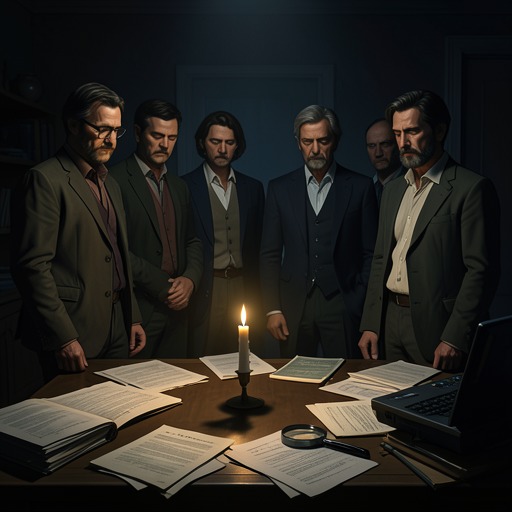
The crisis follows an investigation that has begun to turn suspicion into a prosecutable pattern. At the former sheriff's desk, Carson Bradley, Stiles Stilinski, Scott McCall, and their allies review hospital surveillance from the night Jessica was murdered, searching for Matt among a crowded mass of patients, wheelchairs, and gurneys. The hospital had been overwhelmed by a six-car pileup, making the footage difficult to read, but the search is driven by the conviction that Matt had to pass a camera on the way to Jessica. The investigation then acquires several forms of corroboration: shoeprints alongside tire tracks at the trailer park, a possible match placing Matt at the trailer, the hospital, and the rave, and a credit-card receipt signed by Matt at the garage when the mechanic was killed. The evidence does not remain a vague suspicion; it begins to connect separate crime scenes through physical traces and documentary records.
That movement toward confirmation explains why Matt's later demand is not random. He does not simply seek escape from a police building. He targets the machinery by which his crimes could become legible to authorities. The surveillance footage, paper files, witness statements, and scene records together threaten to transform scattered violence into a coherent case. His hostage-taking is consequently an attack on investigation itself: if the records are destroyed, the connection between Matt and the murders becomes harder to prove, even if the violence has already occurred.
The wider setting has already established a pattern in which ordinary legal procedures are repeatedly displaced by emergency measures. Gerard Argent has entered Beacon Hills High School as its new principal and immediately uses detention as a demonstration of authority, announcing that at least two students must take the fall for an infraction. Carson and her friends also steal a police vehicle to contain Jackson and prevent him from hurting anyone, while Jackson is subject to a restraining order that limits contact with others. These episodes contrast formal rules with improvised containment. The police-station crisis intensifies the same contradiction: Matt claims practical control through a weapon, while the teenagers and adults around him are left to navigate a legal order that cannot protect them in the moment.
The Hostage-Taking
Matt forces Carson backward down the hallway with the gun pressed against her back. He intends to take four people hostage and is willing to let Jackson kill in order to accomplish it. Carson experiences the weapon as a direct bodily threat: the accelerating heart rate, the impulse to scream or run, and the recognition that neither response is available establish the crisis as an enforced condition of silence. Her only presented option is to do what Matt demands. The gun does not merely threaten death; it dictates movement, speech, and attention, reducing the hostage to an unwilling participant in Matt's sequence of commands.
At the office, Matt pushes Carson through the doorway, where Stiles and Scott see her arrive before Matt follows with the gun hanging between his fingers. Stiles Stilinski's father, Sheriff Stilinski, is present, and he tries to address Matt as someone who can still choose a solution that does not involve a gun. Matt rejects that appeal by claiming that he wants to hurt many people. He specifically tells the group that the four hostages were not initially on his list, but that Scott's attempt to call for help could make them targets. The statement reveals the arbitrary structure of his power: survival depends not on innocence or procedure, but on whether Matt decides that a particular action has earned punishment.
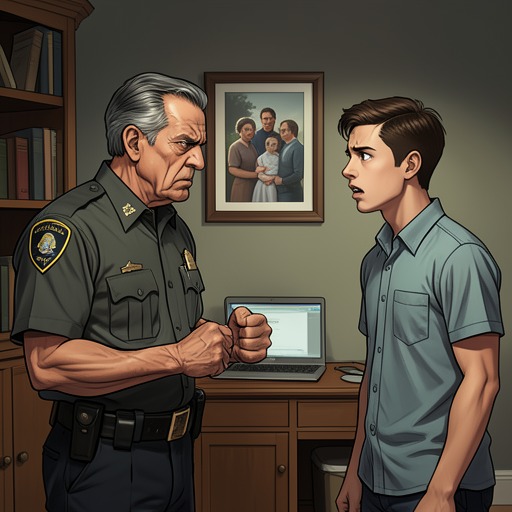
Matt's control becomes more intimate when he orders Stiles to handcuff his own father to a bench. Stiles Stilinski complies while Matt points the gun at both father and son, then insists that the restraint be tightened. Carson stands beside Scott as the weapon remains aimed at Stiles and Sheriff Stilinski, watching Matt's finger move along the trigger. The demand forces Stiles to become the immediate agent of his father's confinement, turning a family bond and a police procedure into instruments of humiliation. The station's normal mechanisms of custody are thus inverted: an officer is restrained not through lawful arrest, but through the obedience of his son under armed threat.
The scene's violence is not limited to the people in the office. When Scott, Carson, and Stiles are driven down a perpendicular hallway, they encounter three officers covered in blood. Two lie on their backs, another sits against the wall, and blood marks the floor and wall in splashes, smears, and finger trails; one officer appears to have been dragged. The physical arrangement functions as a crime scene inside the institution that should document crime scenes. Matt refuses responsibility for carrying out every killing himself. He explains that Jackson does the killing while Matt only thinks about it, dividing intention from execution without reducing his control over the result. Jackson's violence becomes the visible force, while Matt presents himself as the planner who directs it.
Destruction of Evidence
After forcing the hostages into the sheriff's office, Matt notices the papers on the desk and the surveillance footage on the computer. He orders Stiles Stilinski to delete the videos and Scott McCall to shred the remaining evidence. With the gun raised, they begin: Stiles highlights and permanently deletes the recordings, while Scott separates the papers into small shreds. The destruction is systematic rather than impulsive. It removes both visual documentation and physical records, attacking the two forms of proof that had been bringing the investigation closer to Matt.
The consequences are immediately legal as well as practical. With the files gone, a single statement from Melissa McCall would not be enough to stand up in court. Matt understands that testimony without supporting records can be weakened, disputed, or dismissed, and he uses the hostages to manufacture that weakness. The crisis therefore stages a conflict between lived knowledge and institutional proof. Carson, Stiles, and Scott know what Matt has done, but Matt's objective is to ensure that their knowledge cannot be stabilized by footage, paperwork, or a preserved chain of evidence.
Carson openly challenges Matt's belief that he can escape responsibility for killing so many people. Matt answers by treating the situation as a performance in which every story requires a villain, and his sadistic amusement reinforces the role he has chosen. Carson responds by mocking his dependence on Jackson and arguing that the villain does not win. Her defiance does not remove the gun or end the immediate danger, but it interrupts Matt's attempt to control the scene's meaning. He wants the hostages to recognize him as the author of an inevitable nightmare; Carson answers by refusing to grant him narrative mastery, even while the danger remains unresolved.
Institutional Inversion and Surveillance
The crisis gains additional force from the way surveillance has already shaped life at Beacon Hills High School. On arriving at the library, Carson Bradley sees a large white camera positioned to monitor movement, with similar devices reportedly covering hallways, classrooms, the cafeteria, the pool, and the gym. The cameras are connected to the enforcement of the restraining order separating Allison Argent and Scott McCall, making observation part of everyday school governance. Yet the police station reveals the limit of such visibility: footage can exist and still fail to protect anyone, while Matt can force its destruction once he controls the people and equipment around it. The school cameras promise constant observation; the hostage crisis demonstrates that whoever controls the archive controls the usable past.
This contradiction links Matt's violence to other forms of coercive authority in Beacon Hills. Gerard Argent's arrival as principal places a werewolf hunter and family power broker inside an educational institution, where he immediately frames punishment as administrative necessity. The teenagers' theft of a police vehicle to contain Jackson Whittemore similarly treats emergency action as a reason to bypass ordinary legality. Matt's seizure of the station is the most extreme version of the same logic. He does not receive lawful authority, but the gun allows him to suspend the procedures that would otherwise constrain him. The building remains a police station in name, yet its protections are displaced by an improvised regime in which command, detention, surveillance, and evidence all serve the armed captor.
Stakes and Value Shift
The event turns the investigation's value structure from pursuit to survival. Before Matt appears, Carson Bradley, Stiles Stilinski, and Scott McCall are investigators trying to recover a hidden sequence of crimes from surveillance, shoeprints, tire tracks, and receipts. Once Carson feels the gun against her spine, inquiry becomes obedience, and the possibility of legal resolution gives way to the immediate possibility of death. The shift is concrete: the same station that should preserve evidence becomes the place where evidence is shredded, and the same officers who might intervene are found bloodied in the corridor.
The hostages are also forced into morally contaminated roles. Stiles Stilinski must handcuff Sheriff Stilinski, his father, rather than protect him through ordinary family or police action. Scott McCall must destroy records under threat, even though those records are essential to proving Matt's crimes. Carson Bradley is compelled to walk into the office while carrying the knowledge that resistance could cause her death or provoke further killings. Matt's strategy is to make survival itself look like collaboration, then use that coerced collaboration to erase the distinction between the victims' actions and his own.
Matt's statement that the four hostages were not originally on his list, but could be persuaded into becoming targets, makes the danger unstable by design. His threats are not presented as a fixed plan with predictable limits. They are conditional, escalating, and dependent on his interpretation of resistance. Scott's attempt to call someone for help becomes, in Matt's account, a reason to endanger everyone. The result is a climate in which even an effort to summon rescue can be recast as misconduct, allowing Matt to treat any movement toward freedom as justification for greater force.
Consequences and Narrative Significance
The bloodied officers establish that the hostage crisis is not a contained standoff but the institutional culmination of the murders under investigation. Three officers are visibly injured or dead in the hallway, while Matt identifies Jackson Whittemore as the one who carries out the killings. This division between the master and the instrument clarifies the structure of the threat: Jackson supplies physical violence, but Matt supplies direction, purpose, and the decision about who is expendable. The station's casualties therefore expose the practical consequences of the Kanima master bond even before the full pattern is secured as evidence.
Matt's attack also transforms the meaning of the investigation's records. The hospital surveillance had been difficult to search because a six-car pileup filled the building with patients and emergency traffic, but the investigators continued because Matt had to pass a camera on the way to Jessica. The trailer-park shoeprints and tire tracks, the possible connection to the hospital and rave murders, and the credit-card receipt from the garage had begun to overcome that uncertainty. By forcing Stiles Stilinski to delete the footage and Scott McCall to shred the papers, Matt attacks the accumulated labor that made those connections visible. The destruction does not undo the murders; it attempts to restore them to isolation, where each crime can be disputed as an unrelated incident.
The hostage situation consequently serves as both an action sequence and a revelation of how power operates in the story. Matt's authority is temporary, physical, and theatrical, but it is effective because it commandeers the institutions that ordinarily distinguish accusation from proof. His gun determines movement; Jackson's violence produces bodies; the station's computers and files determine whether those bodies can be linked to a perpetrator. Carson Bradley's refusal to accept Matt's self-fashioned role as an unbeatable villain supplies the scene's opposing force. Even while she remains under threat, her mockery preserves a distinction between control of the room and control of the story. The crisis ends the investigation's period of relatively detached observation: from this point, the evidence has become something the guilty will actively destroy, and the investigators themselves have become part of the crime scene.