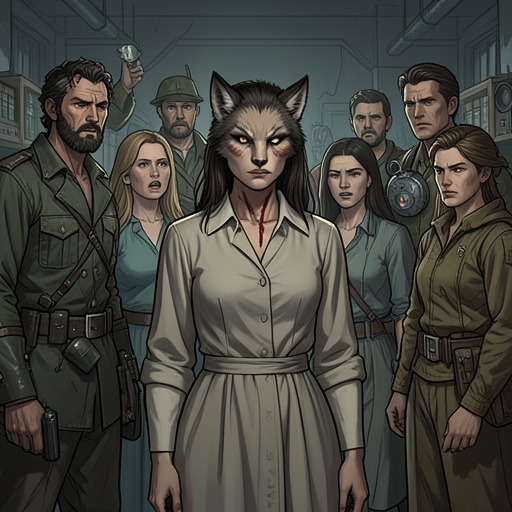
Peter bites Lydia
Holding Out for a Hero ▸ Stiles Stilinski (2)Peter bites Lydia is the decisive bodily event behind Lydia Martin’s central mystery: bitten by an Alpha, she survives the rule that the bite either transforms its victim or kills them, yet she does not return to ordinary health. Her recovery, strange behavior, and visions force Carson Bradley and the others to reconsider what the bite has done to her and whether Lydia is becoming something other than a werewolf.
The Bite and Its Immediate Medical Consequences
Lydia wakes from a coma after almost two weeks in the hospital, relieving her parents, doctors, and friends because the possibility that she might never regain consciousness had remained real. Her recovery appears initially reassuring. Lydia is healing beautifully, can rise from bed, and is able to take her own showers. Yet the wound left by Peter Hale’s bite behaves unlike the wound associated with Scott McCall’s transformation. Scott’s bite healed within a day and returned to smooth skin, while Lydia’s bite is still beginning to scab over. The visible wound therefore preserves the event as an active problem rather than a completed injury.
The medical explanation also fails to settle the matter. Lydia’s doctors describe her condition in terms of an allergic reaction, while her continued survival contradicts Peter Hale’s stated rule that an Alpha’s bite either takes the victim or leaves the victim dead. She is not dead, but neither does she become a conventional werewolf. Her body occupies an unstable middle ground in which ordinary healing and supernatural causation cannot be cleanly separated.
The Bite as the Source of Lydia’s Disappearance
Lydia’s apparent recovery is abruptly overturned when Carson Bradley and the others find her hospital bathroom empty. The shower is still running, but Lydia has vanished; there are no connected rooms and no obvious route by which she could have left. The disappearance transforms the bite from a wound being observed by doctors into a force capable of disrupting Lydia’s agency and the hospital’s control over her body.
The timing deepens the suspicion. Isaac Lahey reports seeing a clawed hand at the cemetery, which leads Carson to infer that a werewolf had been present there. Scott McCall is unlikely to have been crawling through a graveyard to eat a liver, and Derek Hale is also treated as an unlikely explanation, so Carson considers the possibility that Beacon Hills has acquired another werewolf. Because Lydia vanished shortly before Isaac’s account, she becomes a possible suspect in the graveyard killing. The theory remains inconsistent: Lydia still had her bite wound when Carson last saw her, and there is no credible explanation for how the injury could have healed so quickly. The contradiction keeps the bite mysterious rather than proving Lydia’s guilt.
From Failed Transformation to Supernatural Condition
Carson eventually argues that the bite may be causing Lydia’s abnormal experiences even though it has not made her a werewolf. She connects the sequence directly: Peter bites Lydia; doctors interpret the resulting symptoms as an allergic reaction; Lydia appears immune to the expected transformation; then she escapes from a second-story hospital room, spends two days moving through a fugue state, and begins seeing things and screaming. Carson’s conclusion is that Lydia may not be a werewolf, but she is not simply human either.
This interpretation is tested when Lydia reacts to something beneath the ice. Scott McCall sees nothing there, but Carson insists that Lydia was clawing at the ice and therefore saw something, whether or not the object was corporeal. The bite becomes the most plausible link between her physical injury and her later visions. Lydia’s condition is consequently defined less by a confirmed species than by a chain of effects: coma, unusual healing, disappearance, fugue-state behavior, and perception of entities others cannot see.
The investigation takes place alongside incomplete supernatural knowledge. Carson searches for the Kanima through internet combinations such as the creature’s name, its legend, its shape-shifting nature, and the description of a giant lizard that cannot swim, but finds almost nothing. The bestiary on Stiles Stilinski’s laptop is equally difficult for her to interpret. The lack of reliable terminology mirrors the uncertainty surrounding Lydia: the group has names for werewolves and Kanima, but the bite has produced a condition that resists their available categories.
Wider Supernatural and Human Stakes
The bite is understood within a dangerous system of rules. A transformed werewolf can become a target for the Argent family’s wolfsbane bullets, while Lydia’s apparently normal status means that she does not visibly carry the same target on her back. Carson learns that wolfsbane is relevant to the group’s supernatural crisis, but the discovery does not solve Lydia’s condition; it instead shows how quickly medical treatment, hunter violence, and supernatural lore overlap.
The wider plot repeatedly reinforces that physical events are never merely private injuries. Erica Reyes suffers an epileptic seizure during rock-wall training, Scott is shot in the stomach during the police-station hostage crisis, and Carson later deals with the aftermath of being held hostage and suffering a mild concussion. Against these events, Lydia’s bite is distinctive because its danger is hidden inside apparent survival. It does not announce itself through immediate death or an unmistakable transformation. It produces uncertainty, making Lydia’s body evidence that must be interpreted rather than a condition that can be safely named.
The investigation also occurs through a group whose members are trying to maintain ordinary responsibilities. Stiles is pulled toward school activities and the team, while Coach Finstock insists that Scott must raise his grades to remain eligible for the next season. Deaton, whose veterinary office functions as an informal supernatural refuge, offers help with the Kanima problem, but even the group’s trust in him is based on accumulated assistance rather than complete knowledge. Lydia’s bite therefore contributes to a broader pattern in which teenagers, schools, hospitals, police stations, and veterinary spaces all become competing sites of supernatural management.
Narrative Significance and Unresolved Meaning
Peter bites Lydia is a failed transformation event that creates a new mystery instead of resolving one. The bite should produce a binary outcome—werewolf or death—but Lydia survives outside that rule. Her healing wound, coma, fugue state, disappearance, and visions turn the expected certainty of supernatural lore into an epistemological crisis for Carson Bradley, Stiles Stilinski, and Scott McCall.
Its most important consequence is that Lydia becomes both victim and possible threat without the narrative allowing either identity to settle immediately. The suspected graveyard connection raises the possibility that she is responsible for violence, while her hospital disappearance and later disorientation also present her as someone acted upon by forces she cannot control. By binding ordinary medical observation to supernatural signs that doctors cannot explain, the bite makes Lydia’s body the story’s central site of ambiguity: it is healing, but not normally; alive, but not safely understood; human in appearance, but possibly altered in kind.