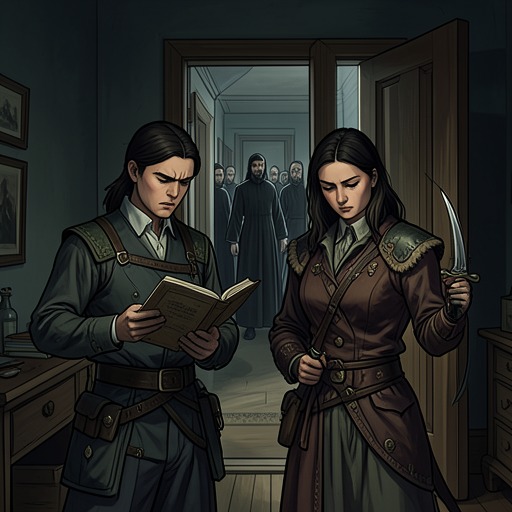
Scott McCall and Allison Argent
Holding Out for a Hero ▸ Stiles Stilinski (2)Scott McCall and Allison Argent’s relationship is the story’s defining forbidden romance: Scott is a newly changed werewolf, while Allison is the youngest member of the Argent family, a lineage of hunters committed to eliminating supernatural threats. Their love therefore joins two identities that the surrounding world treats as incompatible. The relationship’s significance lies not only in attraction, but in the choice to remain connected after both characters understand what the other represents. Against hunters, secrecy, family pressure, and the continuing danger of the supernatural, Scott and Allison make their bond an act of loyalty and resistance.
Identity and Forbidden Beginning
Scott’s transformation begins after the woods expedition that follows Stiles Stilinski’s eavesdropping on a sheriff’s call. Scott becomes stronger, faster, and more sensitive, and Carson Bradley, Stiles Stilinski, and Scott McCall eventually recognize that he is a werewolf. The discovery places Scott inside a hidden supernatural world just as he becomes involved with Allison, whose family is responsible for hunting creatures such as him. Their relationship is consequently marked from its beginning by the contrast between Scott’s imposed supernatural identity and Allison’s inherited hunter identity.
Carson Bradley describes the situation through the language of a forbidden Romeo-and-Juliet romance: Scott and Allison are drawn together across a family conflict that makes ordinary dating impossible. The Argent family is not merely disapproving. Its members regard the werewolf threat as something that must be eliminated, making Allison’s affection for Scott a direct challenge to the assumptions governing her family. Allison’s position as the youngest member of that family intensifies the conflict, because her personal attachment develops inside the very household that defines Scott as an enemy.
Secrecy and External Pressure
After the confrontation with the Alpha, Scott and Allison find it increasingly difficult to see each other openly. They begin sneaking around, and Mr. Argent discovers enough to intervene directly. He follows them, holds a gun to Scott’s head, and forces Allison’s newest relationship to end. The breakup is therefore not a mutual decision produced by fading affection; it is imposed through a threat of violence and the authority of Allison’s family.
Scott and Allison refuse to accept that imposed separation. Because the forbidden-love pattern remains active, they choose not to break up and instead become more careful about their meetings. Carson Bradley and Stiles Stilinski are the only people they trust with the secret, which makes their relationship dependent on a small circle of friendship as well as on their own determination. Their intimacy must exist in concealed spaces and interrupted moments, with discovery always carrying consequences beyond embarrassment.
That secrecy becomes especially urgent when Allison comes to a hospital parking lot looking for Lydia Martin. Allison insists that Lydia is one of her best friends and that they must find her before the hunters do. Scott offers to use his enhanced sense of smell to locate Lydia before the police can, while Carson Bradley supports his reasoning. The scene shows the relationship operating within a larger network of care: Allison’s commitment to her friend, Scott’s supernatural ability, and Carson Bradley’s alliance with both of them combine to make the couple’s private loyalty part of a collective rescue effort.
Friendship, Family, and Social Contrast
Scott and Allison’s relationship is sustained by friendships that make secrecy bearable. Allison brings emotional commitment to the group, insisting that Lydia Martin cannot be abandoned, while Scott contributes the heightened senses created by his werewolf condition. Carson Bradley and Stiles Stilinski provide the trusted witnesses who know about the couple’s nighttime meetings and help protect their connection from the Argent family’s surveillance.
The relationship also develops amid family histories that complicate intimacy. Carson Bradley’s mother disappeared without a note or belongings, leaving only a plate of cookies after departing during a night when Carson’s father was working and Carson was at the Stilinski residence. This history gives Carson a particular understanding of unexplained absence and the pain of family abandonment, even though the text does not equate that experience with Scott and Allison’s situation. The contrast clarifies why Carson is attentive to hidden relationships and vulnerable separations: she recognizes that people can vanish from a life without explanation, while Scott and Allison are struggling to remain present for each other under deliberate external pressure.
The wider school environment supplies another contrast. Allison and Carson Bradley observe Lydia Martin entering school while other students stare at her as the town’s newly labeled “nut job.” Allison encourages Lydia’s confidence, and the moment places Scott and Allison’s romance within a social world quick to turn difference into spectacle. The couple’s private conflict with the Argent family is more dangerous, but it belongs to the same pattern of judgment: identities are assigned from the outside, and loyalty requires seeing the person beneath the label.
Romantic Development and Future Imagination
Scott and Allison’s attachment is not presented as a temporary rebellion. In a conversation about how long they might remain together, Scott jokes that he has been in the relationship longer than Carson Bradley because Carson spent years not knowing about Stiles Stilinski’s feelings. Carson shyly observes that Scott makes it sound as though they will be together forever. Scott answers that he would not mind that future. The exchange turns an apparently playful calculation into a declaration of lasting willingness.
The emotional force of the moment comes from its imbalance of certainty. Carson Bradley is unsure what she wants to do with her life, while Scott already imagines a future defined by continuing attachment. Although the exchange is not a direct conversation between Scott and Allison, it establishes the book’s larger romantic ideal: supernatural danger does not erase the desire for ordinary duration. Love is measured not only by surviving the current crisis, but by the capacity to imagine a life beyond it.
The relationship is also framed by the book’s musical and serial structure. The playlist includes “Holding Out for a Hero,” “Castle Walls,” “Beside You,” “Save Me a Spark,” “Thousand Needles,” “Everlasting Love,” “The Love Club,” “Favorite Record,” “Let It Go,” “Blue,” “Cold Water,” and “Cliff’s Edge.” These titles place Scott and Allison’s romance between heroism, enclosure, rescue, endurance, release, and emotional exposure. The story’s movement into Teen Wolf Season Four, announced while Carson Bradley is finishing sophomore year, confirms that their relationship belongs to an unfinished continuity rather than a closed romantic endpoint.
Conflict, Moral Recognition, and Significance
Scott and Allison’s romance is repeatedly tested by the moral simplifications of the hunter-werewolf conflict. The Argents treat werewolves as threats to be removed, but Scott’s behavior gives that category a human face: he remains a friend, a boyfriend, and a participant in efforts to protect others. Allison’s continued choice to help him therefore contests the idea that supernatural identity alone determines moral worth.
Carson Bradley later articulates a similar form of moral recognition while speaking with Jackson Whittemore. She acknowledges that Jackson has ruined lives and hurt people, yet insists that he is a good person underneath. She describes Jackson and Lydia Martin as opposites whose conflict conceals genuine care, arguing that Jackson is unlikely to hurt Lydia even while transformed into the Kanima. This judgment echoes the logic of Scott and Allison’s relationship: a person cannot be reduced to the dangerous identity imposed upon him. The distinction between creature and character becomes the ethical ground on which forbidden love can survive.
The book’s opening reflection gives the relationship an even broader frame. Carson Bradley recalls that, amid werewolves, hunters, death, and the mystery surrounding Derek Hale, the original trio survived with their bonds intact, becoming more cautious, hardened, and grown up. She then reveals that she fell for Stiles Stilinski and that he had already fallen for her. Scott and Allison’s romance belongs to this same network of transformations: the supernatural crisis changes everyone, but it also makes chosen loyalty visible. Their relationship remains significant because it refuses the clean division between hunter and hunted, ordinary and monstrous, or private love and public danger. The book calls the romance a beginning rather than a conclusion, leaving Scott and Allison’s future open while preserving the central fact that they continue to choose one another despite the forces arranged against them.