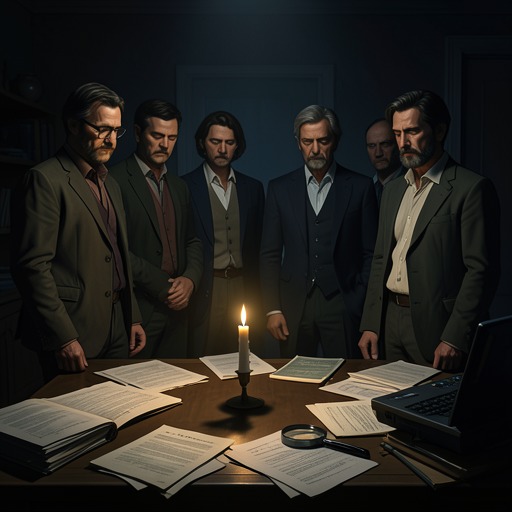
2006 Beacon Hills Swim Team
Holding Out for a Hero ▸ Stiles Stilinski (2)The 2006 Beacon Hills Swim Team is the concealed organizing link among several apparently unrelated victims in the Beacon Hills murder investigation. Its importance lies not in a present-day athletic role, but in the way its past membership transforms isolated deaths into a deliberate pattern: the mechanic, the murdered couple, Jessica, and Isaac Lahey's father are connected to the team, while the Kanima's behavior around water suggests that the swimming history is also bound to the creature's operating limits. The team therefore becomes both a piece of local history and the key to understanding the revenge structure behind the murders.
Identity and Historical Connection
The 2006 Beacon Hills Swim Team is identified as a specific former school team rather than merely a general group of swimmers. Stiles Stilinski tells Carson Bradley and Scott McCall that the dead people, including Isaac's brother, had all belonged to the swim team. Carson then recalls that Isaac's father had once been the coach, giving the group a direct connection to the Lahey family and making the coach's death part of the same investigative pattern.
The year matters. The inquiry first establishes a broad connection to the swim team, then narrows it to the 2006 team in particular. Stiles explains that the Kanima's master hates that team, which changes the question from who has access to the victims to what happened to the team in the past. The group is consequently treated as a historical unit whose members share an unknown experience or association capable of provoking a sustained vendetta.
Role in the Murder Investigation
The team becomes legible through forensic and investigative comparison. When Sheriff Stilinski's father examines the case, he states that the mechanic and the murdered couple had something in common. The trio's subsequent research supplies the missing classification: those victims, Isaac's brother, and other targets were all connected to the 2006 swim team. This progression gives the team the function of a case-making device. It is the repeated commonality that converts suspicion into a pattern rather than leaving the deaths as unrelated incidents.
The investigation also links the team to several kinds of physical evidence. Shoeprints alongside tire tracks place Matt Daehler at the trailer park, the hospital, and the rave, while a credit-card receipt bearing Matt's signature places him at the garage when the mechanic was killed. Surveillance footage from the hospital night of Jessica's murder is searched for Matt amid a six-car pileup and a crowded emergency facility. These details do not prove that every victim was personally attacked by Matt, but they reinforce the conclusion that he was moving through the chain of murders associated with the team.
Water, the Kanima, and Revenge
The swim team's significance is sharpened by the Kanima's relationship with water. Carson, Stiles, and Scott note that the creature did not pursue them once they were in the pool, and they connect that behavior with the victims' shared swimming background. The evidence leaves the exact nature of the connection under investigation, but it establishes a meaningful tension: the team represents water-based athletic identity, while the Kanima is constrained by the same element.
The murders are not presented as ordinary attacks on random members of a school community. Matt Daehler declares that the killers are killing murderers and insists that everyone he has killed deserved it. In context, the 2006 Beacon Hills Swim Team becomes the apparent target of a moralized revenge campaign. Matt controls Jackson Whittemore as the Kanima, turning Jackson's body into the instrument through which the grievance is enacted. This distinction separates the historical group from the immediate agent of violence: the team supplies the shared past and the target category, Matt supplies the controlling will, and the Kanima functions as the weaponized body.
Narrative and Thematic Significance
The team's narrative power comes from delayed recognition. At first, the case contains bodies, a lizard creature, paralyzing venom, and uncertain motives; only later does the investigation reveal that the victims belong to one narrowly defined team from 2006. The retrospective category makes the earlier deaths newly intelligible without erasing their apparent randomness. What looked like supernatural violence is recast as a selective human vendetta carried out through supernatural force.
The team also exposes the danger of classification. The same investigative method that helps Carson, Stiles, Scott, and Sheriff Stilinski identify the killer reduces the victims to a shared label, while the hidden motive behind that label remains unknown for much of the inquiry. The detectives know the who, when, and how before they know the why. Their joking attempt to explain the killings as revenge because Beacon Hills' current swim team has not won in six years underscores the gap between a valid pattern and a valid motive. The 2006 Beacon Hills Swim Team thus stands at the center of the case as both the breakthrough that makes the murders comprehensible and the historical wound whose full meaning must still be recovered.