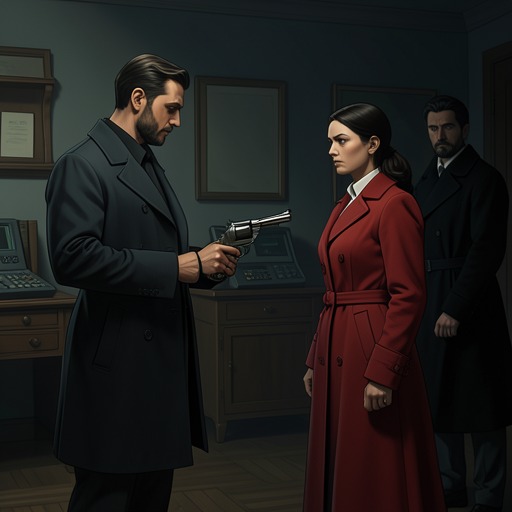
Argent attempt to kill Isaac with wolfsbane
Holding Out for a Hero ▸ Stiles Stilinski (2)The Argent attempt to kill Isaac with wolfsbane is a decisive escalation in the conflict between the Argent family and the werewolves of Beacon Hills. What first appears to be an official transfer of Isaac Lahey becomes, through Allison Argent’s warning and the evidence of the carved container, a covert execution plan. The episode exposes how hunter authority can imitate law enforcement while pursuing a private supernatural code, forcing Carson Bradley, Stiles Stilinski, and Derek Hale to act before Isaac can be reached.
Discovery of the Execution Plan
The danger emerges while Carson Bradley and Stiles Stilinski are being held in detention by Mr. Harris, who has kept their phones from them. Once released, Carson returns Allison Argent’s call and learns that Allison’s family has been questioning her about Lydia Martin and Peter Hale’s bite. The questioning is followed by the appearance of a man dressed as a sheriff’s deputy. His uniform gives the operation an official surface, but Allison immediately distinguishes him from the people who actually work for Sheriff Stilinski.
The supposed deputy is carrying a box marked with a carving. Allison searches through books and sends Carson a photograph of the symbol. The image identifies the substance as wolfsbane, a weapon associated with the hunter campaign against werewolves. Carson therefore interprets the transport not as a lawful detention or medical precaution but as an attempt to kill Isaac Lahey. The revelation changes the urgency of the situation: Isaac is not merely being held by hostile people; he is being moved toward a deliberate supernatural execution.
The Rescue Response
Carson, Stiles Stilinski, and their allies reach the area across from the sheriff’s station roughly twenty minutes later. The full moon shines across the Jeep’s windshield, linking the rescue attempt to the conditions under which werewolf transformations become especially dangerous. Derek Hale arrives unexpectedly and orders Carson into the backseat, a small but revealing reminder that the group’s movements are being directed under pressure and that Carson is repeatedly displaced within the tactical arrangement.
The action is driven by partial information rather than a complete view of the hunters’ plan. Allison Argent has identified the disguise, the box, and the wolfsbane, but the rescuers must still infer the route and timing of Isaac’s transfer. The contrast between the deputy’s appearance and the weapon inside the box makes the scene a conflict over interpretation as much as physical intervention: the hunters conceal violence behind the recognizable signs of the sheriff’s department, while the teenagers decode those signs through their knowledge of the supernatural.
Hunter Authority and Evidence
The episode’s surrounding investigation repeatedly treats physical traces as instruments for converting suspicion into proof. At the hospital, Carson and the former sheriff review surveillance footage from the night Jessica was murdered, but the crowded building and a six-car pileup make the search difficult. They later examine shoeprints, tire tracks, and a credit-card receipt connected with Matt Daehler, linking him to multiple murder scenes. These investigative procedures provide a counterpoint to the Argent operation: the rescue is triggered by a photographed carving and the identification of wolfsbane, whereas the murder inquiry seeks a chain of corroborating records.
The wolfsbane box nevertheless functions as a compact piece of material evidence. Its carving identifies the substance, its destination points toward Isaac Lahey, and its presence reveals the hunters’ intended consequence. The object does not merely confirm that the Argent family is involved; it clarifies the nature of that involvement. The family is not acting as neutral custodians of a dangerous werewolf but as enforcers of a doctrine in which eliminating the supernatural threat takes precedence over Isaac’s individual survival.
The Wider Kanima Crisis
The attempted execution occurs amid a broader emergency involving the Kanima. Carson Bradley and Stiles Stilinski investigate a giant lizard creature whose clawed, scaly hand, tail, yellow eyes, and paralysis-inducing attack have already produced violent consequences. Carson later searches online for the Kanima, its legends, and a giant lizard that cannot swim, finding almost nothing useful; the absence of reliable information leaves the group dependent on Derek Hale’s stories and the Bestiary.
The Kanima threat repeatedly destabilizes ordinary spaces. A worker is killed beneath a moving lift at the Mechanics garage, a clear ooze appears at a window during another attack, and the creature’s presence turns familiar locations into sites of sudden paralysis and pursuit. In this atmosphere, the hunters’ willingness to kill Isaac becomes part of a larger pattern in which uncertainty encourages preemptive violence. The group must distinguish between a newly made werewolf, a creature acting under the Kanima master bond, and the people manipulating both fear and evidence.
Deaton’s role further complicates the response. In the back room of the Beacon Hills veterinary office, Carson, Stiles Stilinski, and Scott McCall rely on Deaton because he has repeatedly helped Scott during supernatural emergencies. He supplies a small bottle and a spring-loaded syringe intended to help with the Kanima problem, making the veterinary office an informal center of supernatural guidance. Against that improvised network of research, trust, and specialized tools, the Argent family brings a more direct solution: wolfsbane and execution.
Consequences and Significance
The wolfsbane attempt marks the point at which Isaac Lahey’s transformation becomes a death sentence in the hunters’ eyes. His identity as a werewolf is treated as sufficient grounds for lethal action, regardless of whether he has chosen his condition or committed the crimes being investigated. The plan therefore intensifies the moral and strategic divide between the Argent family and those trying to understand the supernatural crisis without reducing every transformed person to a target.
For Carson Bradley and the others, the discovery also demonstrates the cost of delayed communication. Detention prevents Carson and Stiles Stilinski from receiving Allison Argent’s calls, and the loss of their phones gives the hunters time to move Isaac. Once the message arrives, the rescue must be assembled hurriedly and under the full moon. The scene’s decisive significance lies in that compression of time: a symbol on a box transforms an ambiguous transfer into an emergency, and recognizing the meaning of wolfsbane becomes the difference between investigating violence after the fact and intervening before it is completed.