Beacon Hills Sheriff's Station
Holding Out for a Hero ▸ Stiles Stilinski (2)Beacon Hills Sheriff's Station is the institutional center of law and emergency response in Beacon Hills, but the narrative repeatedly turns it into a contested space where ordinary procedure proves inadequate to supernatural danger. Sheriff Stilinski's deputies arrive at the Beacon Hills Lacrosse Field after Isaac Lahey's violent transformation, while later scenes place Carson Bradley, Stiles Stilinski, Scott McCall, Derek Hale, and others inside or around the station during rescue attempts, detention, and a hostage crisis. The station therefore carries a double significance: it represents protection and public authority, yet it is also where that authority is infiltrated, bypassed, manipulated, or placed under direct threat.
Law, Surveillance, and Institutional Authority
Beacon Hills Sheriff's Station first appears as an extension of Sheriff Stilinski's authority. After Scott McCall and Isaac Lahey charge at one another during practice, Sheriff Stilinski arrives with two deputies, abruptly transforming a school athletic field into the scene of a police intervention. Isaac is separated from the other students and placed with Stiles Stilinski's father, the deputies, and Coach Finstock, while the crowd speculates about what the previously quiet Isaac Lahey could have done to provoke a police visit. The station's authority thus begins before anyone reaches the building: its presence reorganizes the social space and converts unexplained supernatural behavior into a public disciplinary matter.
That authority is shadowed by a larger surveillance system. At Beacon Hills High School, cameras watch hallways, classrooms, the cafeteria, the pool, and the gym, creating an environment in which students can be monitored almost everywhere except the locker rooms and bathrooms. The cameras are connected to the Argent family's attempt to enforce an approximately eighty-foot separation between Scott McCall and Allison Argent. Against this background, the station does not stand alone as a neutral institution; it belongs to a network of observation and control involving school administrators, police officers, and the Argent family. The narrative's repeated movement between watched school spaces and guarded police spaces makes legality feel less like a stable protection than a structure that continually watches, restricts, and categorizes the teenagers.
Gerard Argent's Occupation of the System
The station's meaning becomes more unstable when Gerard Argent takes over Beacon Hills High School. Carson Bradley, Stiles Stilinski, and Scott McCall encounter Gerard as the new principal, replacing Principal Stevens and inviting them into his office with a deliberately pleasant manner. His stated need to support the teachers quickly becomes a threat of detention: he announces that at least two of them will have to take the fall and remain behind. Gerard's school authority is therefore shown as coercive from its first appearance, and his presence links educational discipline with the broader hunter power represented by the Argent family.
The station is also the destination for a plan that openly violates ordinary law. Under the full moon, Carson Bradley, Stiles Stilinski, Scott McCall, Allison Argent, and Derek Hale wait across the street from the station because Isaac Lahey is in danger and must be reached. Derek identifies the practical obstacle: the cell keys are in a password-protected lockbox in Sheriff Stilinski's office, while a woman is working at the front desk. The rescue depends on bypassing the station's procedures rather than receiving institutional assistance. Derek volunteers to distract the desk officer, and Carson Bradley reassures him that the plan will work before they move into the hallway outside the office. The scene turns the police building into a locked mechanism whose protections must be penetrated by people acting under emergency conditions.
Derek's distraction also exposes the difference between official authority and personal performance. Leaning against the counter, he greets the young female officer with a smile and pours charm into a single word, while Carson Bradley and Stiles Stilinski wait concealed behind a door. The station's front desk, normally a threshold of identification and control, becomes a stage on which Derek manipulates attention. The contrast is pointed: access to the institution is gained not through a warrant or command but through improvised deception, even though the goal is to prevent further harm.
Transformation, Rescue, and the Failure of Containment
Inside the station, the consequences of supernatural violence overwhelm the appearance of order. Carson Bradley follows a trail of blood and finds a man dressed as a deputy rammed into a wall and apparently knocked unconscious. A tall figure assumed to be Isaac Lahey growls at him, and a shattered glass syringe beneath Carson's boot reveals that the room has already become a site of attempted chemical restraint. Isaac's face is distorted in the manner of Scott McCall's werewolf transformation, confirming that he has shifted. The station cannot simply contain the crisis; it becomes one of the places where the crisis erupts, injuring personnel and forcing the teenagers to confront a transformed werewolf at close range.
The station's cells and lockbox suggest a conventional logic of custody, but the supernatural circumstances make custody morally and practically unstable. Isaac Lahey is associated with a police-station transformation, while the people attempting to reach him operate without formal authorization because they believe delay will allow hunters to kill him. Carson Bradley explains that the intended outcome is not ordinary arrest but lethal action against Isaac if he is left in his current condition. The station consequently holds opposing meanings at once: a place where dangerous people might be restrained, and a place whose official processes may deliver a vulnerable supernatural person directly into the hands of those seeking to eliminate him.
Stolen Vehicles and Informal Detention
The station's legal authority is further inverted when Carson Bradley and Stiles Stilinski steal a police vehicle to restrain Jackson Whittemore. They place Jackson unconscious in a van after Scott McCall has had to punch him repeatedly, explaining that the vehicle is meant to keep him from hurting anyone. The plan is openly acknowledged as illegal, but its justification rests on immediate prevention rather than recognized procedure. The police vehicle, normally an emblem of authorized movement and custody, is repurposed by teenagers as an improvised containment unit for a Kanima threat.
This episode belongs to a broader pattern of exceptional measures. Jackson Whittemore is later abducted and detained in a police van, then escapes, showing that the stolen vehicle provides only temporary control rather than a durable solution. The station and its vehicles therefore function less as secure endpoints than as unstable instruments passed between official and unofficial actors. Police equipment can be borrowed, stolen, or redirected according to the emergency of the moment, while the teenagers repeatedly assume responsibilities that the formal system cannot safely perform.
The Hostage Crisis and the Station as Captured Space
The most severe transformation of the location occurs during the police-station hostage crisis. Matt Daehler forces Carson Bradley down the hallway with a gun pressed against her back, intending to take four people hostage and permitting Jackson Whittemore to kill people in order to make that plan possible. Carson's fear is inseparable from the station's symbolism: the building that should offer protection becomes the setting in which the threat is organized and enforced. Matt Daehler controls movement through the corridors, and Carson is reduced to silence and compliance because the normal hierarchy of police protection has collapsed.
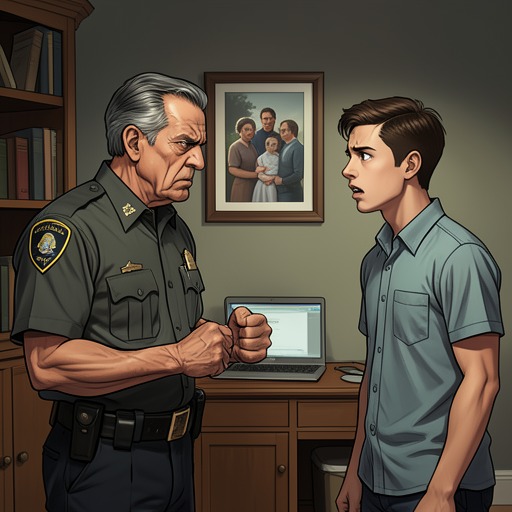
Matt Daehler then orders Stiles Stilinski to handcuff his father to a bench in the holding room. Sheriff Stilinski is deliberately removed from the situation, while Scott McCall and Carson Bradley stand aside and Matt aims the gun at Stiles and his father. The handcuffs, bench, holding room, firearm, and officer's station all remain recognizable tools of law enforcement, but their functions have been reversed: the sheriff is restrained, the teenager is compelled to perform the restraint, and the criminal controls the room. The station becomes a captured version of itself, a place where the language and equipment of custody are turned against the people meant to administer them.
The episode's decisive value shift is the movement from institutional safety to forced vulnerability. Earlier, the station is approached as a place from which Isaac Lahey might be rescued; during the hostage crisis, it becomes the site from which Carson Bradley, Stiles Stilinski, Scott McCall, and others must survive. The building's repeated role in rescue, detention, and coercion makes it a structural image of the town's wider crisis: the characters still need law, but they can no longer assume that lawful spaces will remain outside the supernatural conflict.