Beacon Hills State Lacrosse Championship
Holding Out for a Hero ▸ Stiles Stilinski (2)Beacon Hills State Lacrosse Championship is the climactic game in which Beacon Hills appears to win through Stiles Stilinski’s sudden transformation from sidelined outsider into decisive player. The victory briefly restores confidence, belonging, and shared celebration, but the game is also shaped by Gerard Argent’s threatening authority and the expectation that violence will erupt. Its final reversal—stadium lights failing immediately after the buzzer—makes the championship a false moment of safety: the team wins on the field while the supernatural danger surrounding it remains unresolved.
Power, Subtext, and the Stakes of the Game
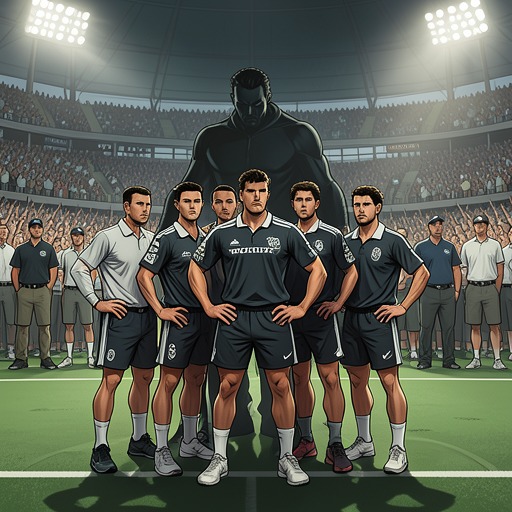
The championship begins under Gerard Argent’s new authority as principal. Addressing the school’s winning team, Gerard declares his pride in having a winning team and emphasizes that only one co-captain will lead that night. The announcement benches Scott McCall, whose panic makes clear that the decision is not ordinary coaching. Gerard is not merely managing school athletics; he is manipulating the team’s structure and removing a supernatural defender from the field at the moment danger is expected.
Gerard then urges the players to get out and “murder them.” Coach Finstock hears the instruction as ordinary competitive rhetoric and orders the players onto the field, unaware of its deadliness. Carson Bradley recognizes the phrase as an underlying message. In context, the language converts a sports command into a threat, making the game’s public spectacle carry a private meaning for those who know Gerard’s intentions. The championship therefore operates on two levels: a contest governed by rules and a concealed confrontation in which the players may be exposed to lethal supernatural violence.
This atmosphere is intensified by earlier examples of adults and students suspending ordinary law in response to danger. Gerard has already threatened to make at least two students take the fall and remain behind for detention on his first day, while Carson Bradley and the others later resort to stealing a police vehicle to keep Jackson Whittemore from hurting anyone. The championship belongs to the same emergency-driven world: formal institutions remain visible, but their authority can be redirected, abused, or bypassed whenever the supernatural crisis demands it.
Stiles Stilinski Enters the Field
The game initially leaves Stiles Stilinski outside the expected order of play. Carson Bradley sits near Stiles Stilinski’s father, Sheriff Stilinski, when the sheriff suddenly realizes that his son is running onto the field. Stiles wears jersey number twenty-four and a helmet, and the sight overwhelms Carson’s earlier anger toward him. The familiar jersey makes his unexpected participation immediately legible: he has crossed from observer to player, from someone presumed useless to someone occupying the team’s public space.
The change is surprising precisely because Stiles is not introduced as an established athlete. His entry is treated as an improvised decision by Finstock, and even his father reacts with disbelief. The game has already been framed by missing players and supernatural danger, so Stiles’s appearance carries both comic improbability and genuine risk. His presence gives the team another body on the field, but it also places an unprepared participant inside the confrontation that Gerard has implicitly engineered.
The narrative keeps Stiles’s first movements close to Carson’s astonished perspective. Carson watches the number on his jersey, looks down at the sweatshirt being worn in the stands, and then looks back at him. The repeated visual comparison turns the uniform into a sign of changed status. Stiles is still the same person, but the jersey temporarily makes him part of a collective identity that had previously excluded him.
The Goal That Reverses the Game
With the score at seven to nine against Beacon Hills and half the team already gone, the match appears to be slipping away. The remaining players seem like too few pieces in a checkers game, and the team’s defeat is described as a kind of massacre. Against that background, the ball suddenly rolls directly in front of Stiles’s stick after leaving an opposing player’s net. The opportunity arrives without preparation, and Stiles initially hesitates while the other players close in on him.
Stiles begins running toward the goal while screaming in terror. He reaches the goal but does not immediately shoot, even as the opposing players approach and Finstock shouts that he is being foolish. Carson Bradley responds by leaping from the seat and yelling, “Shoot it!” Stiles looks toward Carson for a brief instant, then sends the ball into the net. The goalie misses, and the unexpected player scores.
The goal changes more than the score. It changes Stiles’s relation to the field and to the people watching him. He announces that he has scored, and the crowd’s reaction confirms that the act has become publicly meaningful. Carson and Lydia Martin hug and squeal, while Sheriff Stilinski reacts with uncontrolled excitement. The goal is both an athletic success and a moment of recognition: Stiles is no longer merely tolerated as an inadequate participant but has performed the action that the team needs.
After the first goal, Stiles develops a new confidence. He gains possession of every ball that follows, weaving away from opposing players before sending the ball toward the net. The sequence reverses the earlier image of the team being overwhelmed. Beacon Hills rises from seven to nine, ties the game, and then reaches ten to nine with only seconds remaining. The victory does not come through a supernatural display or an established captain’s command; it comes through Stiles’s improbable persistence after Carson’s shouted instruction gives him the immediate push to act.
Victory, Recognition, and the Snow Globe Image
The buzzer confirms that Beacon Hills has won, and the players in red swarm Stiles Stilinski. The same teammates who once saw him as useless now jump over him, shouting and cheering. His social position changes in the space of a game: he becomes the visible center of the team’s celebration, not because the institution has gradually accepted him, but because one decisive action forces recognition.
The celebration also creates an intimate counter-image. Stiles remains at the edge of the circle, and his eyes find Carson Bradley in the crowd. Around them, people hug, cheer, and scream, yet the narration narrows the moment until it seems to contain only the two of them. Their shared gaze produces their “snow globe world,” a recurring image of temporary enclosure and emotional separation from surrounding turmoil. The public championship becomes, for an instant, a private space in which their relationship takes precedence over the crowd and the threats beyond it.
That private stillness does not erase the danger. Scott McCall is on the field looking around in confusion, apparently expecting something to happen, and the wider group shares that expectation. The victory is therefore marked by an unresolved contradiction: the team has achieved the result it wanted, but the people who understand the supernatural conflict cannot interpret the game as merely a game. The score offers a positive value shift from likely defeat to triumph, while the surrounding threat prevents that triumph from becoming secure.
The Buzzer and the Collapse of Safety
The final seconds are rendered as a countdown: two seconds, then one, followed by the buzzer. The fans respond with even louder screams, and for a moment the game is over without the catastrophe everyone anticipated. Nothing has happened on the field, or so Carson Bradley believes. Even Jackson Whittemore may no longer be on the field, leaving Scott McCall to search in confusion. The apparent absence of the expected attack makes the victory feel safe only by postponing the reversal.
Immediately afterward, the giant spotlights lining the field begin shutting off with loud booms. Darkness covers the field, someone screams, and the crowd breaks into chaotic movement. People run and shout as Carson’s eyes adjust. The event thus ends by overturning the meaning of the buzzer. The official conclusion says that Beacon Hills has won; the blackout reveals that the larger conflict has not concluded at all.
The championship’s decisive significance lies in this double ending. Stiles Stilinski’s goal grants him confidence, recognition, and a shared moment with Carson Bradley, while Beacon Hills secures a last-second ten-to-nine victory. Yet Gerard Argent’s ominous command, Scott McCall’s expectation of danger, the missing or displaced players, and the immediate blackout keep the victory suspended between celebration and crisis. The game is a genuine triumph in athletic terms, but as a narrative event it exposes how little ordinary victory can protect the characters from the supernatural emergency surrounding them.