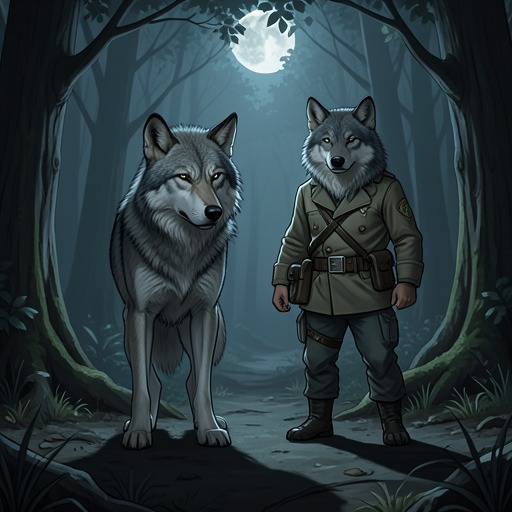
Boyd Lockwood becomes a werewolf
Holding Out for a Hero ▸ Stiles Stilinski (2)Boyd Lockwood becomes a werewolf when Derek Hale exploits the loneliness that has made him nearly invisible at school. The transformation is important not only because it enlarges Derek's pack, but because it reveals that the offer of supernatural power is also an offer of recognition: Boyd is drawn less by abstract loyalty than by the hope of no longer eating lunch alone.
Causes and Background
Carson Bradley, Scott McCall, and Stiles Stilinski already understand that Derek is seeking isolated students. When Carson notices that Boyd's cafeteria table is empty, the absence becomes a warning sign rather than an ordinary detail. She recognizes a pattern in Derek's recruitment: the people most likely to accept a dangerous offer are those who have been left without a social place. Carson therefore treats Boyd's disappearance from the table as evidence that he has become a target and immediately pulls Scott and Stiles away to devise a response.
The larger danger is shaped by the town's supernatural conflict. Scott's transformation has placed the three friends between werewolves and the Argent family of hunters, while Derek has been building a separate werewolf force. Carson understands that joining Derek does not simply provide Boyd with new abilities; it places him inside a conflict involving hunters, uncontrolled full-moon transformations, and the threat of being used as part of Derek's expanding brigade.
The Transformation and Recruitment
The first practical sign of Boyd's recruitment appears through a surprise arranged by Stiles. He leads Carson toward a back table and looks around as though someone might be watching before approaching Boyd, who is eating Doritos and visibly frowning at Stiles. This meeting identifies Boyd as someone already connected to the group, even though he remains socially separate from Carson, Scott, and Stiles.
The crisis becomes explicit when Carson sees that Boyd's table is empty. Scott and Stiles initially treat the table as nothing more than an empty place, but Carson forces them to ask whose table it is. Once they identify it as Boyd's, she concludes that Derek has found another lonely student to recruit. The friends hurry out of the cafeteria, trying to plan without being overheard, and decide that Carson and Scott will go to the ice rink to find him.
At the rink, they discover Boyd driving the Zamboni across the ice. Scott and Carson enter in ordinary shoes and cautiously cross the rink, while Boyd refuses to stop until Scott calls out that they only want to talk. Scott asks whether Derek has told Boyd everything, including the danger of losing control during the full moon. Boyd stops the machine only after admitting that Derek has told him about the hunters, confirming that the recruitment has already brought him into the supernatural world.
The Motive of Belonging
Boyd's decisive explanation is painfully ordinary: he wants to stop eating lunch alone every day. His statement silences Carson and Scott because it strips away the spectacle of the werewolf plot and identifies a human need beneath the transformation. Boyd is not presented merely as a mysterious student or a potential monster. His loneliness has become visible, and Carson realizes that she had previously mistaken his isolation for a personal choice.
Carson understands that Boyd did not necessarily choose to reject other people; rather, other people had chosen to ignore him. His years of coping have kept him functioning without healing the hurt that produced his withdrawal. This recognition changes Carson's response from suspicion to intervention. She offers friendship, invites him to sit with the group, and argues that he would be better off remaining human with friends who know the truth about werewolves than staying with Derek's pack.
The offer is morally complicated because it arrives after the supernatural choice has already begun. Carson wants to save Boyd by giving him the belonging he sought, but the scene also shows why Derek's offer has force. Derek can provide a pack immediately, while ordinary school friendship has failed Boyd for years. The werewolf bite therefore operates as both bodily transformation and social recruitment: it creates a new identity by promising that the lonely student will finally have a place among others.
Consequences and Wider Connections
Boyd's recruitment contributes to Derek's attempt to assemble a werewolf pack from vulnerable students. Later discussion describes Isaac Lahey as another newly accepted werewolf moving through Beacon Hills High, and Carson reacts uneasily to the prospect of yet another hormonal werewolf in the corridors. Boyd's case thus becomes part of a recurring pattern in which adolescent isolation, supernatural power, and pack membership overlap.
The friends' efforts to understand the supernatural are themselves improvised and incomplete. Their research into the Kanima produces almost nothing useful online: searches for the Kanima, its legends, its shape-shifting nature, and the giant lizard that cannot swim yield little, while the bestiary on Stiles's laptop contains words Carson cannot understand. Their dependence on partial lore parallels their uncertainty about Boyd. They can identify the danger of Derek's recruitment, but they cannot simply solve the emotional conditions that made the recruitment attractive.
Deaton becomes an important source of practical help in the wider struggle. Although the group knows little about him, they trust him because he repeatedly assists Scott and functions as their veterinarian and supernatural guide. His bottle and spring-loaded syringe are prepared to help with the Kanima problem, while Coach Finstock's later insistence that Scott remain on the lacrosse team reconnects the supernatural crisis with ordinary school obligations. Against this background, Boyd's transformation is part of a world where supernatural identities must coexist with lunch periods, classes, grades, and team expectations.
Significance
Boyd Lockwood becomes a werewolf at the intersection of danger and neglect. Derek's pack is threatening because it is growing, but it is persuasive because it answers a need that the school community has ignored. Carson's attempt to reclaim Boyd through friendship exposes the central contradiction of the event: the human world warns him against the werewolf world only after failing to make him feel humanly included.
The event also deepens Carson's role within the original trio. She does not merely follow Scott and Stiles into another supernatural investigation; she notices the social clue they overlook, identifies Boyd's vulnerability, and confronts the emotional cost of treating isolated people as convenient recruits. Boyd's transformation consequently enlarges the conflict while making its stakes more intimate. The question is not only how many werewolves Derek can gather, but what kinds of loneliness allow a pack to be built at all.