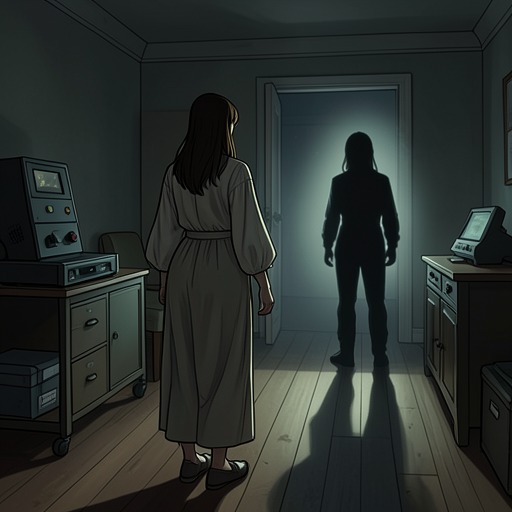
Carson escapes handcuffs with a bobby pin
Holding Out for a Hero ▸ Stiles Stilinski (2)Carson escapes handcuffs with a bobby pin during the police-station hostage crisis, a decisive reversal in which improvised knowledge and composure briefly overcome an armed captor’s control. Bound while Matt Daehler holds Carson, Stiles Stilinski, Scott McCall, and others at gunpoint, Carson turns an object already hidden in her hair into the means of restoring movement, agency, and the possibility of escape.
Causes and Background
The escape occurs after the crisis has stripped away ordinary protections. Matt Daehler forces Carson down the hallway at gunpoint, intending to take four students hostage, while the threat of Jackson Whittemore’s violence makes every command immediate and credible. Carson experiences the pressure of the weapon against her back and understands that silence and obedience are, for the moment, the only options available. The hostage situation therefore places her in a condition of enforced passivity: she is not merely restrained physically but compelled to surrender decision-making to Matt’s demands.
Matt then removes Sheriff Stilinski from the situation by ordering Stiles Stilinski to handcuff his father to a bench in the holding room. Stiles Stilinski is left silent as he fastens the cuff, while Scott McCall and Carson stand nearby and Matt keeps the gun trained on Stiles Stilinski and his father. The scene makes the stakes intimate as well as institutional. The weapon is aimed at both a parent and a boyfriend, and Matt’s finger moving along the trigger turns the handcuffing into a performance of possible execution rather than a routine act of detention.
The Hostage Crisis
Carson is still trapped when Scott McCall is taken back toward the front at gunpoint. Her party dress is stained with Scott McCall’s blood, and she contrasts the present imprisonment with the earlier birthday party, where she had already witnessed the disturbing spectacle of her mother. The comparison shows how quickly an apparently social evening has become a sequence of escalating threats. Carson’s body carries the immediate evidence of the crisis, while her thoughts turn toward the practical problem of getting everyone out.
Stiles Stilinski’s absence becomes especially important. Carson believes that he would already have devised a second plan, but Stiles Stilinski is paralyzed in the office with Derek Hale, leaving her to construct the next move herself. Her response is not a sudden disappearance of fear; it is the conversion of fear into focused attention. She searches for a usable resource while remaining under restraint, and the answer comes from the bobby pins set in her hair.
The Bobby Pin Escape
Carson remembers that Stiles Stilinski’s father had once accused her of spending too much time with his son. That shared time now supplies the knowledge that makes the escape possible. Carson recalls an evening when she and Stiles Stilinski, unwilling to play video games, searched the internet and watched lock-picking videos. Stiles Stilinski had laughed at the apparent uselessness of the lesson and suggested that it might become useful one day. During the hostage crisis, that dismissed pastime becomes actionable knowledge.
Carson removes a bobby pin from her hair, pulls away its small plastic tip with her teeth, bends the exposed piece, and inserts it into the handcuff’s keyhole. The procedure is uncertain rather than effortless. She remembers the mechanism described in the video, tries to press against it, and attempts to release the tooth-edged bar from the lock, but the metal does not immediately respond. The others watch while she works, and the failed attempts make the escape a suspenseful process instead of a convenient trick.
A small click finally confirms that the mechanism has shifted. Carson drops the pin into her lap, reaches for the cuff, and pulls until the bar slides out from the side. Her hand is free. The response from Melissa McCall is a small cheer, while Sheriff Stilinski answers with a smile and jokes that Carson’s time with Stiles Stilinski deserves thanks after all. The immediate consequence is practical: Carson can now use the same improvised method to work on Sheriff Stilinski’s cuff, extending her individual escape into a rescue attempt.
Consequences and Significance
The value change is stark. At the beginning of the sequence, Carson is a hostage whose life depends on not provoking Matt Daehler; after the click of the lock, she becomes the person capable of changing the conditions of captivity. Freedom first returns through a nearly invisible object rather than through supernatural strength, official authority, or a larger weapon. The bobby pin is ordinary, portable, and already part of Carson’s appearance, yet its significance changes when memory and necessity give it a new function.
The scene also develops Carson and Stiles Stilinski’s relationship through practical inheritance. Stiles Stilinski is not present to make the plan, but a shared activity from their ordinary life supplies Carson with the technique. Their intimacy is therefore represented not only by affection but by accumulated knowledge that remains useful under extreme pressure. The escape proves that the couple’s seemingly trivial time together has produced a durable resource, allowing Carson to act in Stiles Stilinski’s characteristic problem-solving role while he is unable to do so.
Finally, the escape punctures Matt Daehler’s claim to total control. His gun, the handcuffs, the holding room, and the police setting all embody institutional power placed in the hands of a captor. Carson defeats none of those structures outright, but she finds a precise weakness within them and uses it. The small click of the lock marks the beginning of resistance: a hostage recovers one free hand, Sheriff Stilinski gains a possible ally, and the crisis acquires a new direction.