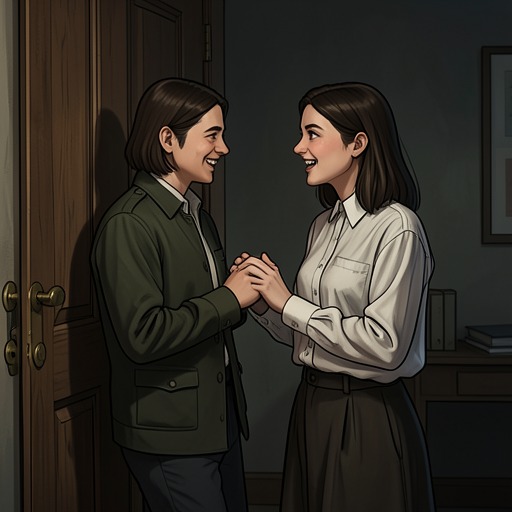
Carson–Stiles relationship
Holding Out for a Hero ▸ Stiles Stilinski (2)The Carson–Stiles relationship is the emotional partnership between Carson Bradley and Stiles Stilinski, and its decisive significance lies in the way it separates love from physical invulnerability. Stiles fears that he cannot deserve or protect Carson because he lacks the supernatural strength associated with Scott McCall and Derek Hale. Carson answers that she does not need a rescuer: she needs Stiles himself, the person who listens, loves her, and continues trying to help. Their relationship therefore turns vulnerability into a form of heroism and develops toward an emphatic promise of lasting mutual devotion.
Emotional Foundation
Carson and Stiles understand themselves as complementary rather than identical. Carson has generally regarded Stiles as the stronger person in the relationship: he is the one with ideas and jokes, the one who helps her endure difficulty. That assumption is unsettled when Stiles admits that he also feels helpless. His confession is prompted by the night when he watched Matt Daehler take Carson down and could not intervene or save her. The knowledge that Carson might be lost to him leaves him frightened, and his distress becomes part of the relationship rather than something he can hide behind humor.
Carson recognizes that Kanima venom could incapacitate anyone, including Derek Hale, whom she considers one of the toughest people she knows. She therefore refuses to treat Stiles’s failure to prevent the attack as a personal fault. Her response is not to deny danger but to deny the idea that love requires one person to defeat every danger on the other’s behalf. In this exchange, the relationship makes room for both partners to be afraid: Stiles can confess inadequacy, while Carson can acknowledge his pain without accepting his self-condemnation.
Conflict and Reconciliation
The immediate conflict centers on Stiles’s belief that Carson needs protection he cannot provide. Carson tells him that she is fine and does not need protecting, but Stiles hears her confidence and independence as evidence that he has no essential place in her life. He reduces himself to being merely Stiles, contrasting his ordinary humanity with the abilities of Scott McCall and Derek Hale. His fear is not simply that Carson may be physically harmed; it is that her strength makes him unnecessary.
Carson directly challenges that interpretation. She tells Stiles that needing him does not mean expecting him to take a gunshot for her, and she distinguishes emotional dependence from the demand for spectacular self-sacrifice. More importantly, she explains that she has been going out of her mind because he was absent, not because she needed a supernaturally powerful substitute. She needs someone to talk to and someone who will love her in the way she loves him. The relationship’s central reassurance is consequently precise: Stiles does not have to become Scott or Derek, acquire supernatural speed, or become indestructible. He only has to remain Stiles.
Carson then reframes Stiles’s ordinary conduct as heroism. She tells him that heroes bleed and struggle, and that they are heroes because they do what is right rather than because they possess extraordinary bodies or wear capes. Her comparison of Stiles to Batman preserves the playful language associated with him while giving that language moral weight. Stiles’s value is located in care, effort, and solidarity. His apology is met not with accusation but with Carson’s declaration that there is nothing for which he needs to be sorry.
Love and Commitment
The reconciliation becomes explicit when Carson tells Stiles, “I love you, Stiles Stilinski. I love you.” Stiles answers, “Forever,” and seals the promise with a kiss to her forehead. Carson confirms the restored relationship by saying, “We're okay,” then kissing his non-bloody cheek. The physical details matter because the scene does not present reconciliation as an abstract agreement: apology, forehead kiss, nod, and answering kiss make the renewed bond tangible.
Their intimacy is briefly interrupted when Carson’s phone receives a call from Scott McCall. The interruption produces comic irritation after the emotional seriousness of the reconciliation, with Carson threatening to skin Scott’s werewolf ass. The contrast keeps the romance embedded in the larger supernatural and friendship network rather than isolating it from the group’s emergencies. Even at the point when Carson and Stiles are moving toward a kiss, their relationship remains exposed to the demands of the world around them.
Domestic Intimacy and the Future
Later, Carson and Stiles share a quieter scene in which they lie together on her bed and decide what to watch. When Stiles says that it does not matter, Carson tells him that she loves him, with the narration emphasizing the full emotional force behind the words. This ordinary setting gives their commitment a domestic dimension: their bond is not sustained only by danger, rescue, or confrontation, but also by the possibility of simply occupying the same space.
Carson goes further by treating their future as inevitable. She argues that they were always going to end up together and that they are meant to be with each other, describing their permanence as fate. Stiles rejects the existence of fate, but he does not reject the relationship; when Carson responds that anything is possible and that they are meant to be together forever, he says that he would not mind that. His qualified acceptance sends Carson into euphoria and prompts her to kiss him.
The ensuing physical closeness develops the emotional claim into embodied intimacy. They kiss repeatedly, shift positions, hold each other by the waist and face, and touch one another’s hair and backs. Carson experiences the contact as overwhelming happiness and describes the pair as made for each other. The scene is interrupted before it can proceed further, but the interruption does not undo its meaning. Desire, comfort, and commitment have become part of the same relationship rather than separate stages.
Narrative Meaning
Carson’s understanding of the relationship is shaped by contrast with her previous search for love. She recalls spending a long time looking aimlessly for affection and dating people she regards as jerks and assholes, only to realize that the person she loved was already directly in front of her. Stiles is presented as the “right guy” not because he is flawless or powerful, but because his care is consistent with the kind of love Carson wants: intimate, mutual, and emotionally present.
The relationship also resists the expectation that first loves are temporary. Carson explicitly rejects the idea that her love for Stiles must be brief simply because it is a first love, insisting that their story is different and that she wants everything with him—the kind of love associated with films and novels. This is not only romantic exaggeration; it is a declaration against impermanence. The relationship’s forward-looking force comes from Carson’s refusal to let fear, supernatural danger, or Stiles’s self-doubt define the limits of their future. By the end of the supplied scenes, they are not merely reconciled. They are reaffirming a shared identity, a lasting promise, and a love Carson is determined not to lose.