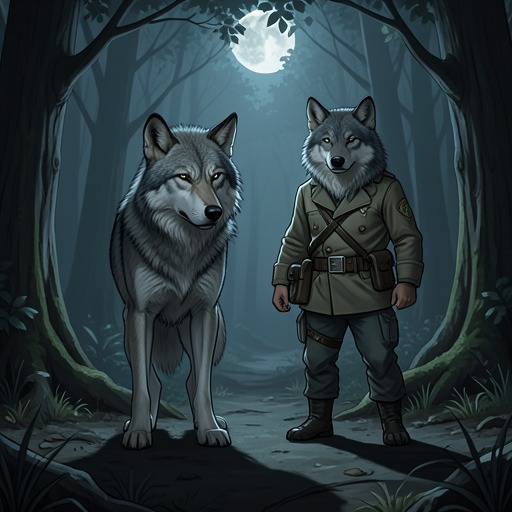
Derek Hale and Vernon Boyd
Holding Out for a Hero ▸ Stiles Stilinski (2)Derek Hale and Vernon Boyd are connected through a relationship that begins as recruitment but becomes a contest over what belonging should mean. Derek notices Boyd’s social isolation, targets him for transformation, and presents membership in his werewolf pack as an alternative to being ignored. Boyd accepts the bite, yet his later declaration that he wants to be like Scott McCall rather than Derek Hale reveals that the relationship has failed to satisfy the need that made him vulnerable in the first place.
Recruitment Through Isolation
Derek’s interest in Boyd is recognized before Boyd openly joins the pack. When Carson Bradley sees that Boyd’s cafeteria table is empty, she interprets the absence as evidence that Derek is pursuing “the lonely, misunderstood ones.” The image turns Derek’s recruiting method into a pattern: social exclusion makes students easier to approach, and the promise of supernatural strength offers a substitute for ordinary acceptance. Boyd is not initially presented as someone aggressively seeking power. He is presented as someone whose isolation has made power appear useful.
The recruitment also operates through a choice that is less free than it first sounds. Stiles Stilinski explains that Derek is giving the prospective werewolves a choice, and Carson objects that the supposed choice is being offered to people already marked by loneliness and neglect. In Boyd’s case, the circumstances are especially clear. He admits that he wants only to stop eating lunch alone every day, and his sadness forces Carson and Scott to reconsider their assumptions about him. His solitude is not simply a personality preference; it is the result of other students choosing to ignore him. Derek therefore reaches Boyd through a wound created by the school community, not through a neutral invitation.
The Pack as a Substitute for Belonging
Boyd’s first connection with Carson, Scott, and Stiles provides a direct alternative to Derek’s influence. Carson tells him that he can sit with them and be their friend, arguing that he would be better off knowing about werewolves with them than remaining with Derek and his “brigade of freaks.” Her offer does not promise status or a new body. It promises company, information, and the possibility of remaining human while making an informed decision. That distinction exposes the moral difference between the two forms of belonging: Derek offers transformation and pack membership, while Carson’s group offers recognition before any transformation occurs.
The contrast is reinforced at the ice rink. When Derek’s newly recruited werewolves, Erica Reyes and Isaac Lahey, move toward Scott, Carson tells Scott to fight back and climbs onto the zamboni platform beside Boyd. Boyd does not reject her presence; he helps pull her up. The gesture is small but important because it places him physically alongside a person who has chosen to treat him as more than a target. At the same time, Derek remains the dominant supernatural force. Scott can defeat the newer members of the pack, but Derek’s experience and Alpha status give him the advantage, and Boyd leaves with Derek after Scott is injured.
The Bite and the Choice of Allegiance
Boyd’s transformation confirms that Derek’s recruitment has succeeded in practical terms. Derek has identified an isolated student, brought him into the orbit of the pack, and converted his desire for connection into a supernatural allegiance. Yet the scene also reveals the instability of that allegiance. Scott tells Boyd that he should not want to become like Derek, and Boyd answers by revealing the bite on his side and explaining that he wants to be like Scott instead. The revelation changes the meaning of the earlier encounter: Boyd has not merely accepted Derek’s offer. He has selected a different model of what a werewolf can be.
Boyd’s response is not a rejection of supernatural identity itself. He still wants the strength and belonging associated with the bite. What he rejects is Derek’s version of leadership. Derek’s pack is organized around hierarchy, intimidation, and the promise that injured outsiders can become powerful by joining him. Scott represents another possibility, one in which supernatural power is constrained by loyalty to friends and concern for others. Boyd’s decision therefore makes the relationship an argument about identity as much as a record of recruitment.
Recognition, Conflict, and Moral Contrast
The relationship between Derek and Boyd is shaped by a sharp imbalance of knowledge and authority. Derek appears to understand how to use Boyd’s loneliness, while Boyd is still trying to understand what the transformation will make him. The pack’s structure places Derek at the center and the recruits beneath him, leaving Boyd with membership but not equal agency. His isolation is answered, but it is answered by incorporation into another hierarchy.
Carson’s response to Boyd complicates that hierarchy. She initially misjudges him as someone who simply prefers to sit alone, then recognizes that his behavior is a form of coping with long-term exclusion. Her offer of friendship refuses to reduce him to either a lonely boy or a prospective werewolf. This recognition makes Derek’s approach look narrower by comparison. Derek sees a recruit; Carson sees a person whose pain could have been addressed without exploiting it. The contrast does not erase Boyd’s responsibility for his choice, but it clarifies the conditions under which that choice is made.
Significance of the Relationship
Derek Hale and Vernon Boyd’s relationship shows how the werewolf pack can function simultaneously as refuge and instrument of control. Derek’s recruitment gives Boyd access to strength and a group, but it does not resolve the loneliness that motivated him. The decisive evidence of that failure is Boyd’s preference for Scott: after accepting Derek’s bite, he still identifies with the friendlier and more protective figure rather than the Alpha who transformed him.
The relationship also broadens the book’s treatment of the supernatural. Werewolf transformation is not only a biological or magical change; it is presented as a social decision shaped by exclusion, persuasion, and the search for recognition. Boyd enters Derek’s pack because he wants not to be alone, but his allegiance remains open because belonging depends on how a leader treats the vulnerable. Derek can provide a pack, yet Scott’s example suggests that genuine belonging requires the person inside the pack to be seen, trusted, and allowed a moral choice.