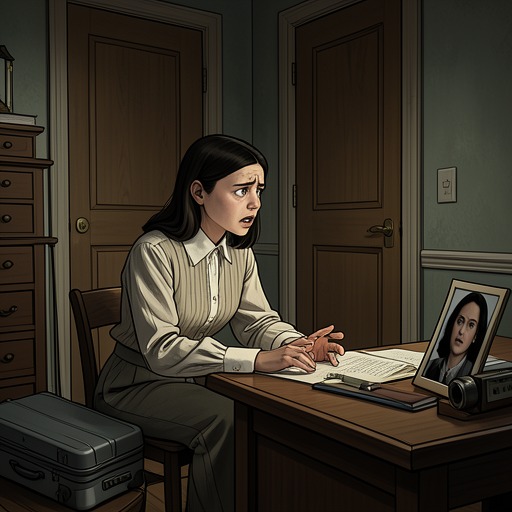
Fugue state
Holding Out for a Hero ▸ Stiles Stilinski (2)Fugue state is the unexplained condition surrounding Lydia Martin’s disappearance from Beacon Hills Hospital and her subsequent four-day absence in the woods. In the narrative, it is both a medical label and a limit of medical knowledge: doctors can name Lydia’s behavior, but they cannot explain why she escaped a second-story hospital room, ran through the wilderness naked, and returned with no memory of what happened. The condition therefore becomes the first organized description of a mystery that ultimately points beyond ordinary illness and toward the supernatural consequences of Peter Hale’s bite.
Definition and First Signs
Fugue state first becomes meaningful when Lydia vanishes from a hospital bathroom without leaving any trace. For an hour, there is no sign of her anywhere in the building, and the hospital responds with a spreading panic as people search every part of the premises. Carson Bradley experiences the disappearance not as an abstract symptom but as the sudden removal of her best friend from a controlled medical environment. The hospital’s failure to account for Lydia makes the condition feel less like a diagnosis than an event that has broken the institution’s usual procedures.
The circumstances surrounding Lydia’s escape intensify that rupture. She had apparently gotten out of a second-story hospital room, after which she was found running through the woods naked. Her return does not restore continuity, because she cannot explain how she arrived there or why she had been moving through the forest. The phrase fugue state supplies a conventional medical category for behavior that remains radically unconventional within the story’s world.
Memory Loss and the Four-Day Absence
When Carson finds Lydia, Lydia is shivering and in need of a shower, but there are no immediately visible wounds to account for what has happened. Her first questions expose the central feature of the condition: she asks why she is outside and why she is naked in the middle of nowhere. Carson’s eyes widen when it becomes clear that Lydia remembers nothing. The absence is therefore not merely physical. Lydia has lost the narrative of her own actions, leaving Carson and the other investigators to reconstruct a period that Lydia herself cannot witness.
The doctors later describe the episode as a fugue state and admit that they have no explanation for why Lydia spent four days running around the woods naked. Lydia treats the diagnosis with striking emotional distance. She says that she feels fantastic and even jokes that she has lost nine pounds, setting her apparent physical well-being against the disturbing blankness in her memory. Her reaction creates a sharp contrast between the clinical seriousness of the disappearance and her own light, almost dismissive response to its consequences.
Connection to Peter Hale’s Bite
The fugue state becomes more than a medical curiosity after Carson places it in sequence with Peter Hale’s attack. Lydia was bitten by Peter, yet she did not become a werewolf in the ordinary way that Peter had described. Doctors initially attributed her condition to some kind of allergic reaction, but the later pattern is harder to contain within that explanation: after the bite, Lydia escapes from the hospital, wanders in a fugue state, and later begins seeing things and screaming.
Carson concludes that whatever happened when Peter bit Lydia is causing the abnormal events. Lydia appears normal by werewolf standards, which only means that she is not visibly marked for attack by the Argents and their wolfsbane bullets. The fugue state thus occupies an unstable middle ground. Lydia is not confirmed as a werewolf, but neither is she medically ordinary. Her altered behavior becomes evidence that Peter’s bite has activated a different kind of supernatural condition.
Consequences and Narrative Significance
The condition changes how the group understands Lydia’s disappearance. At first, the mystery is framed as a missing-person emergency inside a hospital; then it becomes a problem of memory, bodily vulnerability, and unexplained movement; finally, it becomes part of the larger question of what Lydia is becoming. Her inability to remember prevents her from serving as a reliable witness to the episode, while her apparently healthy return prevents the others from treating it as a straightforward injury or illness.
Fugue state also gives the supernatural plot a language of uncertainty. The doctors can identify the surface behavior without identifying its cause, while Carson connects the episode to Peter Hale’s bite and to Lydia’s later visions. That gap between diagnosis and explanation is crucial: the medical term does not resolve the mystery but preserves it, allowing Lydia’s four-day absence to stand as a visible consequence of a transformation that has not yet taken a recognizable form. In this sense, the fugue state marks Lydia’s passage from a patient who has disappeared into a person caught between ordinary human categories and the supernatural world.