Grave robbery and liver theft
Holding Out for a Hero ▸ Stiles Stilinski (2)Grave robbery and liver theft is the first sharply defined crime in the investigation surrounding Lydia Martin’s unexplained condition. What initially sounds like an isolated desecration—a grave opened and a liver removed—becomes a material clue in a widening chain of attacks. The theft forces Carson Bradley, Stiles Stilinski, and Scott McCall to confront the possibility that the danger is not confined to Lydia Martin’s hospital recovery, and it gives the emerging mystery its most disturbing physical evidence: a body part taken from the dead and the marks of something with claws.
Discovery of the Missing Organ
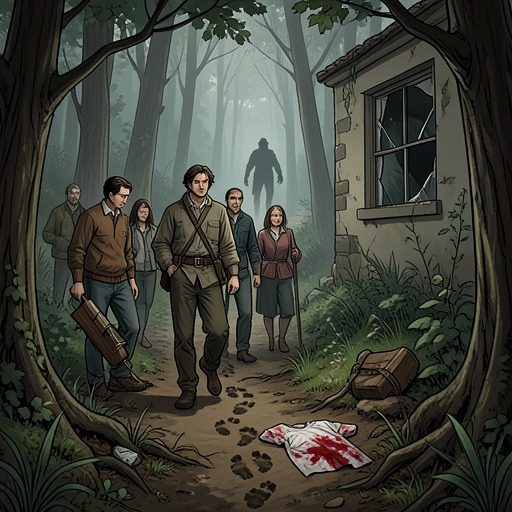
The crime enters the story through Stiles Stilinski’s hurried account as Carson Bradley, Stiles Stilinski, and Scott McCall walk toward a building. He reports that there has been a grave robbery and that a liver was stolen. The information is incomplete and secondhand, supplied by a boy who works in the graveyard rather than by an official investigator. That uncertainty matters: the group has a fact, but not yet a reliable explanation, perpetrator, or even a confirmed connection to Lydia Martin.
Carson Bradley immediately tests the most frightening possibility by asking whether the crime points to Lydia Martin. Scott McCall reacts with the same revulsion, wondering whether Lydia Martin might have eaten the liver. Stiles Stilinski corrects them: the report says only that the liver is missing, not that Lydia Martin consumed it. His observation that the liver is the most nutritious part of the body makes the exchange macabre, but it also keeps the investigation focused on evidence rather than assumption. Carson Bradley then identifies the weakness in the account by asking who actually said the liver was missing. Stiles Stilinski can name only the cemetery worker, and Carson Bradley suggests Isaac Lahey as the likely source.
Claws and the Supernatural Hypothesis
The grave robbery becomes more significant when Carson Bradley presses Isaac Lahey for information about what he saw. She rejects his initial reluctance and insists that Lydia Martin, her best friend, is outside in the woods naked, making any withheld observation urgent. Isaac Lahey finally supplies the decisive description: claws, shaped not like a cat’s paw but like a human hand fitted with claws. The distinction shifts the crime from an ordinary act of grave desecration toward a specifically humanoid and predatory threat.
The testimony also links the stolen organ to a visible bodily form without explaining that form. Isaac Lahey does not identify the attacker, and Carson Bradley does not yet know whether the creature is an animal, a transformed human, or something else. The image of a human hand with claws is therefore both evidence and a limit on knowledge. It gives the group a concrete sign to pursue while preserving the central uncertainty: the thing responsible has recognizable human anatomy but operates outside ordinary human behavior.
From Cemetery Evidence to a Living Predator
The later attack at the Mechanics garage gives the cemetery testimony a horrifying visual counterpart. Carson Bradley sees a clawed, scaly hand reach down near a worker, followed by a tail that slices the back of the man’s neck. The creature’s yellow eyes turn toward her, and its hiss is followed by Stiles Stilinski collapsing into paralysis. The scene confirms that the claws associated with the missing liver belong to a large lizardlike being capable of killing, moving through an industrial space, and immobilizing witnesses.
The attack also establishes that the grave robbery is not merely an act against the dead. It belongs to a pattern in which the creature’s physical traits—claws, scales, a tail, yellow eyes, and a disabling effect—become recurring investigative markers. The garage worker’s death gives the earlier cemetery clue a new meaning: the stolen liver was not evidence of Lydia Martin’s appetite, but part of the creature’s unexplained behavior and apparent connection to a series of violent incidents.
Investigation, Doubt, and the Name Kanima
The search for an explanation proceeds through incomplete sources. Carson Bradley and the others find little through ordinary internet searches for the Kanima, Kanima legends, a Kanima shapeshifter, or a giant lizard that cannot swim. The absence of sightings and stories conflicts with Derek Hale’s claim that he has heard accounts of such a creature, leaving the group dependent on the bestiary and on fragments of supernatural knowledge that they cannot easily translate.
Carson Bradley eventually finds a reference to a were-jaguar, though it does not describe the lizard creature accurately. The result is not a solution but a provisional route into the unknown: a nearby mythic category is treated as a possible lead because the available evidence is so scarce. In this phase, the liver theft functions as an anchor for speculation. Unlike the vague legend, it is a concrete act with a location, a missing organ, and a witness report about claws; it keeps the investigation attached to an actual crime while the characters struggle to name the being responsible.
Expansion into a Pattern of Attacks
The grave robbery gains further weight when later incidents repeat its combination of bodily evidence and unexplained violence. At the hospital, Carson Bradley and Allison Argent find clear ooze dripping from an open window sill, the same substance previously seen at the Mechanics garage. The residue does not identify the culprit by itself, but its recurrence connects separate locations and turns the investigation into a search for a repeating physical signature rather than a collection of unrelated crimes. The creature’s presence is inferred through what it leaves behind as much as through what witnesses see.
The investigation also becomes entangled with institutional evidence. While reviewing hospital surveillance from the night Jessica was murdered, Carson Bradley, Stiles Stilinski, and the former Sheriff Stilinski face a crowded hospital and a crucial absence: the footage contains hundreds of patients and staff, but no immediate sight of Matt Daehler. The former Sheriff Stilinski then finds shoeprints beside tire tracks at the trailer park and links them with records from the hospital and the rave. A credit-card receipt signed by Matt Daehler at the Mechanics garage potentially places him at a fourth murder scene, including the location where the mechanic was killed. These records shift the case from a creature report toward a murder investigation in which physical traces, surveillance gaps, and transactions compete with supernatural testimony.
Competing Explanations and Bodily Stakes
The case repeatedly confuses ordinary medical interpretation with supernatural explanation. Lydia Martin has awakened from a coma after roughly two weeks and is recovering, even though Peter Hale’s rule about an Alpha bite presents survival as an either-or outcome. Her bite begins to scab rather than killing her or healing with the speed seen in Scott McCall’s case, leaving her condition medically visible but supernaturally unresolved. That uncertainty helps explain why the missing liver is initially connected to her: the characters are trying to interpret an altered body through the most immediate and frightening evidence available.
Other bodily states sharpen the same uncertainty. During a climbing-wall exercise, Erica Reyes begins trembling and crying before the group remembers that she has been epileptic since they started attending school together and is prone to seizures. The moment supplies a non-supernatural explanation for frightening physical behavior, even as the wider plot continually encourages the characters to read bodies as signs of transformation, infection, or attack. The liver theft therefore operates within a story where a coma, a bite, epilepsy, paralysis, and gunshot wounds can all become competing objects of diagnosis and suspicion.
The Kanima investigation eventually acquires practical support from Deaton. In the back room of the Beacon Hills veterinary office, Carson Bradley, Stiles Stilinski, and Scott McCall trust him because he repeatedly helps Scott McCall in moments of supernatural danger, even though they know little about him and regard his guidance as cryptic. Deaton provides a small bottle and a spring-loaded syringe, explaining that they may help with the Kanima problem. The equipment shows that the response to the creature is becoming organized: the group is no longer merely identifying a stolen organ or chasing an uncertain legend, but preparing tools for restraint and intervention.
Narrative Function and Significance
As an action, Grave robbery and liver theft is the investigation’s transition from rumor to material proof. It begins with a missing organ and an unreliable chain of information, then develops through testimony about claws, a later lizardlike attack, recurring ooze, and documentary traces associated with multiple murder scenes. Each addition does not simply solve the previous clue; it alters its meaning. What first provokes disgust at the thought that Lydia Martin might have eaten human tissue instead becomes evidence of a predator whose identity remains concealed behind partial sightings and incomplete records.
The crime also establishes the story’s forensic rhythm. A grave, a missing liver, claw marks, ooze on a windowsill, surveillance footage, shoeprints, tire tracks, and a credit-card receipt form a chain of objects that can be examined, doubted, and connected. Yet the chain is never wholly secure. Witnesses offer fragments, official footage is difficult to read, and supernatural texts provide only approximate parallels. The investigation advances by placing concrete traces beside uncertain interpretation, making the stolen liver the first emblem of a mystery in which the dead body, the damaged scene, and the altered living body all demand explanation.