Homicidal lizard attacks Carson's home
Holding Out for a Hero ▸ Stiles Stilinski (2)Homicidal lizard attacks Carson's home marks the moment when an obscure supernatural danger crosses into Carson Bradley's private space. The encounter begins as a night of uncertain noises and ends with a giant reptilian creature surviving a direct blow, recognizing Carson in some troubling way, and escaping through her bedroom window. Its intrusion establishes the creature as both physically formidable and narratively mysterious, while forcing Carson and her allies to search for an explanation beyond the werewolf world they already know.
Causes and Background
The attack follows a sequence of unexplained sounds outside Carson's room. After the third thump, Carson remains fixed on her door, wavering between going into the hall and staying safely inside. Her fear is sharpened by experience rather than ignorance: she runs with werewolves and has helped defeat an Alpha, so she attempts to treat the disturbance as a minor threat by reminding herself that a bump in the night should not be fatal. That self-coaching reveals the altered scale of her life. Supernatural danger is no longer unimaginable to her, but the familiarity of one kind of monster offers no protection against another.
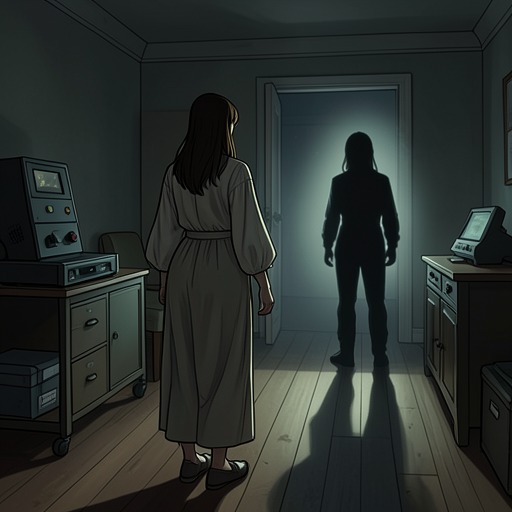
Carson does not leave the room empty-handed. Before touching the handle, she pulls a metal bat into her grip and holds it tightly, converting an ordinary household object into her only immediate defense. When the door opens, the light from her room projects a rectangular patch into the dark hallway. The limited illumination delays recognition: first the empty left side of the hall offers relief, then the right side reveals two reptilian eyes gleaming in the darkness. The architecture of the house briefly appears to promise safety, but the hallway becomes a narrow threshold through which the unknown enters Carson's domestic world.
The Attack
The creature initially exists as a partial shape, with its eyes visible before the rest of its body emerges. Carson screams, but the sound does not drive it away. Instead, the animal-like figure lurches forward until its scaly skin becomes visible. It resembles an overgrown lizard, stands taller than Carson, carries a long whipping tail, and bares rows of sharp teeth. The description moves from uncertainty to physical specificity without making the creature comprehensible: Carson can see its body clearly enough to fear it, yet still cannot identify what it is or what it wants.
Carson chooses confrontation over retreat. Looking down at the bat, she calculates that one strong strike to the head might stop the creature, then raises the weapon with both hands and urges it to come closer. The invitation provokes the attack. The lizard bolts toward her, and when it is less than two feet away, Carson swings. The bat connects solidly with its head, producing a sickening crack. The scene's apparent action logic is immediately overturned: an impact that should injure or disable the creature has no visible effect.
The creature's response is more unsettling than a simple counterattack. It halts and cocks its head, watching Carson as though it knows her. Rather than pursuing the advantage, it turns and scuttles up the wall, continues across the ceiling, enters Carson's room, and slips out through the window. Carson is left staring at the billowing curtains while the bat hangs uselessly at her side. The escape denies her both victory and explanation. The attack has been repelled only in the narrowest sense; the creature has withdrawn without being harmed, identified, or defeated.
From Intrusion to Investigation
The following day, Carson is still reeling from what crossed her ceiling and survived the metal bat strike. Werewolves are, by comparison, a threat she knows how to place within her existing understanding. A giant lizard creature that can invade a bedroom, absorb a blow to the head, climb walls and ceilings, and leave through a window exposes the limits of that knowledge. The incident therefore changes the supernatural investigation from a familiar conflict with werewolves into an inquiry about a new creature whose abilities and motives remain unknown.
The search eventually attaches the creature to the name Kanima, but the available information is frustratingly sparse. Carson tries combinations including the creature's name, its supposed shape-shifting nature, and the fact that it cannot swim. Internet searches produce almost nothing: no sightings, stories, or legends that explain the being confronting the group. Derek Hale has heard stories, yet those stories are not available through ordinary online research. The gap between Derek's knowledge and the empty search results makes the Kanima feel like a threat outside the accessible public record.
The investigation also turns toward the bestiary open on Stiles Stilinski's laptop. Its strange words mean nothing to Carson, and an online translator is unlikely to help when it cannot even handle her French homework correctly. A search result concerning a were-jaguar offers a possible lead, but it contains nothing relevant about a lizard and provides no reliable account of the creature at Carson's home. The group is left with a provisional name, scattered supernatural references, and the memory of a body that refused to obey ordinary physical expectations.
Trust, Preparation, and the Expanding Threat
The attack also changes the practical terms of the group’s response. Investigation is no longer limited to identifying what the creature might be; it requires finding something capable of restraining it. In the back room of the Beacon Hills veterinary office, Carson, Stiles Stilinski, and Scott McCall gather while Deaton prepares materials that could help them control the Kanima when they find it at the rave. Deaton presents a small bottle and a syringe-like device with a spring mechanism, explaining that the items will help with the Kanima problem. The equipment gives the investigation a concrete direction, but it also confirms how far the danger has advanced: the group is preparing for capture and containment rather than merely trying to understand a strange sighting.
Carson’s distrust and reliance on Deaton coexist. None of the three knows much about him, yet they follow an unspoken rule of trusting him more than many other people involved in the supernatural. His repeated assistance to Scott has established him as a dependable guide, even though his advice often arrives through riddles and incomplete explanations. The contrast is important to the lizard attack’s aftermath. Carson’s home has been breached by a creature that cannot be classified through ordinary searches, while Deaton’s veterinary office becomes a provisional command center where ordinary medical tools are adapted to an extraordinary threat.
Consequences for the Wider Conflict
The creature’s intrusion is not an isolated household scare. It becomes part of the larger Kanima crisis, a conflict serious enough that the group later speaks of taking down a mass-murdering lizard. The progression from a single nocturnal attack to a coordinated attempt to locate and restrain the Kanima enlarges the stakes without resolving the original mystery at once. Carson’s first encounter establishes the creature’s resilience and mobility; the later preparations answer those traits with specialized equipment and collective action.
The incident also separates the Kanima from the werewolves already familiar to Carson. Her earlier experience with werewolves and an Alpha gives her confidence in confronting danger, but the bat’s failure exposes the inadequacy of that confidence when applied to a different supernatural body. The Kanima does not merely threaten Carson; it invalidates the rules she thought she understood. Its ability to survive a head strike, climb vertical surfaces, and retreat through the ceiling and window turns the house from a place of protection into evidence that no familiar boundary can reliably contain the supernatural.
Narrative Significance
The attack functions as a threshold event. It begins with an ordinary domestic defense—the bedroom door, a patch of light, and a metal bat—but each object is rendered insufficient as the creature crosses into view. The hallway’s darkness withholds the threat until its eyes appear; the partial glimpse becomes a recognizable but still inexplicable body; and the decisive blow produces not safety but further uncertainty. The scene therefore makes knowledge, rather than physical survival alone, the central value at stake.
Carson survives, but she does not gain control. The creature leaves her with the unanswered question of what has entered her life and with proof that the existing supernatural vocabulary is incomplete. Later searches, the bestiary, Deaton’s equipment, and the group’s preparations all grow from that unresolved encounter. Homicidal lizard attacks Carson's home is significant because it converts the Kanima from a distant or theoretical possibility into a personal menace and sets the investigative machinery of the wider conflict in motion.