Jackson Whittemore
Holding Out for a Hero ▸ Stiles Stilinski (2)Jackson Whittemore occupies the story’s most dramatic space between performance and identity. He first appears as the effortlessly privileged athlete in a dark silver Porsche, dressed in a loose scarf and aviators, a figure who treats status as armor and other people as pieces on a social board. Yet the apparent certainty of that persona repeatedly breaks open: Jackson shows concern for Lydia, protects Matt in a moment of danger, confesses a long-suppressed attachment to Carson, and is ultimately forced through two deaths before returning as a werewolf. His decisive significance lies in the way the supernatural plot externalizes a human contradiction already visible in him: beneath the cruelty and self-display is a frightened, wounded teenager still searching for a connection strong enough to change him.
Identity and Public Persona
Jackson is established through conspicuous social and physical markers. His arrival at school is announced by the scream of the wheels of a familiar dark silver Porsche; moments later he steps out in a scarf and aviators, presenting himself as someone accustomed to being noticed. The car is not merely transportation but part of his public image, and its later reappearance as Jackson’s “infamous Porsche” turns that image into a recurring emblem of his recognizable place in Beacon Hills. He moves through the school with the confidence of an athlete whose wealth and popularity appear to make him untouchable.
That confidence is sharpened by his habitual contempt. When the group discusses Lydia’s disappearance and possible transformation, Jackson dismisses the situation with a crude remark about her taking a naked hike in the woods. He then rolls his eyes and argues that if Lydia is changing, she will be the person who does not need help. His language makes supernatural danger sound like an inconvenience and reduces the people around him to objects of ridicule. The contrast is important: Jackson does not initially lack awareness of the crisis so much as refuse the vulnerability that acknowledging it would require.
His hostility also places him within a network of suspicion and danger. When Stiles asks Danny where Jackson is, Jackson’s absence has already become relevant to the group’s investigation. Later, he is identified in connection with the Kanima mystery, and his own blunt question, “What the hell is a kanima?” marks a moment when the threatening name is still external to his understanding. The irony is that the creature being discussed is not simply an enemy operating near Jackson; Jackson himself is bound to the Kanima’s identity and violence.
Attachments Beneath the Cruelty
Jackson’s relationship with Carson exposes a history hidden beneath his public arrogance. He tells her that he noticed her as the popular, attractive girl who did not seem to care about status and who had remained friends with Scott and Stiles despite their low standing in the school hierarchy. He recalls hoping that her independence from status might make a relationship between them possible, and he traces that hope across seventh grade, eighth grade, and freshman year. The confession gives his behavior a different emotional contour: his interest was not a sudden response to the supernatural crisis but a long-standing desire for recognition that he had never managed to express successfully.
The confession also reveals Jackson’s sense of exclusion. He believes Carson gave chances to other boys while never giving him the opportunity he wanted, and he frames his frustration as the result of being overlooked rather than as a consequence of his own behavior. That self-justifying perspective does not erase the harm he has caused, but it shows that his cruelty is connected to an unstable need for affirmation. Jackson’s status protects him from being ignored in public while leaving him emotionally uncertain in private.
Carson’s later assessment makes the contradiction explicit. She acknowledges that Jackson has ruined lives, hurt people, and behaved as an “overall douche bag,” but also insists that he is a good person underneath the surface. She describes him as ice and Lydia as fire, suggesting that Lydia’s connection to him can melt the exterior he has built around himself. The image does not make Jackson innocent; instead, it defines his capacity for change as something relational. He does not transform through solitary self-knowledge. The people who remain connected to him force the buried person beneath the persona into view.
The Kanima Crisis
Jackson’s transformation into the Kanima turns his unresolved identity conflict into a public threat. The group discovers that the mass-murdering reptilian creature is being controlled, making the danger worse than an independent monster. The Kanima is already lethal, but the existence of a master means Jackson’s actions are shaped by a bond of domination and punishment. This distinction matters because the story separates the creature’s violence from the teenager’s full moral agency without making the consequences disappear.
The group attempts to contain the danger, but Jackson escapes while Stiles, Isaac, Erica, and Carson are supposed to be watching him. His escape reveals the limits of their control and intensifies the crisis: the Kanima is not safely confined, and the person directing it remains unknown. Jackson therefore becomes both victim and weapon, a body caught inside a supernatural system that others can exploit. His status as a popular student offers no protection once his physical form has become evidence against him.
Jackson’s remaining human instincts nevertheless appear in the middle of the violence. When Matt is pulled into danger, Jackson reaches in and drags him out. Matt looks at Jackson with shock while Jackson glares at the others as though they had tried to kill his brother. The act is startling because it cuts directly against the image of Jackson as someone concerned only with himself. His protection of Matt does not undo the Kanima’s murders, but it demonstrates that loyalty survives within the transformed body and that Jackson can still recognize a personal bond even while surrounded by fear and accusation.
The group’s uncertainty about Jackson is reflected in the questions that follow. Scott identifies him, and later news indicates that Jackson is still alive and able to move despite reports of his death. Messages describe goo covering him and indicate that the Argents are temporarily cooperating with the others. Stiles reduces the impossible situation to its simplest form by asking whether Jackson died and then ceased to be dead. The question captures Jackson’s narrative condition: he has become a contradiction that the ordinary categories of life, death, human, and monster cannot contain.
Lydia and the First Death
Jackson’s connection with Lydia becomes the emotional center of his final transformation. Others explain that she may be the one person with whom Jackson has a genuine connection, even though he has treated her badly. Her presence reaches a part of him that his wealth, popularity, and aggression keep frozen. Lydia is not presented as curing him through sentiment alone; rather, her ability to recognize and answer the vulnerable person beneath the Kanima makes possible a last return toward human choice.
At the confrontation, Lydia calls Jackson’s name as the reptilian creature approaches with one clawed hand raised. The creature’s features begin to recede. Scales still cover Jackson’s skin, and claws remain on his fingers, but his eyes lose their reptilian surface. He takes the key from Lydia’s fingers and looks back at her, responding to the significance of the exchange with a small movement of his head. That gesture functions as a final acknowledgment between them, a sign that the person inside the monster is present and understands her.
The acknowledgment does not save him immediately. Derek and Peter attack Jackson from opposite sides, driving their claws through his abdomen. Scott realizes that there is nothing he can do as the two Hales lift Jackson, withdraw their claws, and let him fall. Lydia cries out, and Jackson collapses while still trying to ask whether she continues to feel something for him. He falls forward into her arms before the key strikes the floor.
Jackson’s death is described not as the death of an abstract creature but as the death of a boy. The last scales disappear from his face, leaving a teenager who has been dealt the wrong card. Carson’s response emphasizes that he has now died twice in one night: the first death at the game feels distant and almost unreal, while this second body, held by Lydia amid the silence and her tears, makes the loss undeniable. The repeated death deepens rather than cancels the earlier one, turning Jackson’s apparent destruction into the emotional threshold for his final metamorphosis.
Resurrection and Werewolf Metamorphosis
Jackson’s apparent death is not the end of his trajectory but the violent threshold of a new identity. After Lydia lays him down, the room seems to settle into grief until the sound of nails scratching across the floor reveals movement. The detail is small and physical, refusing the comfort of a clean ending: Jackson’s hand moves before the rest of his body follows. Lydia turns in time to see his eyes open, and the group watches him rise beneath the light of Stiles’s Jeep.
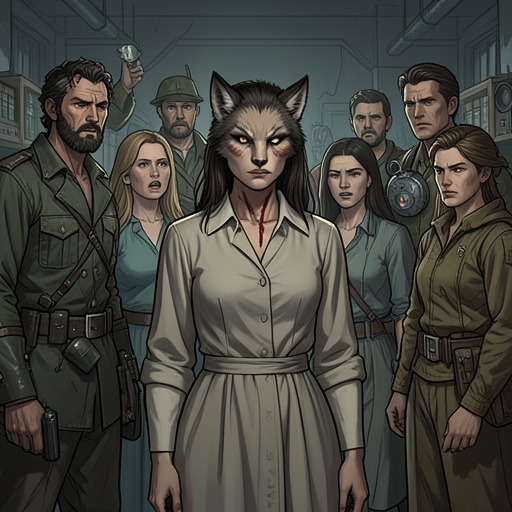
His revival is also a full transformation. Jackson arches his back as the remaining human form gives way to a wolf, his eyes glowing bright blue while a howl breaks through the room. The claws eventually retract, and his human face returns, but the reversal does not restore the old Jackson. He stands as a newly made werewolf, carrying visible proof that death, Kanima violence, and supernatural manipulation have not erased him but have forced him into another kind of existence. The transformation is startling precisely because it follows two apparently final deaths and because Jackson’s body, once used as the site of someone else’s control, now expresses a different supernatural condition.
Lydia responds by rushing into his arms, and Jackson holds her tightly. The embrace completes the emotional movement that began with her calling his name: recognition becomes contact, and contact becomes a bond that survives the boundaries between monster and boy. The others watch the new werewolf and Lydia together, making Jackson’s return both a private reunion and a public confirmation that he has crossed into a new state.
Relationships, Rivalries, and Recognition
Jackson’s relationship with Lydia is defined by contradiction. He has treated her harshly, yet the narrative identifies her as the person with whom he has a real connection. His earlier dismissal of her possible transformation therefore acquires retrospective irony: the boy who claims not to care about her danger is ultimately drawn back toward her recognition. Lydia’s presence does not simply comfort him after the crisis; it reaches him when every external marker of his former identity has failed.
His connection with Carson is older and more complicated. Jackson remembers watching her choose friendship with Scott and Stiles over the status hierarchy he understood so well, and he interprets her refusal to choose him as a missed opportunity rather than a judgment on his conduct. Carson, however, can hold both sides of him in view. She remembers the lives he has damaged and the people he has hurt, while still recognizing that goodness remains beneath the cruelty. Her description of his frozen exterior gives language to the pattern governing his relationships: Jackson performs indifference until someone’s loyalty makes indifference impossible to maintain.
Jackson’s bond with Matt reveals another buried capacity for attachment. During the crisis, he rescues Matt from danger and then glares at the people around him as though they had threatened his brother. The response is protective rather than performative. It exposes a Jackson capable of care even while the Kanima identity makes him appear to be an instrument of indiscriminate violence. His protectiveness does not absolve him, but it prevents the supernatural plot from reducing him to a single monstrous function.
His place among Scott, Stiles, Isaac, and Erica is consequently unstable. They investigate him, watch him, attempt to contain him, and fear the consequences when he escapes. Scott identifies Jackson as the Kanima, while Stiles and the others confront the practical danger of a creature whose controller remains unknown. Yet the same group also reacts to Jackson’s apparent death with grief and disbelief. Carson admits that she hates him but remembers him as one of her best friends when they were younger, making his loss painful even after his misconduct and violence. Jackson remains both suspect and friend, threat and victim.
Change and Narrative Significance
Jackson’s arc follows a metamorphosis plot, but its decisive change is not merely biological. The Kanima gives physical form to the conflict between the identity Jackson performs and the person he cannot entirely suppress. His status-conscious persona, represented by the Porsche, scarf, aviators, contemptuous jokes, and habitual dismissal of vulnerability, is repeatedly contradicted by attachment: his long desire for Carson’s attention, his protection of Matt, and his response to Lydia.
The two deaths intensify that contradiction through repetition. At the game, Jackson’s body appears dead in a way that feels almost unreal, as though the group were witnessing an image rather than a human loss. Later, after Derek and Peter kill him, the scene becomes painfully concrete: the scales recede, Lydia holds him, and Carson recognizes that this death is real. The scratching hand and sudden revival then transform grief into astonishment. Jackson does not simply survive; he returns altered, making the second death retrospectively part of a passage rather than a conclusion.
His blue-eyed werewolf form also carries a moral and symbolic contrast with the Kanima. The Kanima body is associated with control, paralysis, punishment, and murderous compulsion, while Jackson’s revival culminates in an embrace he actively returns. The narrative does not claim that becoming a werewolf resolves every consequence of what happened to him. Instead, it gives him a new condition in which agency and connection may become possible. His final movement is therefore from being acted through by an unseen master toward being recognized by Lydia and accepted in his altered form.
Jackson’s ending preserves the damage rather than erasing it. He has ruined lives and hurt people; those facts remain part of Carson’s judgment and the group’s fear. At the same time, the final image refuses to leave him as only a killer or a victim. The boy who seemed sealed inside an arrogant public performance emerges alive, transformed, and held by the person capable of reaching him. Jackson Whittemore’s narrative importance lies in that unresolved but meaningful survival: the story turns a socially dominant teenager into a supernatural captive, lets human loyalty break through the creature’s surface, and ends by granting him not normality but the possibility of becoming someone other than the role imposed on him.