Jackson Whittemore restraining order
Holding Out for a Hero ▸ Stiles Stilinski (2)Jackson Whittemore restraining order is a formal fifty-foot separation rule that converts a volatile conflict into an institutional command. Issued after Carson Bradley, Stiles Stilinski, and Scott McCall are accused of misconduct involving Jackson, it forbids contact while requiring the students to remain inside the same school system. The order therefore does more than regulate distance: it turns an already dangerous supernatural investigation into a problem of surveillance, paperwork, and forced proximity.
Issuance and Terms
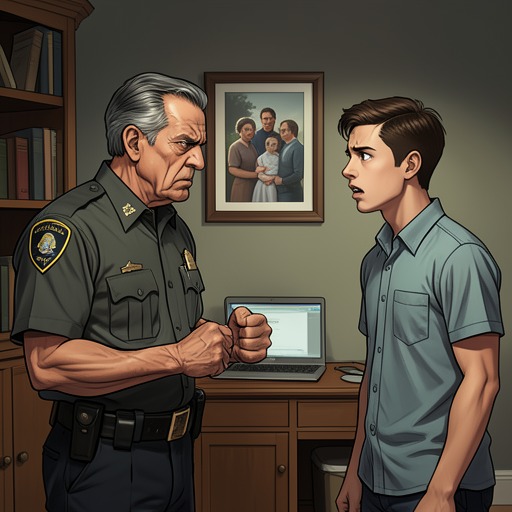
The order is read aloud by Sheriff Stilinski while Carson, Stiles Stilinski, and Scott McCall sit together in distress. Jackson’s father has chosen the restraining-order route, and his visible satisfaction intensifies the humiliation and anger in the room. The rule is precise: the three are not to come within fifty feet of Jackson Whittemore, speak to him, approach him, or assault or harass him either physically or psychologically. Its language treats the conflict as a conventional legal dispute even though the surrounding circumstances involve the Kanima investigation and threats far beyond an ordinary school quarrel.
The order also places Carson, Stiles Stilinski, and Scott McCall under a behavioral burden. They understand that they have made a serious mistake and that any further confrontation could worsen their position. Carson’s anger remains active rather than resolved; the restraint is externally imposed, not the result of reconciliation. The document consequently creates a tension between legal compliance and the characters’ continuing conviction that Jackson is connected to an emergency that cannot safely be ignored.
School Life Under Forced Distance
The rule is immediately difficult to apply because Jackson Whittemore and the accused students attend the same school. When Stiles Stilinski asks what happens at school, Sheriff Stilinski explains that they will still take classes while maintaining a fifty-foot distance. The answer preserves ordinary education only by making ordinary movement nearly impossible: classrooms, corridors, and shared facilities become spaces that must be navigated according to an invisible perimeter.
The order is treated with uneasy humor in detention. Jackson Whittemore points out that he has a restraining order against the other students, while Mr. Harris questions whether that means all of them. Carson responds that the order concerns only the three students, identifying herself, Stiles Stilinski, and Scott McCall as the prohibited group. The exchange does not dissolve the threat; it shows how adolescent sarcasm becomes a pressure valve for a rule whose severity is difficult to reconcile with the school setting.
The wider school environment reinforces the order’s atmosphere of scrutiny. At the library, Carson notices large white cameras positioned throughout the campus, including the hallways, classrooms, cafeteria, pool, and gym. The cameras are connected to the effort to keep Allison Argent and Scott McCall apart, but they make the fifty-foot order feel like part of a broader regime in which students are expected to regulate themselves because they may be watched at any moment. Even before Carson is pulled into an aisle, the school has become less a shared public space than a monitored field of prohibited approaches.
Conflict with the Supernatural Investigation
The order’s central contradiction is that Jackson Whittemore is not merely an aggrieved classmate. The students are trying to understand and contain the Kanima, a shape-shifting creature whose identity and behavior remain difficult to trace. Carson searches online for information about the Kanima and finds almost nothing: no useful sightings, stories, or legends, only an uncertain possible lead involving a were-jaguar. This investigative work places her and her allies in a position where contact with Jackson may be dangerous, necessary, or both, while the order declares contact itself unlawful.
That contradiction is visible in the group’s preparation at the Beacon Hills veterinary office. Deaton provides equipment intended to help with the Kanima problem, including a small bottle and a spring-loaded syringe. Carson, Stiles Stilinski, and Scott McCall trust Deaton because he repeatedly helps Scott in supernatural emergencies, even though they know little about him. Their preparations show that the group’s objective is not simply to confront Jackson in anger; they are assembling means to restrain a threat. The restraining order nevertheless places every attempted intervention under the risk of being interpreted as prohibited contact.
The order also collides with the institutional response to violence. Later, Matt Daehler holds people at the police station at gunpoint, handcuffing Sheriff Stilinski to a bench and forcing Stiles Stilinski to participate while Carson and Scott stand nearby. The earlier legal restriction has no power to protect anyone in that crisis. Its ordinary bureaucratic logic is overwhelmed by a hostage situation in which proximity is dictated by the captor, not by the court or the family that requested the order.
Practical Effect and Narrative Significance
Jackson Whittemore restraining order functions as both a rule and a symbol of failed containment. It attempts to impose a measurable boundary on people whose lives are already governed by shapeshifting, paralysis, violence, and hidden identities. The number fifty offers an appearance of control, but the school scenes expose how fragile that control is: the prohibited parties continue to share classes, detention, investigations, and crises.
The rule also redistributes power. Jackson’s father uses legal procedure to place Carson, Stiles Stilinski, and Scott McCall on the defensive, while the students must manage their anger under official observation. Yet the order cannot settle the underlying conflict or answer the supernatural questions driving the investigation. Its lasting significance lies in that mismatch. A legal boundary can dictate where the students stand and what they say, but it cannot make Jackson Whittemore’s danger disappear, cannot prevent institutions from becoming sites of violence, and cannot turn a supernatural emergency into an ordinary disciplinary case.