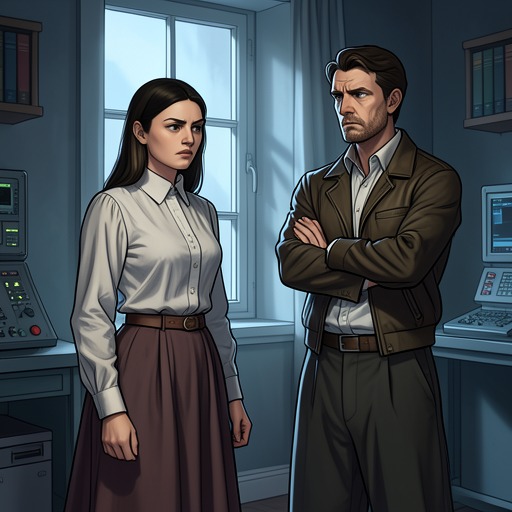
Jackson Whittemore–Lydia Martin relationship
Holding Out for a Hero ▸ Stiles Stilinski (2)The Jackson Whittemore–Lydia Martin relationship is one of the story’s most unstable intimate bonds: a romance marked by status, cruelty, jealousy, separation, and an emotional loyalty that survives even after Jackson becomes the Kanima. Its decisive significance lies in the contrast between Jackson’s public behavior and his private attachment to Lydia. He repeatedly hurts her, yet when violence closes around him, she remains the person whose safety he cannot stop caring about.
Formation and Rivalry
Jackson’s connection with Lydia exists alongside his earlier relationship with Carson Bradley, which makes the later pairing part of a chain of adolescent loyalties and wounds rather than an isolated romance. Jackson eventually breaks up with Carson for her best friend, Lydia Martin. Carson remembers the betrayal as painful but final, saying that she and Jackson were simply bad together; by contrast, she describes Jackson and Lydia as an “Epic” match because their constant fighting conceals a deeper investment in one another.
Jackson’s social confidence gives the relationship a competitive surface. He treats Carson’s former place in his life as something he can reclaim, even approaching her with the assumption that she owes him a date because he had once wanted her. Carson rejects that entitlement and makes clear that Stiles Stilinski is her boyfriend. Her response also clarifies the relational contrast: Jackson seeks validation through popularity and control, while Lydia is bound to him through a more painful, reciprocal history.
Separation and Supernatural Exposure
The relationship is strained further when Jackson becomes entangled with the Kanima. During the investigation into the creature, Jackson is questioned about the first full moon and insists that nothing happened. His evasiveness contributes to the uncertainty surrounding his identity, while his position as the Kanima’s apparent target, witness, or possible victim complicates the question of how much responsibility belongs to Jackson himself.
Lydia is also drawn into the investigation. Jackson hears that others intend to test her for Kanima venom, and the possibility that Lydia might be connected to the creature alarms Carson. The uncertainty matters because the relationship is no longer confined to school romance: Lydia’s body, memory, and safety become part of the supernatural crisis, while Jackson’s own monstrous identity threatens the person who remains emotionally connected to him.
Their separation becomes literal and terrifying when Lydia disappears from Beacon Hills Hospital. Carson finds the shower still running, pushes aside the curtain, and discovers that Lydia is gone; there is no connecting room or obvious route by which she could have left. The scene turns disappearance into the governing image of the relationship. Lydia is repeatedly made unreachable, while Jackson remains emotionally present only through traces, evasions, and consequences.
Jackson’s Hidden Attachment
Jackson’s cruelty does not erase his attachment to Lydia; instead, the crisis forces it into language. Before the final confrontation, he grabs Carson’s hand and asks her to make sure Lydia is safe. Carson challenges him about the contradiction between that concern and the pain he has inflicted on Lydia. Jackson can barely answer, but he admits through his reaction that Lydia matters to him.
Carson tells him that Lydia still cares about him even though she will not admit it. Jackson’s response is not triumphant. He says that she should not care, recognizing that his treatment of her has made her affection undeserved rather than guaranteed. This exchange changes the relationship’s emotional meaning: beneath the insults and destructive behavior is not a healthy romance, but neither is there simple indifference.
Carson interprets Jackson as divided between an armored exterior and a more vulnerable interior. She calls him “ice” and Lydia “fire,” arguing that Lydia is the one person who has ever reached the person beneath his hardness. The image explains both the attraction and the damage. Jackson’s defenses make him controlling and cruel, while Lydia’s emotional force threatens to expose the dependence he tries to conceal.
Carson ultimately tells Jackson that he and Lydia are “Epic,” despite their fighting, because Lydia is the person he has cared about most deeply. She also separates Jackson’s moral identity from the Kanima’s violence, saying that whether he is the Kanima or not, she does not believe he will hurt Lydia. That judgment is a crucial act of recognition: Jackson is not absolved, but he is treated as capable of choosing against the weaponized identity imposed on him.
Crisis, Recognition, and Loss
Lydia’s continuing attachment is visible when she watches Jackson on the lacrosse field with sadness. She sits beside Carson and Sheriff Stilinski, visibly out of place among the adults, while her attention remains fixed on Jackson. Carson attempts to speak with her about him, but Lydia redirects the conversation toward Carson’s troubles with Stiles, revealing the mutual pattern of concealment: both girls care about damaged relationships while avoiding direct admission of their own pain.
Jackson’s concern for Lydia becomes especially significant because he is being used as a weapon in Gerard Argent’s scheme. Carson understands that Jackson is an ass but not a murderer, and that the Kanima’s actions are connected to his being made a puppet in Gerard’s cruel game. The relationship therefore becomes part of a larger conflict over agency. Jackson’s violence is real, but his bond with Lydia gives the story evidence that the creature has not completely erased the person inside it.
The relationship reaches its darkest point during the lacrosse game. Jackson is found motionless on the field, with massive claw marks across his body, while Lydia pushes through the crowd and stops at the sight of her ex-boyfriend. Melissa McCall tries to revive him and reports that he is not breathing. Carson concludes that Jackson is dead, and Lydia is left confronting the apparent loss of the person who has repeatedly broken her heart.
The apparent death does not resolve the relationship into closure. Instead, it freezes Jackson and Lydia at the point where his hidden care has finally been recognized but cannot yet be repaired. Jackson’s last expressed priority is Lydia’s safety; Lydia’s visible grief confirms that his cruelty never made him emotionally irrelevant. Their bond ends this phase not with reconciliation, but with a tragic convergence of love, harm, supernatural coercion, and loss.
Narrative Meaning
The Jackson Whittemore–Lydia Martin relationship dramatizes the difference between attachment and ethical intimacy. Jackson is capable of wanting Lydia, fearing for her, and recognizing that she still cares, but those feelings do not prevent him from humiliating or hurting her. The story refuses to treat emotional intensity as proof of relational health. Their bond is powerful precisely because it contains incompatible truths: Jackson is both cruel and vulnerable, Lydia is both wounded and attached, and their fighting is both destructive and evidence of continued investment.
The relationship also serves as a test of identity under supernatural pressure. Jackson’s transformation externalizes the violence and defensiveness already present in his social persona, while his plea concerning Lydia reveals a self that the Kanima’s programming cannot entirely suppress. Carson’s intervention gives that contradiction a moral shape: she neither forgets what Jackson did nor reduces him to it. In the resulting portrait, Lydia is not merely a former girlfriend or a victim of Jackson’s behavior; she is the person through whom his buried capacity for care becomes legible, even at the moment when the relationship seems lost.