Kate Argent
Holding Out for a Hero ▸ Stiles Stilinski (2)Kate Argent is a werewolf hunter whose death functions as both an ending and an ignition point. She is laid to rest after a violent end, but the funeral does not close the damage associated with her life: revelations about her arson and killings stain the Argent family’s public standing, while her death clears the way for Gerard Argent to declare war. Kate therefore remains a decisive presence after death, shaping the loyalties, secrecy, and escalating violence that define the next phase of the story.
Identity and Reputation
Kate Argent is identified through the combined roles of hunter, killer, arsonist, and Allison Argent’s aunt. The account does not present her as an ordinary member of the Argent family’s hunting tradition. Instead, it emphasizes the violence attached to her name and the consequences of her actions. Her death is described as violent, and her acts of arson become sufficiently known to turn the Argent family into social pariahs. The family’s loss of status is not caused simply by mourning or by the supernatural conflict; it follows from the public exposure of what Kate did.
Kate’s reputation also stands in contrast to the outward formality of her burial. At the funeral, the Argent family gathers in a small gated section of Beacon Hills Cemetery before Kate’s grave, surrounded by hundreds of photographers and journalists. Allison sits with her family, Mrs. Argent wears a fur coat, Mr. Argent stands to the side, and an unidentified elderly man with snow-white hair is protected by two men resembling secret-service agents. The scale of the press presence makes the funeral a public spectacle rather than a private farewell. It places Kate’s death at the intersection of family ritual, media attention, and social judgment.
Death and Its Immediate Consequences
Kate’s death follows the end of the violent period associated with her actions. Her burial occurs alongside the broader upheaval created by Peter Hale’s death and Derek Hale’s rise as an Alpha. Peter’s murders have stopped, but Derek has begun turning teenagers into werewolves, while the Argent family is absorbing the consequences of Kate’s crimes. The narrative thus places Kate’s death within a transfer of power: one dangerous figure is gone, another leader rises, and the hunter family is forced to confront the public cost of its own violence.
For Allison Argent, the funeral carries a personal contradiction. Kate is her aunt, so the loss is genuinely painful, yet Kate also killed people. Before the ceremony, Allison removes the dress prepared for the funeral from a sealed plastic garment bag while trying to fake happiness and keep herself from breaking down. The scene refuses to separate grief from moral knowledge. Allison is not asked to mourn an innocent relative; she must face the death of a family member whose legacy includes lethal wrongdoing.
The funeral is also secretly infiltrated by Carson Bradley, Stiles Stilinski, Scott McCall, and Allison Argent’s allies. Carson and Stiles find the crowd while looking for Scott and see the Argent family assembled before Kate’s grave. Their presence turns the ceremony into an uneasy meeting point between the hunters and the people resisting them. The public setting offers visibility, but it also heightens the danger of discovery, since journalists and photographers surround the family and make secrecy difficult.
Family Conflict and the War Afterward
Kate’s death does not end the Argent–werewolf war. It changes its emotional and political conditions. The account explicitly presents Gerard Argent as the new and more volatile threat: he does not resemble an ordinary werewolf hunter, yet he is described as the most dangerous of them all, and he declares war. Kate’s removal therefore produces no reconciliation. Her absence becomes a vacancy that Gerard fills with a more aggressive form of hostility.
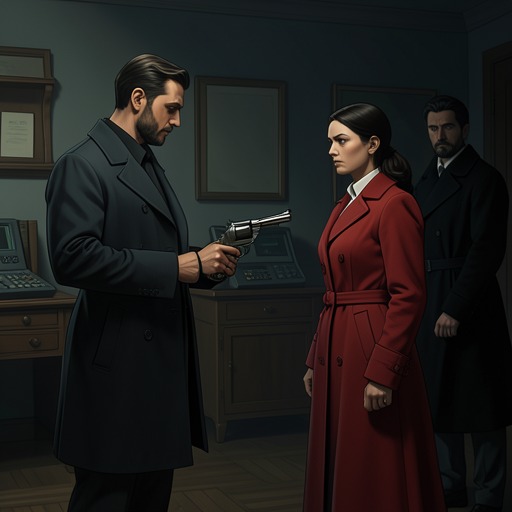
Her influence also persists through the damage inflicted on Allison Argent’s relationship with Scott McCall. After the Alpha confrontation, Allison and Scott can no longer meet openly. They begin sneaking around, but Mr. Argent discovers what they are doing, follows them, holds a gun to Scott’s head, and forces Allison to break up with him. The pressure placed on the young couple is part of the larger hunter-family opposition that Kate’s legacy helps define. Although Allison and Scott refuse to end their relationship and become even more careful, only Carson Bradley and Stiles Stilinski are trusted with the secret. Kate’s death thus exists beside a continuing family structure in which love across the hunter-werewolf divide remains dangerous.
The funeral’s formal gathering makes that structure visible. Allison is seated beside her family, while the older generation occupies positions of authority and surveillance around the grave. The event presents the Argent family as a collective body, even as Kate’s exposed crimes have made that body socially suspect. Public disgrace and private solidarity coexist: the family has been marked by Kate’s actions, but it still controls the ceremony and remains capable of organizing a new campaign.
Narrative Function and Thematic Significance
Kate Argent is a posthumous catalyst. The story opens in the aftermath of recent deaths and transformations, and her burial helps establish that the apparent resolution of one conflict is actually the beginning of another. Peter Hale is dead, Derek Hale has become an Alpha, Kate has been buried, and Gerard Argent has declared war; the sequence converts closure into escalation. Kate’s death is therefore less a full stop than a hinge between phases of the plot.
Her characterization is deliberately compressed around a single, powerful contradiction: she is mourned as family while remembered as a perpetrator. That tension is concentrated in Allison’s funeral preparations, where the attempt to appear happy masks grief that cannot be cleanly separated from judgment. The funeral itself extends the contradiction into public space. Hundreds of journalists and photographers turn private mourning into spectacle, while the gated cemetery section suggests that the family is simultaneously displaying and enclosing its history.
Kate’s legacy also helps blur the story’s moral boundaries. Werewolves, hunters, relatives, and teenagers are not divided into simple categories of innocence and guilt. Kate is a hunter who committed violent acts; the Argent family suffers social consequences because of her; Gerard responds not with accountability but with war; and Allison remains emotionally tied to the family while secretly loving Scott. Kate’s decisive significance lies in this chain of consequences: her death removes her body from the action, but her violence continues to determine how other characters grieve, hide, choose sides, and prepare for the next confrontation.