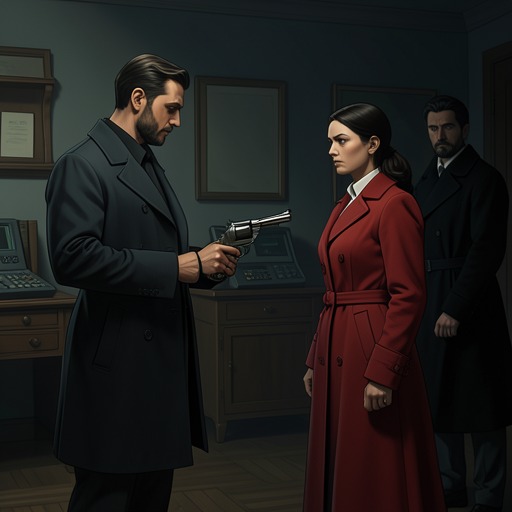
Kate Argent's arson
Holding Out for a Hero ▸ Stiles Stilinski (2)Kate Argent's arson is the defining act of violence associated with her final criminal legacy: an attack that links the Argent family’s hunter identity to deliberate destruction and supernatural danger. Its aftermath turns the family into social pariahs, leaves Kate dead and publicly condemned, and creates the conditions for Gerard Argent to declare war while a new, more enigmatic killer emerges in the resulting chaos.
Background and Motive
Kate’s actions belong to the period after Peter Hale’s death and Derek Hale’s rise as an Alpha. Peter’s murders have ended, but Derek is rapidly creating teenage werewolves, so the supernatural conflict is not actually subsiding. Against that unstable transition, Kate’s arson functions as the human side of the crisis: her violence is not merely a private offense but part of the hunter-werewolf war that makes Beacon Hills increasingly difficult to divide into simple heroes and villains.
The available account identifies Kate as a violent hunter whose acts included arson and whose end was itself violent. It does not provide a separate scene explaining how the fire was planned or what location it destroyed, but it makes the causal outline clear: Kate’s conduct becomes known, her family’s reputation collapses, and the exposure of her actions changes how the town understands the Argent name.
Exposure and Public Consequences
Kate’s arson is discussed as evidence against the Argent family after her death. The family is turned into social pariahs, showing that the consequences extend beyond Kate’s personal guilt. The stigma attaches to the household and to the hunter identity it represents, transforming a once-feared lineage into a publicly distrusted one. This social reversal is crucial: the Argent family is no longer able to appear simply as an institution protecting ordinary people from monsters, because one of its own members has been associated with arson and violent supernatural attacks.
The consequences also reach the high school. Harris treats the revelation surrounding Kate as a disciplinary matter and keeps Stiles Stilinski in detention because Stiles’s father failed to tell the police that he had told Kate how to get away with arson. The incident therefore enters an institutional chain involving police information, school discipline, and adult authority. Gerard Argent’s first day as the school’s new principal intensifies that chain: he announces that students will be made to take the fall and remain in detention, while his attention settles on Stiles Stilinski and Carson Bradley. Kate’s crime thus survives her death as a source of pressure on the teenagers who know what happened.
Family, Funeral, and the Hunter War
Kate’s funeral gives the exposure a public and familial setting. Allison Argent prepares formal clothing for the ceremony while attempting to conceal her grief, despite Kate’s record of killing people. That contrast captures the divided meaning of Kate’s death: she remains Allison’s aunt and a member of the family, but the family can no longer mourn her without also confronting the violence attached to her name.
Gerard’s emergence after Kate’s death turns the aftermath into a new phase of conflict. He does not present himself as an ordinary werewolf hunter; he is described as the most volatile of them all, and he declares war. Kate’s arson therefore does not end the hunter threat. Instead, it helps expose the extremity within the Argent family and provides the political and emotional ground on which Gerard can assume a more aggressive role.
Narrative Function and Significance
The arson marks a shift from concealed supernatural danger to publicly discredited human power. Its consequences blur the line between good and evil: Derek Hale’s teenage werewolf pack, Gerard Argent’s hunter campaign, and the unidentified killer operating in the shadows all arise within the same destabilized moral landscape. The act is significant less as an isolated fire than as a breach whose effects spread through family reputation, school authority, police procedure, and the wider conflict between hunters and werewolves.
Kate’s violent legacy also helps explain why ordinary protective rules begin to fail. Teenagers are detained, police vehicles are stolen to contain Jackson Whittemore, and a gunman later forces Carson Bradley through a hallway while threatening to take hostages. These later emergencies are not presented as direct results of the fire, but they belong to the same atmosphere of institutional breakdown and exceptional violence. In that atmosphere, Carson Bradley’s bond with Stiles Stilinski becomes a stabilizing counterforce, while Kate’s arson remains the emblem of how quickly protection can become persecution and family duty can become war.