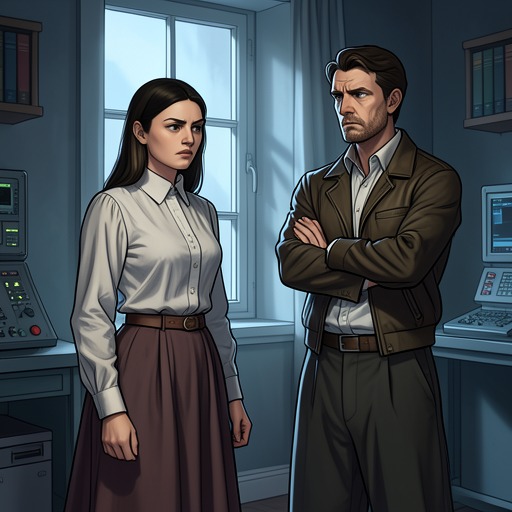
Lydia Martin
Holding Out for a Hero ▸ Stiles Stilinski (2)Lydia Martin is one of the story’s most important points of contact between ordinary teenage life and the supernatural world. Her apparent survival after Peter Hale’s bite makes her body a mystery, while her disappearance, visions, emotional intensity, and knowledge of Jackson Whittemore place her at the center of the Kanima crisis. She is not merely rescued by the group: at the decisive moment, Lydia recognizes Jackson when everyone else sees a monster, and her recognition helps bring him back.
Identity and Introduction
Lydia enters the narrative as one of Carson Bradley’s best friends and as a hospitalized survivor whom Carson visits despite an intense dislike of hospitals. Her importance is immediately personal rather than merely investigative: Carson goes because Lydia is there. At the hospital, Ms. McCall observes that Lydia is healing well, but the recovery does not follow the expected supernatural pattern. Peter Hale has described the Alpha bite as a choice between transformation and death; Scott McCall’s bite healed within a day, restoring his skin. Lydia’s wound, by contrast, begins to scab like an ordinary human injury, and she remains alive. This apparently mundane healing becomes a disturbing contradiction, suggesting that Lydia does not fit the established categories of victim, werewolf, or corpse.
That contradiction is followed by absence. Lydia is simply reported gone, and later the group still has no idea what happened to her. Her disappearance converts a medical mystery into a crisis of identity and location: the question is no longer only what Peter Hale’s bite has done to her, but where Lydia has gone and what may be acting through or around her. The story repeatedly places her between visibility and concealment, present as a friend one moment and absent at the moment when her knowledge is most needed.
Supernatural Exposure and Bodily Mystery
Lydia’s supernatural significance develops through signs that she cannot initially control or explain. When Carson encounters a message from Lydia late at night, the timing is unusual enough to provoke concern, especially because Lydia normally protects her sleep and personal boundaries. Later, Lydia appears at the front of a classroom in tears, gripping a piece of chalk while words in her handwriting cover the blackboard. The writing looks backward and unreadable, turning her own hand into an instrument of an unknown force. Her body produces evidence before she can interpret it herself.
The group also learns that Lydia may be connected to the Kanima investigation in a way they do not understand. Stiles Stilinski reports hearing that the so-called graveyard kid intends to test Lydia, and the prospect of such a test makes her body an object of supernatural examination. The uncertainty is sharpened by the creature’s repeated attacks and by the near-total absence of useful information online. Carson’s searches for the Kanima, its legends, and even a giant lizard that cannot swim yield almost nothing, while the bestiary contains words the group cannot translate. Lydia therefore occupies a crucial evidentiary position: her experiences are real and visible, but their meaning is withheld until the group learns how to read them.
Her supernatural exposure does not erase her connection to ordinary social life. Lydia remains associated with clothes, parties, popularity, and the rituals of adolescence. Carson follows the strawberry blonde up Allison Argent’s stairs while questioning the need for so many dresses, and Lydia later opens the Martin house door holding a tray of pink drinks with an unimpressed expression. These domestic and social images contrast with the blackboard writing, hospital wound, and monster attacks. Lydia’s character is built from that tension: the polished social persona and the increasingly undeniable evidence that her life has become entangled with forces beyond ordinary explanation.
Relationships and Emotional Position
Lydia’s central emotional relationship is with Jackson, even after their romantic relationship has ended. She retains a key to Jackson’s house, an object associated with their private access and continuing intimacy. Carson understands the key as something Jackson gave Lydia to make late-night visits easier, but its significance becomes much larger when Lydia uses it during the final confrontation. The object carries a memory that survives Jackson’s transformation more effectively than threats, weapons, or explanations.
Carson also serves as Lydia’s close friend and emotional witness. Lydia appears at the lacrosse championship and sits beside Carson and Sheriff Stilinski, visibly out of place among the adults and separated from the social world of the snobbish girls who once surrounded her. Carson notices Lydia watching Jackson on the field with sadness and recognizes that Jackson is concealing feelings he should confess. Their friendship is reciprocal even when their concerns differ: Carson tries to address Lydia’s pain about Jackson, while Lydia turns the conversation toward Carson’s problems with boys. Lydia’s sharp social awareness and Carson’s protective loyalty give their friendship an ordinary language for emotions that the supernatural plot keeps making extraordinary.
The story also places Lydia within the wider network surrounding Scott McCall, Stiles Stilinski, Allison Argent, Derek Hale, and Peter Hale. When the group realizes that something is wrong with Jackson and that he may still be alive, they urgently insist that Lydia must be found. Derek and Peter have a plan, but the plan depends on Lydia’s presence. This dependence reveals that Lydia is not peripheral to the investigation: her personal history with Jackson is itself the missing instrument needed to interpret the Kanima’s behavior.
Recognition of Jackson and Restoration
The decisive movement of Lydia’s arc begins when Carson, Stiles, and the others go to retrieve her. The group believes the emergency requires immediate action, and Lydia arrives with the key to Jackson’s house hanging from a chain. She also admits that the others have been keeping supernatural matters from her, noting the archaic Latin book Allison had asked her to translate and acknowledging that strange things have been happening to her. Lydia is therefore no longer entirely excluded from the hidden world; she recognizes the pattern of secrecy around her and understands that her own experiences are part of it.
When the Kanima appears, Lydia refuses to remain safely behind the others. The creature shrieks at her and raises a clawed hand, but she approaches it while Carson and Stiles try to manage the danger. Lydia calls out to Jackson, and instead of following Carson’s orders she produces the key. The Kanima stops and stares at the small piece of metal. Its reaction suggests memory: the light catches on the key, and the creature seems to recognize it. Lydia’s knowledge of Jackson is expressed not through supernatural power but through an intimate material sign that the monster cannot completely suppress.
The recognition produces a physical reversal. Reptilian features begin to disappear, and Jackson stands before the group, still scaled and clawed but no longer fully defined by the Kanima form. He takes the key from Lydia and looks back at her. When he collapses, Lydia catches him and lowers him to his knees while he struggles to breathe. The scene makes her response active and bodily: she does not simply identify him from a distance but moves toward him, supports him, and remains beside him through the immediate aftermath of the transformation.
Her emotional confession completes the restoration. Lydia repeatedly tells Jackson that she still loves him, and the repetition conveys both urgency and the difficulty of forcing feeling into the open after prolonged concealment. For perhaps the first time, she breaks down openly in front of the group, crying as she tries to keep herself together. Jackson then opens his eyes and rises, transforming into a wolf with brilliant blue eyes before returning to his human face. Lydia rushes into his arms, and he holds her tightly. The embrace does not erase the danger or simplify their history, but it establishes recognition and love as the forces that reconnect Jackson to a human identity after the Kanima has made him appear irretrievably other.
Narrative Role and Significance
Lydia’s narrative role rests on the contrast between what the group can diagnose and what she can recognize. Medical observation cannot explain why she survives Peter Hale’s bite in an apparently human way. Internet searches cannot explain the Kanima. The bestiary cannot be read. Even the visible creature cannot be understood through appearance alone. Lydia’s knowledge is initially fragmented into wounds, disappearances, backward writing, emotional distress, and unexplained events, yet those fragments eventually become the basis for an accurate recognition.
Her arc also gives the Kanima conflict an intimate rather than purely tactical resolution. The creature is not defeated by superior force in the final encounter; Jackson is reached through a key associated with Lydia and through her direct acknowledgment of their continuing bond. Lydia’s role demonstrates that the monster’s identity remains relational. The Kanima’s body appears alien, but its response to the key reveals a buried continuity with Jackson, and Lydia is the person capable of perceiving that continuity.
By the ending, Lydia has moved from passive medical mystery to informed participant and emotional agent. She understands that the group has concealed the supernatural from her, recognizes that her own strange experiences matter, risks approaching the Kanima, identifies Jackson, physically helps him after his collapse, and openly declares her love. Her significance lies in this combination of social intelligence, embodied vulnerability, and emotional courage: Lydia is the character who sees the person inside the monster and makes that recognition consequential.