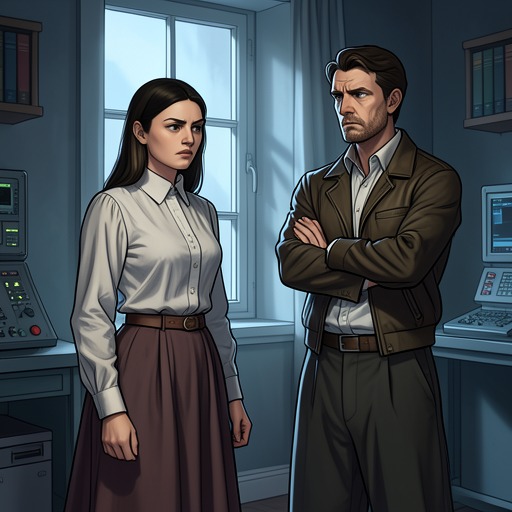
Lydia used the key to bring back Jackson's humanity
Holding Out for a Hero ▸ Stiles Stilinski (2)Lydia Martin’s key intervention is the decisive recognition scene in which Jackson Whittemore’s human identity begins to break through his Kanima form. During a violent confrontation, the key becomes more than an object: it is a private token of memory that the transformed Jackson can still recognize, allowing Lydia to reach him when commands and force cannot.## Circumstances and Immediate Threat The intervention occurs after the Kanima has leapt onto the hood of the vehicle carrying Lydia Martin, Stiles Stilinski, and Carson Bradley. The creature’s arrival turns the vehicle into a trap, and Lydia’s first instinct is not safety but recognition: she approaches the reptilian figure rather than remaining with the others. Carson Bradley orders her to run and grabs her shoulders, but Lydia does not follow. Her refusal places her directly between the creature’s raised claw and the possibility of recovering Jackson Whittemore.
The scene is shaped by a sharp contrast between ordinary rescue procedure and personal attachment. Stiles Stilinski runs toward Scott McCall, while Carson Bradley tries to pull Lydia Martin away from danger. Lydia instead produces the key she had been handling earlier. The group has been confronting a creature defined by paralysis, violence, and physical transformation; Lydia answers that threat with an object connected to Jackson’s human past.
The Key as Recognition
When Lydia Martin holds out the key, the Kanima stops. Its wide-eyed attention fixes on the simple piece of metal, and the reflected light appears to trigger recognition. The narrative does not describe the key as a weapon or supernatural instrument. Its power comes from its personal meaning and from Jackson Whittemore’s capacity to respond to something associated with his former self.
This pause creates the event’s central reversal. A moment earlier, the Kanima is advancing with a claw raised; after Lydia presents the key, its aggression gives way to attention. The object changes the value of the encounter from immediate survival to the possibility of recovery. The scene therefore treats identity as something that can remain accessible beneath monstrous appearance, even when the transformed body still carries scales and claws.
Jackson Whittemore’s Partial Return
The transformation back is gradual rather than complete. The Kanima’s reptilian features begin to disappear, and Jackson Whittemore appears before the witnesses, but his skin remains covered in scales and his fingers still end in claws. His eyes lose their reptilian surface, marking a return of human recognition without erasing the bodily consequences of the Kanima state.
Jackson takes the key from Lydia Martin and studies it before looking back at her. That gesture reverses the earlier direction of threat. Lydia is no longer merely confronting a creature; she is receiving a response from Jackson. Yet the scene remains unstable. Jackson does not instantly become fully human, and the others continue to watch cautiously. Carson Bradley steps back because the moment belongs to Lydia and Jackson, while Stiles Stilinski wraps his arms around Carson, turning the surrounding group into silent witnesses to a private recovery.
Relationships and Emotional Stakes
The intervention gains force from the damaged history between Lydia Martin and Jackson Whittemore. Carson Bradley has already characterized Jackson as someone who has hurt people and ruined lives, but also as a good person beneath an icy exterior. Carson argues that Lydia’s emotional intensity can reach what Jackson conceals, describing their connection through the contrast between ice and fire. That earlier judgment gives the key scene a relational logic: Lydia does not save an abstract victim but the person she has continued to care about despite his cruelty and their constant conflict.
The key also answers the story’s recurring pattern of disappearance and uncertain identity. Lydia Martin once vanished from the hospital without explanation, leaving the others to confront an impossible absence. Carson Bradley carries a parallel wound because Carson’s mother likewise disappeared without a note or belongings. Against that history of people vanishing beyond reach, Lydia’s action creates a reversal: Jackson is visibly present in monstrous form, and she finds a way to call him back rather than losing him entirely.
Consequences and Narrative Significance
Lydia Martin’s intervention does not solve every danger surrounding Jackson Whittemore. The remaining scales and claws show that recovery is incomplete, and the group’s caution makes clear that recognition is not the same as safety. Peter Hale watches from the sidelines, while Jackson lowers the key and steps back, leaving the encounter suspended between rescue, transformation, and further violence.
Even so, the event establishes recognition as a counterforce to coercion. Jackson’s return begins not through physical domination but through Lydia Martin’s knowledge of a meaningful object and her willingness to approach what everyone else sees as a monster. The key’s importance lies in its ability to carry memory across a fractured identity. In the broader story, the moment joins the themes of transformation, attachment, and recovery: the body may remain altered, but a remembered relationship can still open a path toward the person beneath it.