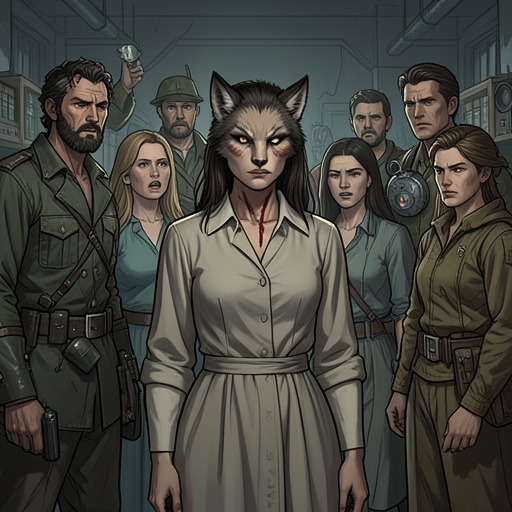
Lydia's ice vision
Holding Out for a Hero ▸ Stiles Stilinski (2)Lydia's ice vision is a defining episode of unexplained perception and supernatural dread: at the Beacon Hills Ice Rink, Lydia Martin abruptly begins screaming and attacking the ice as though something beneath it were calling or threatening her. No physical object is found, yet the force of what she saw is undeniable, making the vision important not because it immediately yields an answer, but because it reveals that Lydia's experience cannot be measured by ordinary evidence alone.
The Vision at the Rink
Lydia's episode begins at the moment Carson Bradley and Stiles Stilinski have withdrawn into an intimate, protective calm. Stiles's arms make Carson feel safe enough to stop fearing the fall, and his presence functions for her like a stabilizing anchor against the surrounding supernatural threats. That fragile private moment is broken by a feminine scream from the center of the rink. Lydia is crouched on the ice, wailing and clawing at it as if something below the surface is taunting her.
Carson moves toward Lydia despite her uncertainty on the ice, using Stiles to push off and gliding forward until she is close enough to drop to her knees behind Lydia. The fall sends pain through her legs, but she ignores it and wraps her arms around Lydia, trying repeatedly to pull her away from the ice. Lydia continues screaming with an intensity that recalls her earlier terror at the hospital. Allison Argent and Scott McCall get onto the ice to help, while Stiles remains behind Carson; the scene turns Lydia's private vision into a collective emergency.
Carson finally shouts Lydia's name until Lydia's scream stops. Lydia's eyes are wet, her lip is trembling, and Allison crouches beside them with a hand on her shoulder. Lydia can offer only the broken repetition that the danger is connected to the ice. When Carson and Allison inspect the spot, they find only ice shavings and a perfectly ordinary, compacted patch of frozen water. The contrast between Lydia's bodily certainty and the surface's emptiness creates the episode's central mystery: her terror is materially unsupported, but it is not therefore meaningless.
From Apparition to Investigation
After leaving the ice, Lydia becomes unusually silent. She refuses even to say that she is all right and will not meet Carson's or Allison's eyes. The silence is more alarming to Carson than Lydia's scream because Lydia is normally defined by her constant stream of opinions and observations. Her withdrawal therefore registers as a change in function as well as mood: the person who might explain what happened is temporarily unable or unwilling to put the experience into words.
Allison takes Lydia home because Lydia's car remains at the Argent House. Carson, Stiles, and Scott stay in the parking lot, still trying to understand the scene. Scott repeats that there was nothing under the ice, treating the lack of physical evidence as an answer. Carson accepts that the ice was empty but rejects the conclusion that Lydia's reaction was empty or purposeless. Lydia had been clawing at the surface, and Carson argues that she must have seen something, whether or not that something was corporeal.
The investigation immediately expands beyond the rink. Carson wonders whether the episode is connected to Lydia's bite. Scott considers Lydia normal by a werewolf standard, but Carson points out that this only means Lydia is not displaying the obvious signs that would place a target on her back for the Argents' wolfsbane bullets. The distinction matters: the absence of a conventional werewolf transformation does not establish the absence of supernatural consequences. Lydia's ice vision becomes evidence of an unresolved condition rather than proof that nothing is happening to her.
Recurrence Within a Pattern of Threat
The ice episode gains force from its position among other scenes in which the characters confront events that ordinary explanations cannot contain. Lydia had previously vanished from the Beacon Hills Hospital bathroom even though the shower was still running, the curtain was only partly open, and there was no connected room through which she could have escaped. The apparent impossibility of that disappearance prepares the narrative for another event in which Lydia perceives or enters a reality unavailable to the people around her.
The same period also brings direct encounters with the giant lizard creature. At the Mechanics garage, Carson sees a clawed, scaly hand, a tail that strikes a worker's neck, and yellow eyes that seem disturbingly familiar. Stiles becomes paralyzed, and Carson calls the police while the lift descends toward the injured mechanic. Later, clear ooze appears at a window sill just as it did at the auto shop, confirming that the creature's presence can leave physical traces even when its identity remains unclear. Against this background, Lydia's vision occupies an uneasy middle ground: it has no visible residue, but its emotional and bodily force resembles the warnings produced by the creature's attacks.
The group's attempts to identify the threat expose the limits of available knowledge. Carson searches for Kanima-related material, including legends, shape-shifting accounts, and stories about a giant lizard unable to swim, but finds almost nothing useful online. The bestiary opened on Stiles's laptop contains words she cannot understand, and even a possible lead concerning a were-jaguar fails to match the creature they are pursuing. Lydia's vision belongs to this same field of incomplete signs, where fragments, bodily reactions, and apparently unrelated clues must be assembled before the supernatural pattern becomes legible.
Aftermath and Narrative Significance
The immediate consequence of the vision is not revelation but intensified uncertainty. Lydia is removed from the rink, yet no one can remove the question of what she saw. Carson's intervention prevents the episode from becoming an isolated spectacle: by physically holding Lydia, examining the ice, and challenging Scott's insistence that the empty surface settles the matter, Carson turns an inexplicable reaction into a problem the group must continue investigating.
The incident also establishes a recurring contrast between official or visible evidence and lived experience. A hospital search can find no Lydia; the rink can reveal no object beneath the ice; surveillance footage can later require painstaking review because the truth is hidden among crowds and missing views. In each case, the absence of proof does not erase the event. The narrative asks the investigators to treat screams, paralysis, familiar eyes, residue, and silence as forms of evidence, even when those signs do not yet translate into a coherent explanation.
Lydia's ice vision therefore marks a turning point in how her supernatural involvement is understood. She is not simply a bystander who survives the werewolf and Kanima crisis, nor is she explained by the ordinary werewolf categories the group already knows. Her vision makes perception itself unstable: Lydia may be responding to a reality others cannot see, and her refusal or inability to explain it leaves the group dependent on witnessing her body. The empty ice becomes a powerful image of that condition—solid, visible, and apparently harmless, yet capable of carrying a terror that changes the people who stand upon it.