Peter Hale
Holding Out for a Hero ▸ Stiles Stilinski (2)Peter Hale is the story’s central figure of violent supernatural power and impossible return. Introduced through the aftermath of his crimes, he is remembered as an Alpha responsible for a string of murders, then treated as dead after Derek Hale slashes his throat. Yet death does not settle his place in the narrative. Peter reappears when Jackson Whittemore’s transformation reaches its crisis point, carrying a plan that may stop or even save Jackson. His decisive significance lies in that contradiction: Peter is both the source of lethal danger and the possessor of knowledge without which the surviving characters may have no way forward.
Alpha, Predator, and the First Reversal
Peter’s earlier reign as an Alpha is defined by bloodshed. The murders attributed to him are described as rabid and relentless, and his death appears to end that sequence permanently, leaving no further blood to stain his hands. The apparent conclusion is also the beginning of a new supernatural order: Peter’s nephew Derek Hale takes the helm as Alpha, his eyes turning blood red as he begins transforming teenagers into creatures of the night at an accelerating pace. Peter therefore shapes the plot even in absence. His removal does not restore ordinary life; it transfers authority to Derek and opens a second danger in which a new Alpha rapidly builds power.
The rules surrounding Peter’s bite make his legacy still more unsettling. Scott McCall’s changes after being bitten—greater strength, speed, and heightened senses—confirm that Peter’s attack has created a werewolf rather than merely injured a human. Lydia Martin’s case complicates the apparent rule that an Alpha’s bite either transforms its victim or kills them. Her wound begins to scab instead of becoming fatal or producing the expected werewolf transformation, leaving the characters to wonder whether Peter’s bite has initiated an entirely different supernatural process. Peter’s violence thus remains active after his death, not as a visible attacker but as an unresolved cause inside the bodies and identities of those he has bitten.
Death That Does Not Hold
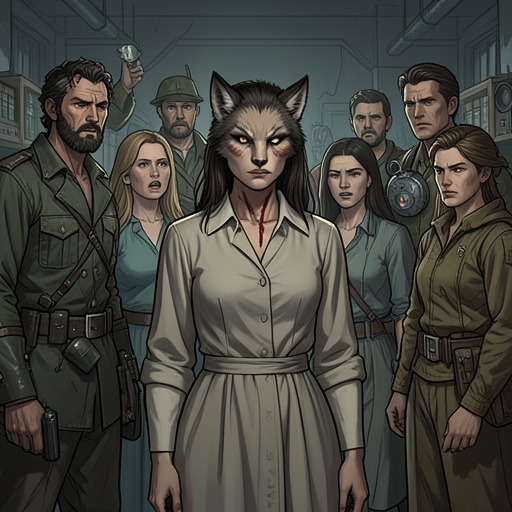
The characters initially understand Peter as someone who tried to kill them all and was defeated by fire and Derek’s slashing claws. His reputation is summarized as that of Derek’s uncle and the biggest asshole in the world, a personal judgment that joins family history to the memory of attempted murder. When Derek appears at the entrance of the group’s gathering, the interruption first suggests another immediate crisis; moments later, Peter’s voice makes the impossible unmistakable. Peter Hale is alive.
His resurrection is presented as a reversal of the story’s most settled fact. The man whose throat was cut and whose body was believed destroyed returns without erasing the violence that made his death seem justified. Instead, his survival forces the others to revise their understanding of the past while continuing to fear the person standing before them. The return is not a moral purification. Peter comes back still marked by his former identity as killer, Alpha, and Hale family threat, but the plot now requires the group to distinguish between what he has done and what he may be able to do.
Knowledge as Leverage
Peter’s value after returning is practical rather than trustworthy. Derek explains that Peter knows how to stop Jackson Whittemore and may even know how to save him. The statement changes Peter’s function from defeated enemy to dangerous resource. Jackson is no longer merely a creature to be hunted; his continued existence has become a problem requiring specialized knowledge, and Peter possesses that knowledge because of his deeper connection to the supernatural forces governing the transformation.
The plan is kept partly hidden from the rest of the group. A message says that something is wrong with Jackson, that Jackson is probably still alive, and that Derek and Peter have a plan but need Lydia Martin immediately. Stiles Stilinski is startled specifically by the name Peter, having missed the developments that followed the resurrection. The explanation he receives is deliberately compressed: Peter is back from the dead and has a plan to take Jackson down. This withheld detail makes Peter’s return feel less like a reunion than an emergency operation whose success depends on trusting someone the group has every reason to reject.
Peter’s own actions reinforce his role as a concealed strategist. At the burned staircase, he kneels and draws a box from inside one of the steps, revealing that he knows where something has been hidden and that the ruined Hale property still contains resources connected to the family’s supernatural history. The object is not explained in isolation, but the gesture gives physical form to Peter’s advantage: he knows the house, its secrets, and the arrangements made beneath the visible wreckage. His authority comes not from persuasion or repentance, but from access to buried knowledge.
The Jackson Operation
The final confrontation places Peter beside Derek in a coordinated assault on Jackson. Jackson lowers the key and steps away from Lydia Martin while Peter watches from the sidelines. After Jackson gives a single nod, Derek and Peter attack from opposite directions, extending their claws and driving them through Jackson’s abdomen. Scott McCall steps forward but realizes that intervention cannot change what is happening. Lydia cries out as Jackson coughs; the two Hales lift him on their claws, withdraw them, and let him fall.
The scene clarifies the limits of Peter’s supposed rescue. Derek and Peter are not helping Jackson in any ordinary sense. They intend to kill him, using lethal force as the means of stopping the Kanima crisis. The plan therefore preserves Peter’s essential contradiction: he may be the person capable of ending Jackson’s transformation, but the method associated with him remains bodily violence and death. Peter’s return does not replace the old logic of killing with a gentler moral order; it makes that logic newly useful to characters who must decide whether saving someone is possible only by destroying the form that person has become.
Peter’s presence also binds the ending to the family conflict that began with his death. Derek, once the nephew who killed him, now acts beside him in the same attack. Their alliance is tactical and unsettling, formed around a shared objective rather than restored affection. Peter’s influence has therefore shifted from Alpha command to clandestine expertise, but it has not diminished. He remains the Hale whose choices force every other character to confront the unstable boundary between rescue, punishment, transformation, and murder.
Narrative Function and Ethical Ambivalence
Peter Hale’s importance extends beyond the mechanics of his resurrection or his knowledge of supernatural transformations. He is the figure through whom the story tests whether violence can ever become morally neutral when it is directed toward a supposedly necessary end. His earlier murders make him an intolerable threat, while his knowledge of Jackson Whittemore makes him indispensable at the very moment the group needs an answer. That contradiction prevents his return from becoming a simple redemption arc. Peter does not regain trust by confessing, apologizing, or demonstrating a changed character; he becomes useful because the crisis demands knowledge that only someone like him appears to possess.
The narrative repeatedly places Peter at the edge of other characters’ understanding. His bite produces consequences that continue through Scott McCall and Lydia Martin, yet its effects cannot be reduced to a single predictable rule. Scott McCall becomes a werewolf, while Lydia survives an Alpha’s bite without becoming one, leaving the group to question what Peter’s violence has set in motion. Even after Peter’s apparent death, the consequences of his actions remain dispersed through altered bodies, uncertain identities, and competing explanations. His resurrection intensifies that uncertainty: the dead man is suddenly present, but the meaning of his survival is withheld until the group must act.
Peter’s final appearance with Derek Hale concentrates the story’s moral instability into one image. The nephew who once killed Peter now fights beside him, and the two Hales use their claws to destroy Jackson in an operation described as a possible rescue. Peter watches from the sidelines before joining the attack, occupying the position of both observer and executioner. Jackson’s single nod gives the violence a form of consent, but it does not make the scene humane; the claws still enter his abdomen, Lydia still cries out, and his body is dropped to the ground. Peter’s presence ensures that the ending cannot be read as a clean restoration of order. The crisis may be contained, but the method leaves the characters confronting the same question Peter embodies: whether ending a supernatural threat by killing the person inside it is salvation, punishment, or simply another act of violence.