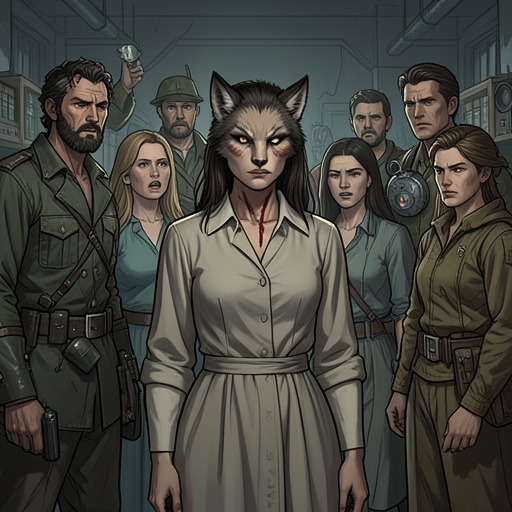
Peter Hale and Lydia Martin
Holding Out for a Hero ▸ Stiles Stilinski (2)Peter Hale and Lydia Martin are connected through a werewolf bite that should have produced a clear, lethal choice but instead leaves Lydia alive, physically recovering, and profoundly altered. The relationship is therefore less a conventional alliance than a chain of cause, bodily evidence, and unanswered questions: Peter’s bite places Lydia at the center of the supernatural crisis, while Lydia’s refusal to fit the expected pattern exposes limits in the rules the characters thought they understood.
The Bite and Its Immediate Consequences
Peter Hale bites Lydia Martin before the hospital mystery unfolds, and the wound becomes the decisive material sign of their connection. Peter presents the werewolf bite as an absolute process: it either takes hold and transforms the victim or the victim dies. Scott McCall’s experience appears to confirm that logic, since his bite heals within a day and leaves his skin naturally smooth while turning him into a werewolf. Lydia’s case develops differently. She survives, but her wound begins to scab rather than disappearing, and her recovery resembles that of an ordinary human patient. The contrast makes her condition evidence against the certainty of Peter’s own rule.
Lydia’s survival is especially striking because she has spent nearly two weeks in a coma and only wakes about three days before the hospital disturbance. Her awakening relieves her parents, doctors, and friends, who have been living with the repeated medical warning that a coma patient might never regain consciousness. Once awake, she can rise from bed and take her own showers, signs of ordinary physical recovery that sit uneasily beside the supernatural origin of her injury. The medical setting initially gives her condition a familiar vocabulary, but Peter’s bite prevents that vocabulary from being sufficient.
Disappearance and the Expansion of the Mystery
The connection between Peter and Lydia becomes more threatening when Lydia vanishes from her hospital room. Friends and adults hear the shower running, find the bathroom curtain partly open, and search the room before realizing that Lydia is simply gone. She has not left through any visible connected room, and there is no obvious route by which she could have traveled far. Her disappearance thus turns the bite from a wound into an active mystery: Lydia’s body is healing, yet it is also behaving in a way that defeats ordinary spatial and medical explanations.
The disappearance is later placed beside Isaac Lahey’s account of a clawed hand in the cemetery. A human hand with claws suggests the presence of another werewolf in Beacon Hills, and the possibility initially points toward Lydia because she vanished shortly before the graveyard report. The suspicion is not settled by a simple transformation. Lydia still had her wound when she was last seen, and the apparent lack of miraculous healing makes it difficult to explain how she could have become the creature associated with the cemetery. Peter’s bite creates the suspicion, but Lydia’s physical evidence resists the conclusion.
The investigation consequently shifts from asking whether Lydia is a werewolf to asking what kind of altered state the bite has produced. The characters know that Scott and Derek Hale do not fit the circumstances of the graveyard attack, and Lydia’s timing makes her relevant even when the evidence does not prove that she consumed a liver or transformed. Peter’s action gives the mystery its first causal link, while Lydia’s ambiguity keeps that link from becoming an answer.
Fugue State, Visions, and Competing Explanations
Lydia’s later behavior deepens the connection to Peter without confirming a conventional werewolf identity. She escapes from a two-story hospital room, remains in a fugue state for two days, and later sees something beneath the ice, clawing at the surface and screaming even though nothing corporeal can be found there. These episodes make her bite consequential in a new way: it may not have given her the expected powers or body, but it appears to have opened a channel to experiences that neither doctors nor her friends can easily classify.
Carson Bradley argues that the events following the bite form a pattern. Lydia is bitten, doctors describe her condition as an allergic reaction, she remains immune to the expected transformation, and then she disappears and begins seeing things. In this interpretation, Lydia is not a werewolf but is still something changed by Peter. The statement preserves Peter’s importance while refusing to let his rule explain everything. The bite functions as an initiating event whose consequences are psychological, bodily, and possibly supernatural at once.
The story repeatedly stages a contest between institutional diagnosis and supernatural interpretation. Doctors describe Lydia as recovering like any human, while her friends track the fugue state, the visions, and the possibility that the bite is responsible. Wolfsbane also enters the investigation as a recognized anti-werewolf substance, later associated with the danger of wolfsbane bullets fired by the Argents. Yet Lydia’s condition cannot be reduced to the standard werewolf-versus-hunter conflict, because she is neither plainly transformed nor plainly unharmed. Her body becomes the evidence through which Peter’s supernatural knowledge is tested.
Narrative Function of the Relationship
Peter Hale and Lydia Martin form a relationship of asymmetrical power. Peter acts upon Lydia through the bite, and Lydia bears the physical and narrative consequences without choosing the connection. He is therefore present through causation even when the immediate scenes focus on Lydia’s hospital room, disappearance, or visions. The relationship’s tension comes from the gap between Peter’s confidence about what a bite must do and Lydia’s refusal to obey that explanation.
That gap creates a reversal in the plot. The bite appears at first to threaten Lydia with either death or transformation, but her survival produces a third possibility: she remains recognizably human while entering a condition the characters cannot name. Her coma and recovery make her a survivor; her disappearance and fugue state make survival itself unstable. The audience is led from apparent medical relief to renewed fear, then from the question of whether Lydia is a werewolf to the broader recognition that Peter’s intervention has made her exceptional.
Lydia’s ordeal also enlarges the supernatural world beyond visible combat. Other characters confront claws, venom, guns, paralysis, and direct attacks, but Lydia’s connection to Peter is expressed through a wound that becomes a puzzle and through visions that may not leave physical traces. The relationship therefore links bodily transformation to knowledge: Peter’s bite changes what can happen to Lydia, and Lydia’s anomalous response forces the group to revise what it thinks the supernatural rules mean.
Limits and Significance
The supplied episodes do not establish a reconciliation, partnership, or mutual affection between Peter Hale and Lydia Martin. Their confirmed bond is the bite and its aftermath. Peter supplies the initiating violence and the rule of interpretation; Lydia supplies the surviving body that disproves the rule’s apparent completeness. The relationship remains unresolved in personal terms, but it is decisive in plot terms because Lydia’s condition becomes one of the earliest signs that supernatural identities in Beacon Hills cannot always be read from a single wound or diagnosis.
In this sense, Peter and Lydia are joined by an unfinished transformation. Peter intends, or at least causes, an event understood as binary; Lydia turns it into an anomaly. Her scabbing wound, coma, disappearance, fugue state, and visions collectively preserve the bite as an active question rather than a completed conversion. Their relationship is significant precisely because it refuses closure: Peter’s power is real, but Lydia’s body proves that even a powerful supernatural rule can produce consequences no one in the group is prepared to explain.