Police-station restraining-order conflict
Holding Out for a Hero ▸ Stiles Stilinski (2)The Police-station restraining-order conflict is the point at which the investigation surrounding Jackson Whittemore is recast as a legal offense against Carson Bradley, Stiles Stilinski, and Scott McCall. What the teenagers understand as an effort to contain a dangerous supernatural threat is presented through Jackson and David Whittemore as harassment, assault, and unlawful interference. The resulting order does not resolve the danger; it places a procedural barrier between the investigators and the person they believe may be responsible for further violence.
Causes and Background
The conflict grows out of an atmosphere in which ordinary school discipline and police authority repeatedly collide with an emergency that the adults do not fully understand. Coach Finstock interrupts Scott McCall and Stiles Stilinski during school demands, while Gerard Argent announces that his support for the teachers will require students to take the fall and remain in detention. These scenes establish a structure in which institutional authority can punish the visible disruption without addressing the hidden crisis beneath it.
Carson Bradley and Stiles Stilinski are already operating outside normal procedure when they take a police vehicle to contain Jackson Whittemore. Carson objects that the plan involves stealing a police vehicle, while Stiles justifies it as a way to keep Jackson from hurting anyone. Jackson is knocked unconscious inside the van, and Scott McCall has to strike him repeatedly to keep him subdued. The plan is framed by the teenagers as protective custody, but its illegality makes it vulnerable to being narrated as abduction and abuse once it reaches the authorities.
The investigation also forces Carson Bradley to move through unofficial channels. She is directed toward the stairs near Hamilton's room while searching for Lydia Martin, and Danny Mahealani reports seeing Erica Reyes with her hands on Stiles Stilinski's chest, adding jealousy and personal distraction to an already unstable pursuit. The teenagers' investigative work therefore lacks both legal authorization and emotional distance: they are trying to identify Jackson's history while their own relationships and rivalries remain exposed.
What Happens at the Station
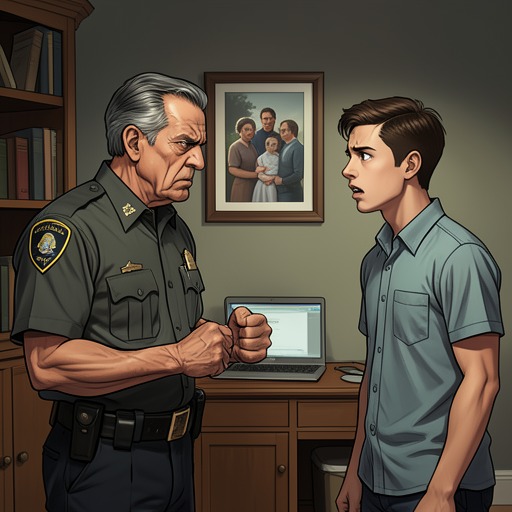
The decisive confrontation occurs when Carson Bradley, Stiles Stilinski, and Scott McCall approach Sheriff Stilinski's office and discover Jackson Whittemore seated in what appears to be a spare police uniform. David Whittemore is leaning against the wall, Jackson is smirking, and Sheriff Stilinski is visibly unhappy. The arrangement makes the teenagers understand that the immediate danger is no longer only Jackson's supernatural behavior; his father has successfully brought the dispute into the police station and turned their actions into a formal case against them.
The order is announced directly by Sheriff Stilinski. Carson Bradley, Stiles Stilinski, and Scott McCall are forbidden to come within fifty feet of Jackson Whittemore, speak to him, or approach him. They are also forbidden to assault or harass him either physically or psychologically. The language is comprehensive enough to restrict not only physical intervention but also the investigation itself, since any attempt to question, follow, or confront Jackson may be interpreted as a violation.
The restriction creates an absurd practical problem because Jackson Whittemore and the three teenagers still attend the same school. Stiles Stilinski asks how school will work, and Sheriff Stilinski explains that they must take classes while maintaining the fifty-foot distance. The order thus treats proximity as a logistical matter even though the school is a confined shared environment. The rule offers no meaningful solution to hallways, classrooms, or daily movement; it simply transfers responsibility for avoiding contact onto the teenagers.
Carson Bradley experiences the ruling as both humiliation and defeat. She sits between Stiles Stilinski and Scott McCall while Melissa McCall remains in the corner, and Carson cannot bring herself to look at her because of the distress and disappointment she perceives. David Whittemore's persistent smirk intensifies her anger, while her frustration leads her to imagine cutting off Jackson's head, followed by the grim recognition that she may still want to do so. The order restrains her body without eliminating the threat that produced her rage.
Stiles Stilinski attempts to comfort Carson Bradley by resting a hand on her knee, but the gesture cannot overcome the situation. Carson instead handles the cool metal of Stiles' car keys in her pocket as a distraction. Their physical closeness becomes especially significant under a rule designed to regulate distance: the order separates them from Jackson while showing the intimacy and solidarity within the group that the legal proceeding has placed under suspicion.
Legal Authority and Emergency Methods
The conflict dramatizes a clash between formal procedure and improvised crisis management. The teenagers steal a police vehicle, detain Jackson Whittemore, and use force because they believe conventional containment has failed. The police-station proceeding answers that emergency logic with a restraining order rather than with an investigation into the supernatural danger. The result is an official solution that restores a visible boundary while leaving the underlying threat intact.
Other events reinforce the same tension. Stiles Stilinski is held in detention because Sheriff Stilinski has kept a twenty-four-hour hold and because Stiles' connection to Kate Argent's arson has not been disclosed to the police. Carson Bradley and Stiles Stilinski are also sent toward the cemetery after detention, where their private investigation continues outside the ordinary school schedule. Institutional punishment and secret inquiry proceed side by side, each treating the other as an obstacle.
The teenagers' methods become still more extreme as the crisis develops. At the police station, a gun is later pressed into Carson Bradley's back while Matt Daehler forces her down a hallway and prepares to take the group hostage, with Jackson Whittemore expected to kill people if necessary. This later hostage situation clarifies the danger the restraining order has failed to contain: the supposed subject of protection remains linked to lethal violence, while the people who suspected him are treated as the immediate legal problem.
Investigation After the Order
The restriction does not end Carson Bradley's search for the truth. At two in the morning, Carson Bradley, Stiles Stilinski, and Scott McCall enter the police station with the former sheriff and examine surveillance footage from Beacon Hills Hospital on the night Jessica was murdered. The footage is difficult to search because a six-car pileup had filled the hospital with people in wheelchairs and on gurneys. The crowded images expose the practical limitations of official evidence while also giving the investigators a route toward identifying Matt Daehler.
The evidence chain gradually strengthens. Shoeprints and tire tracks from the trailer park are compared with other records, potentially placing Matt Daehler at three murder scenes: the trailer, the hospital, and the rave. A credit-card receipt signed by Matt Daehler at the Mechanics garage may connect him to the death of the auto mechanic as well. The investigation therefore moves from suspicion toward a pattern assembled from physical traces, surveillance, and financial records rather than from the restraining order's account of events.
The contrast is central to the event's meaning. The legal conflict defines Carson Bradley, Stiles Stilinski, and Scott McCall through their alleged conduct toward Jackson Whittemore, whereas the parallel investigation asks what Jackson and Matt Daehler have done and who is endangered by their actions. The order produces a temporary appearance of control, but the surveillance footage and scene evidence continue to undermine that appearance.
Consequences and Significance
The immediate consequence is forced distance: Carson Bradley, Stiles Stilinski, and Scott McCall must continue attending school while avoiding Jackson Whittemore by fifty feet, without speaking to or approaching him. The measure damages their freedom of movement and makes ordinary school life a tactical exercise. It also deepens their resentment toward David Whittemore, whose legal intervention is perceived as a weapon rather than as a neutral appeal for protection.
Narratively, the conflict marks a reversal in the teenagers' social position. They have been investigating murders and trying to prevent further attacks, yet the police station receives them as potential aggressors. The value shift is from an expectation of protection to legal exposure: the station, normally a place where danger should be reported, becomes the site where the investigators themselves are constrained.
The order also demonstrates how supernatural emergencies become nearly unintelligible when translated into ordinary legal categories. A stolen police vehicle, an unconscious captive, physical force, and repeated pursuit can all be documented without explaining the Kanima threat that prompted them. The event therefore does not merely interrupt the investigation. It shows how the demand for procedural normality can obstruct the very people attempting to preserve life when the official system cannot yet recognize the nature of the danger.
The conflict ends without genuine resolution. The teenagers remain bound by the restriction, but they continue gathering evidence, and the later hostage crisis confirms that their fear of Jackson Whittemore and Matt Daehler was not baseless. The police-station order temporarily regulates contact; it does not restore normality, establish the truth, or make the supernatural crisis disappear.