Scott McCall–Allison Argent relationship
Holding Out for a Hero ▸ Stiles Stilinski (2)The Scott McCall–Allison Argent relationship is a secret romance at the center of the Beacon Hills crisis, binding Scott McCall, a werewolf struggling to protect the people around him, to Allison Argent, a hunter whose family has taken control of Beacon Hills High School and remains dangerous to werewolves. Their relationship matters because private affection must operate inside public surveillance and supernatural violence. The couple cannot freely speak, meet, or protect one another without involving Carson Bradley and Stiles Stilinski, so romance becomes both a source of vulnerability and one of the story’s most dependable channels of trust.
Identity and Conditions
The relationship is presented as established but concealed rather than newly forming. Since Allison Argent’s grandfather Gerard Argent has taken over as principal, Scott and Allison have barely had time even to look at each other, while their movements are closely tracked. The school therefore becomes an antagonistic space for intimacy: the couple’s difficulty is not a lack of feeling but the active pressure of family authority and institutional control. Their secret status also makes ordinary romantic communication impossible, forcing them to send messages through Carson Bradley and Stiles Stilinski, whom they consider the only people they can trust.
That dependence on intermediaries gives the romance a distinctive social shape. Scott and Allison’s private words pass through friends who are also involved in the wider supernatural emergency, so declarations of love are never isolated from danger, investigation, or embarrassment. The relationship survives by converting secrecy into cooperation, but every additional confidant also becomes part of the risk surrounding it.
Communication and Mutual Attachment
The relationship’s emotional core appears when Stiles Stilinski, unaware that Carson Bradley has approached, apologizes for the previous day and says that he is trying, that they will get through the crisis, and that he loves Allison. Scott McCall reacts with open happiness, while Stiles is overwhelmed by embarrassment. The scene is comic because Stiles is forced to perform another couple’s intimacy in public, yet the humor reveals how urgently Scott and Allison need a safe route through the restrictions imposed on them.
Carson Bradley confirms that Allison will attend the game that night and explains that Allison expected Stiles Stilinski to panic after having to say that he loved Scott McCall aloud. The joke turns the lovers’ secrecy into a shared performance: Allison can communicate with Scott through Carson, while Stiles becomes an unwilling but trusted messenger. Carson’s kiss to Stiles’s cheek as she joins the conversation further places the Scott–Allison romance alongside another intimate relationship, contrasting the hidden couple’s constrained contact with the more openly affectionate bond of Carson and Stiles.
Protection, Danger, and Conflicted Loyalties
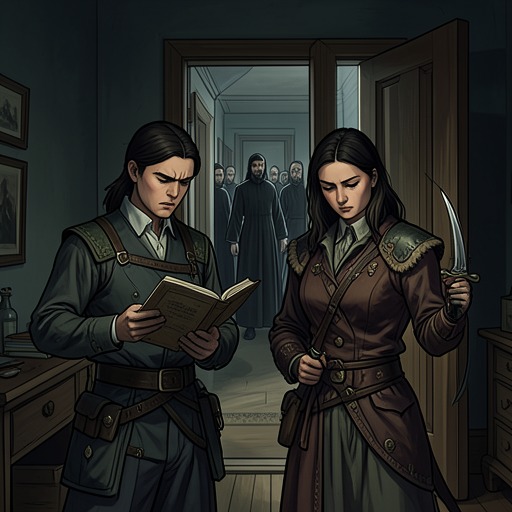
Allison Argent is not merely someone Scott McCall wants to protect. When she produces a miniature crossbow and states that she can protect herself, she asserts an active role in the danger surrounding them. Scott’s response is nevertheless visibly fearful. His concern is described as the fear that someone might hurt Allison or take her away from him, showing that his attachment is expressed through vigilance as much as tenderness. Allison’s capacity for self-defense does not cancel Scott’s protective impulse; it makes the relationship a negotiation between her independence and his anxiety over losing her.
The couple’s danger is intensified by their families’ opposing supernatural positions. Allison Argent considers calling her father when four werewolves are waiting to kill Lydia Martin, even though doing so could endanger both her and Scott. Carson Bradley warns that if Chris Argent finds Allison there, the consequences for the couple could be severe. Allison understands the danger but insists that the attackers are not merely trying to frighten Lydia Martin. Her choice exposes the relationship’s central conflict: loyalty to Scott and their allies does not erase her responsibility to her family, while loyalty to her family can reveal information that places Scott and others at risk.
That conflict produces a temporary rupture after Allison Argent tells her family where the Kanima is. Scott McCall lashes out at her during the rave, and afterward the two are barely speaking. The narration still grants Allison a good-faith position, observing that her heart was in the right place even though her family caused substantial trouble. Their estrangement therefore does not reduce the relationship to betrayal. It shows how the romance is strained by incompatible obligations and by the consequences of choices made under pressure.
Jealousy and External Threats
Matt Daehler becomes a direct threat to the relationship through his interest in Allison Argent. Allison tells Carson Bradley that Matt asked her out and that she accepted because she panicked and did not know what to say, despite dating Scott McCall. Carson challenges the decision, treating a refusal as the obvious alternative. The exchange makes the relationship vulnerable not only to supernatural enemies but also to hesitation, social pressure, and the complications created by its secrecy.
Matt Daehler’s ignorance of Scott and Allison’s secret relationship does not make his pursuit harmless. When Carson Bradley sees him approaching outside the rave, she regards his attempt to take Allison out as predatory and regards Allison as far beyond his league. Later, Carson warns Scott McCall that Matt has feelings for Allison and may want her for himself, interpreting his behavior as the kind of possessiveness that could turn destructive if he cannot have her. Whether or not Scott initially recognizes the full danger, Carson’s warning reframes the romantic triangle as a possible threat to Scott’s safety as well as to the couple’s bond.
The pressure becomes especially acute because Scott McCall and Stiles Stilinski are already confronting deaths, school consequences, a werewolf pursuing Carson, and the wider collapse of their normal lives. Stiles tells Scott that he cannot bear to watch Scott lose Allison to a stalker like Matt Daehler. The statement is exaggerated for comic effect, but it also identifies Allison as one of the few remaining sources of emotional stability in Scott’s increasingly violent world. Scott’s relationship is therefore treated by his friends as something worth defending, not as a distraction from the supernatural plot.
Repair, Responsibility, and Narrative Significance
The relationship also participates in the group’s attempt to restore Lydia Martin’s damaged social and emotional life. When Allison Argent approaches Scott McCall and the others after a period in which Scott and Allison are still not really talking, she quietly reports that Jackson Whittemore is absent. Her subdued entrance places the couple’s unresolved tension inside a larger effort to understand what has happened to Lydia Martin and the people around her.
Carson Bradley argues that the group should give Lydia Martin a chance to return to normal, and Allison Argent immediately supports her. Allison says that Lydia would not have become the town’s outcast if not for them and that they owe her something. Although this is not a direct reconciliation between Scott and Allison, it demonstrates that their shared moral world remains intact. Even while Scott is withholding an apology and the romance is strained, Allison continues to act with the group and to accept responsibility for the damage surrounding their supernatural struggle.
The relationship’s larger pattern is consequently one of attachment under siege. Scott McCall’s fear appears in his watchfulness over Allison; Allison’s commitment appears in her willingness to defend herself, confront threats, and remain present despite family pressure. Their love is repeatedly made difficult by secrecy, surveillance, competing loyalties, and Matt Daehler’s fixation, yet it continues to organize the actions of their friends. The romance does not exist outside the crisis. It is one of the crisis’s clearest measures of what the characters are trying to preserve while ordinary life, family trust, and physical safety are all becoming unstable.