Sheriff Stilinski's leave of absence
Holding Out for a Hero ▸ Stiles Stilinski (2)Sheriff Stilinski's leave of absence is the period in which the sheriff is removed from active duty after the county connects his office to his son's increasingly serious legal and disciplinary troubles. Though presented as temporary, the measure is never securely defined as such, making it both an employment decision and a pressure point in the relationship between Sheriff Stilinski and Stiles Stilinski. Its eventual reversal, marked by the return of the sheriff's badge after the murder investigation advances, turns the leave into a temporary interruption rather than a permanent fall from authority.
Causes and Institutional Pressure
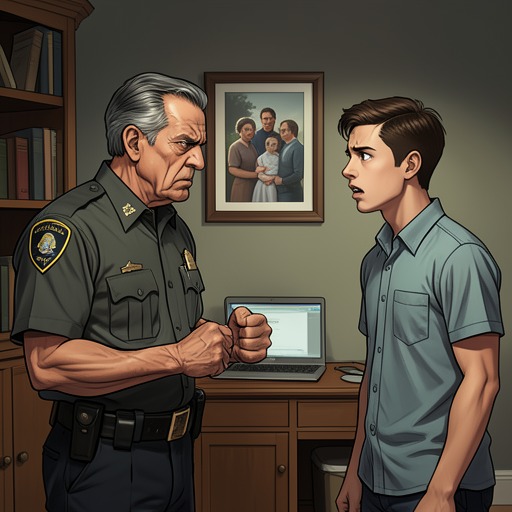
The stated reason for the leave is not a single isolated failure by the sheriff. Mr. Stilinski explains that the county considered it damaging that the son of a police chief had stolen police property and had a restraining order filed against him by the town's most respected attorney. The language makes family association itself part of the case: Stiles Stilinski's conduct is treated as reflecting on his father's public office, even though the leave is imposed on the sheriff rather than on the teenager who caused the scandal.
The surrounding school and police conflicts establish the atmosphere in which the decision becomes possible. Gerard Argent announces that students will be made to stay behind for detention, while Coach Finstock's shouted demand for players to get onto the field supplies a contrasting image of ordinary institutional discipline. Elsewhere, Stiles Stilinski is released from detention only after his father's twenty-four-hour hold has ended, a hold connected to his failure to tell police that he had helped Kate Argent escape after the arson. The sheriff's professional vulnerability therefore grows from a chain of overlapping failures involving secrecy, police property, family reputation, and the concealment of criminal knowledge.
The Meaning of “Temporary”
When Stiles Stilinski learns what has happened, he immediately translates the official euphemism into its practical meaning: the sheriff has been fired. Mr. Stilinski corrects him by calling it a leave of absence and insists that it is temporary, but the reassurance is weaker than the label. When Stiles Stilinski asks whether the county actually said it was temporary, his father admits that it did not. He still tells his son that everything will be fine, yet the exchange leaves the status unresolved rather than settled.
That uncertainty gives the leave its particular dramatic force. It is neither a clean dismissal nor a secure administrative pause. The sheriff remains emotionally and institutionally attached to the office, but his badge is no longer an unquestioned guarantee of protection. The scene also reverses the expected direction of anger. Stiles Stilinski waits for his father to blame him, while Mr. Stilinski does not respond with the anger Stiles expects. The leave thus becomes a shared family injury: the son's actions have endangered the father's position, but the father's restraint prevents the conflict from becoming a simple punishment narrative.
Authority During the Leave
Despite the loss of active status, the former sheriff continues to possess the practical knowledge and investigative habits needed to pursue the murders. At two in the morning, he brings Stiles Stilinski, Carson Bradley, and Scott McCall into the police station, which is nearly empty except for the desk worker, and leads them to his old desk. There they review hospital surveillance from the night Jessica was murdered. The hospital footage is difficult to search because a six-car pileup has filled the building with people in wheelchairs and on gurneys, but the former sheriff keeps the investigation focused on the time and route through which Matt Daehler must have reached Jessica.
The investigation then shifts from incomplete surveillance to physical records. The former sheriff identifies shoeprints alongside tire tracks at the trailer park and connects them with the hospital and rave murders. Another piece of evidence, a credit-card receipt signed by Matt Daehler at the garage where the mechanic was killed, potentially places him at a fourth crime scene. The leave has removed formal authority, but it has not erased professional competence; the investigation proceeds through the same institutional materials—surveillance, tracks, folders, and receipts—that the sheriff understands how to read.
Reinstatement and Consequences
The leave ends when Sheriff Stilinski is reinstated. He receives his badge again and is congratulated for finding who has been killing people. The official account credits him with solving the case, although Carson Bradley privately recognizes that Scott McCall, Stiles Stilinski, and Carson also contributed and choose not to disclose their role. The reinstatement therefore restores the sheriff's public authority while preserving the secret, unofficial labor that helped produce the result.
The contrast between removal and restoration is sharpened by the story's broader emergencies. During the period of the leave, Carson Bradley witnesses a clawed, scaly creature kill a repair worker, sees Stiles Stilinski become paralyzed by its attack, and later joins an illegal attempt to contain Jackson Whittemore in a stolen police vehicle. She is also forced down a police-station hallway at gunpoint when Matt Daehler takes hostages and uses Jackson to threaten further violence. Against these crises, the sheriff's restored badge represents a return to procedural order, but that order has been repeatedly sustained by teenagers who investigate beyond the boundaries of official permission.
Narrative Significance
Sheriff Stilinski's leave of absence dramatizes the fragility of public authority in Beacon Hills. The county treats the sheriff's family as an extension of his office when scandal threatens, yet later welcomes his authority back when his investigative success becomes useful. The episode exposes a double standard: informal teenage investigation is necessary to uncover the truth, while official institutions reserve the right to claim the result once it can be publicly acknowledged.
The leave also changes the emotional landscape between Stiles Stilinski and his father. Stiles carries guilt and confusion, expecting anger but receiving weary reassurance instead. When the sheriff is reinstated, the badge confirms that the crisis has not destroyed the family or the office, but it does not erase the pressure that produced the leave. The state is restored before every private wound is healed, leaving the period as a reminder that institutional recovery and personal reconciliation do not occur at the same speed.