Stiles Stilinski
Holding Out for a Hero ▸ Stiles Stilinski (2)Stiles Stilinski is the human center of the Beacon Hills supernatural story: a sheriff's son whose access to local information, encyclopedic knowledge of monsters, restless imagination, and refusal to abandon friends make him indispensable when ordinary explanations fail. His decisive importance lies in the contrast between his apparent physical vulnerability and his practical courage. Stiles does not become a werewolf, an Alpha, or a Kanima; instead, he remains himself while repeatedly entering conflicts dominated by supernatural strength. His loyalty to Carson Bradley and Scott McCall gives the larger crisis its emotional continuity, while his eventual reconciliation with Carson turns his long history of anxiety, humor, and self-doubt into a more secure commitment to love and friendship.
Identity and Background
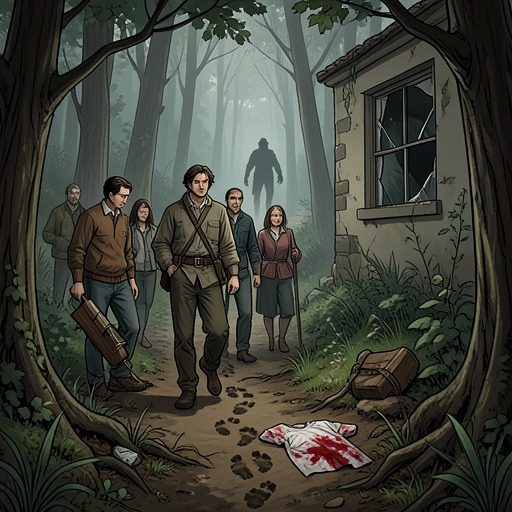
Stiles has known Carson Bradley since he was three, and his friendship with Carson and Scott McCall predates the supernatural events that transform their adolescence. He is Sheriff Stilinski's son, a family connection that gives him unusual access to the town's hidden circulation of information. Because his father is the sheriff, Stiles can listen in on reports and calls concerning Beacon Hills, making official danger available to an inquisitive teenager before it becomes public knowledge. That access is both a resource and a liability: his eavesdropping is the immediate reason the group ventures into the woods, where Scott is bitten.
Stiles's personality is defined by motion. He drags Carson and Scott into what the narration calls his wild adventures, treats the search for a dead body as something that eventually becomes normal, and approaches the unknown through jokes, speculation, and accumulated pop-culture knowledge. His familiarity with movie monsters and supernatural lore helps him and Carson recognize that Scott McCall has become a werewolf after the bite. Their first proposed solution is practical but naive: restraining Scott during the full moon so that nobody is harmed. The plan reveals Stiles's characteristic method—he converts fear into a problem that can be researched and managed—even when the supernatural world is far more complicated than his initial categories allow.
The story later explicitly marks Stiles's point of view, including a distinct Stiles perspective, but his character is also revealed through Carson's sustained observation. In the hospital waiting room, he is found asleep across three chairs with a get-well balloon tied around his wrist, quietly snoring and apparently murmuring in his sleep. The image preserves the comic physicality of Stiles while showing the exhaustion produced by his constant participation in other people's emergencies. He can be ridiculous, tender, and indispensable in the same scene.
Life and Plot Trajectory
Stiles's investigative role expands as Beacon Hills becomes increasingly dangerous. He helps interpret the changes in Scott after the bite, follows the chain of supernatural clues, and continues moving between official information and the group's improvised investigations. His methods are not limited to one source of authority. He listens to police communications through his father's position, searches the internet, consults the bestiary, and relies on Deaton as a trusted veterinary and supernatural guide. The combination makes Stiles a translator between institutions, folklore, and immediate crisis.
The Kanima investigation exposes both the limits and the value of his research. Online searches for the Kanima, its legends, its shape-shifting nature, and even the giant lizard that cannot swim yield almost nothing. The bestiary on Stiles's laptop contains strange words Carson cannot understand, and an online translator is no more useful than it is for French homework. This failure does not stop Stiles; it clarifies the kind of investigator he is. He works not because information is readily available, but because the absence of information itself becomes a clue. When conventional searches fail, he continues to connect testimony, physical appearances, supernatural rules, and the experiences of the people around him.
His involvement repeatedly places him in direct physical danger. A reptilian creature appears in the darkness of a school hallway, and later the Kanima confronts Stiles and Carson on an indoor balcony before leaping down near Derek Hale. Stiles is not protected from the monster simply because he lacks supernatural abilities. He is dragged into rooms, threatened alongside his friends, and forced to act while stronger figures are incapacitated. His courage therefore has a different shape from Scott McCall's or Derek Hale's: it is the courage to remain present, keep thinking, and help others while fully exposed to the same danger.
Stiles also acts as a rapid-response partner during the final confrontations. When Peter Hale's return is revealed, he reacts with disbelief while speeding toward Lydia Martin's house. In the ensuing pursuit, he drives his Jeep through a wall, striking the Kanima and sending it across the ground. The action is reckless, but it is also strategically effective: Stiles turns an ordinary vehicle into a weapon against a creature that has repeatedly overwhelmed supernatural opponents. Later, even while watching the Kanima's transformation reverse and Jackson Whittemore emerge beneath the scales and claws, Stiles's attention can swing toward lacrosse. He jokes about acquiring the skills to become team captain, preserving the ordinary ambitions of adolescence amid extraordinary violence.
Relationships and Conflict
Stiles's most important relationship is with Carson Bradley. Their bond begins in childhood and develops through shared danger into mutual love. Carson states that she fell for Stiles while he had already fallen for her, making their romance a continuation of their long friendship rather than a sudden attachment created by the supernatural plot. Stiles's commitment is repeatedly expressed through caretaking and reassurance. When Carson doubts her own worth after parental abandonment and family pain, he rejects the idea that anyone who leaves her has understood her. He insists that she is worthy of love and tells her that he has loved her since second grade, framing their relationship as something rooted in years of recognition rather than status or convenience.
The relationship nevertheless enters a period of strain. After Carson is affected by Kanima venom, Stiles feels helpless and apologizes for not being able to protect her. He compares himself unfavorably with Scott McCall and Derek Hale, believing that Carson needs someone with supernatural strength or speed rather than someone who is merely Stiles. His insecurity is not presented as a lack of love; it is produced by love and by the fear that ordinary devotion cannot compete with extraordinary rescue. Carson answers by redefining what she needs. She does not need someone to swoop in and save her; she needs someone to talk to and someone who loves her as she loves him. The exchange turns Stiles's perceived weakness into the basis of his value.
Their reconciliation is explicit and emotionally decisive. Carson tells Stiles that she loves him, and he answers with a promise of forever while asking whether they are all right again. The scene does not erase the earlier conflict; it integrates it. Stiles learns that he can be frightened, ineffective, or overwhelmed without becoming dispensable, while Carson recognizes that his role is not to possess supernatural power but to remain emotionally present. Their relationship consequently becomes one of the book's clearest forms of resilience.
Stiles's friendship with Scott McCall is equally foundational. The two are joined to Carson in childhood and become investigators together after Scott's bite. Stiles's knowledge helps identify Scott's condition, while Scott's supernatural transformation creates the danger that draws Stiles further into the hidden world. Even after the crises have altered them, Stiles remains part of Scott's support system. Near the end, he gestures toward the two of them when reassuring another character that Scott still has his friends, presenting friendship as a continuing resource after supernatural identities and personal loyalties have been tested.
His relationship with Sheriff Stilinski is shaped by proximity to law enforcement and by family grief. Stiles's access to police information helps launch the original investigation, but the family also carries the loss of Claudia Stilinski. The discussion of Carson's absent mother becomes a point of recognition between Stiles and Carson: two years after Claudia's death, Carson's mother leaves her life by choice. Stiles's understanding of abandonment is therefore personal as well as investigative, and it helps explain the intensity with which he defends Carson's worth.
Stiles also functions within the wider network of Beacon Hills allies. He trusts Deaton, even though Deaton remains mysterious, because Deaton repeatedly helps Scott in moments of crisis. He works beside Carson during Kanima encounters and research, remains connected to Lydia Martin's emergencies, and responds to the disappearance of Gerard Argent and Stiles himself with immediate alarm. When the crowd reveals that Stiles is missing and Gerard is absent as well, the absence becomes a pattern that Carson recognizes as a new threat rather than an ordinary separation.
Change and Ending
Stiles begins as an adventurous teenager who treats danger as an extension of curiosity. The group eventually emerges more cautious, more grown up, and hardened by death. Stiles's development is therefore not a transformation into a supernatural being but a maturation of judgment and responsibility. He retains his jokes, his impulsive plans, and his appetite for investigation, yet those traits now operate within a deeper awareness of consequences. The same boy who once follows a police call into the woods becomes someone capable of entering a Kanima confrontation because the people he loves need him there.
His most important internal conflict concerns usefulness. Stiles believes that strength is measured by what a person can physically prevent, and Kanima venom confirms his worst fear by rendering people helpless without regard to courage. After Carson's paralysis, he cannot accept that the event was simply something that happened to both of them; he interprets it as a failure to protect her. Carson's response allows him to separate supernatural power from personal worth. Stiles does not need to become Scott McCall or Derek Hale. His intelligence, humor, loyalty, and capacity to stay beside another person are not lesser substitutes for power; they are the qualities that make him irreplaceable.
The ending preserves that revised identity rather than replacing it. Stiles remains involved in the aftermath of the Kanima crisis, learns that Peter Hale is alive, and continues to stand with Carson and Scott as ordinary life and supernatural danger overlap. His final comic movement is characteristically physical and hopeful: he seizes the case, races toward the stairs, announces that Batman awaits, then reassures everyone after a loud thump that he is fine. The joke is not a retreat from the story's violence. It is Stiles's way of reclaiming play, adolescent fantasy, and continuity after terror.
Narrative Role and Significance
Stiles is the narrative's human investigative engine and its emotional counterweight to supernatural spectacle. The werewolves and Kanima supply force, transformation, and bodily threat; Stiles supplies questions, memory, pattern recognition, and the stubborn insistence that a mystery can be approached even when the available tools fail. His position as Sheriff Stilinski's son gives him access to institutional knowledge, while his friendship with Carson Bradley and Scott McCall gives him a reason to use that knowledge for personal rather than official ends.
His recurring contrast with supernatural characters establishes the book's broader idea of heroism. Stiles can be dragged, frightened, poisoned, or physically outmatched, but he continues to investigate and return. His Jeep can become an improvised instrument of resistance; a laptop's useless search results can mark the beginning rather than the end of inquiry; a get-well balloon tied around his wrist can make exhaustion visible without diminishing his loyalty. These details make his heroism material and imperfect.
Most importantly, Stiles's arc connects knowledge with care. He does not merely identify monsters or explain rules. He uses information to keep Scott from being isolated, to help Carson survive emotional and physical danger, and to preserve the bonds that prevent the supernatural crisis from reducing people to their altered bodies. His final affirmation is therefore not that he has acquired new powers, but that he remains Stiles Stilinski—and that, for Carson, this is precisely what is needed.