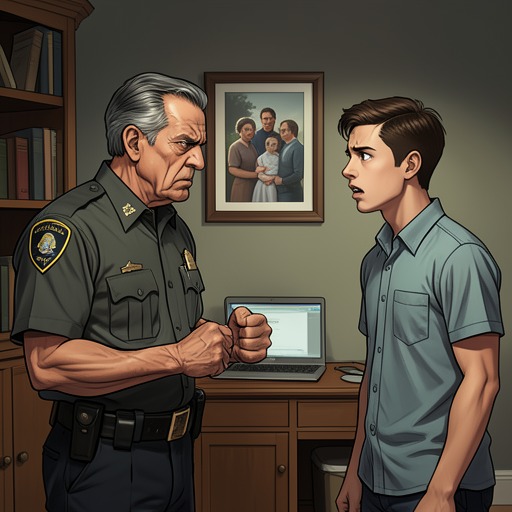
Stiles Stilinski–Sheriff Stilinski father-son relationship
Holding Out for a Hero ▸ Stiles Stilinski (2)The Stiles Stilinski–Sheriff Stilinski father-son relationship is one of the book’s most emotionally durable bonds, shaped by conflict but not reduced to it. Stiles’s involvement in stealing police property and the restraining order filed against him contributes to Sheriff Stilinski’s removal from active duty, yet the father’s response is marked by exhaustion rather than simple condemnation. Their relationship becomes a measure of how family loyalty persists when responsibility, shame, and institutional consequences collide.
Identity and Background
The relationship joins Stiles Stilinski, a volatile and resourceful teenager repeatedly drawn into the supernatural crisis, with Sheriff Stilinski, his father and the police chief whose professional authority is damaged by his son’s conduct. The family bond is therefore also a public one: Stiles’s behavior is not treated as an isolated private mistake because it reflects on the sheriff and on the county. Sheriff Stilinski explains that it was decided that the son of a police chief stealing police property and having a restraining order filed against him by the town’s most respected attorney did not reflect well on the county. The wording turns family trouble into an institutional liability, making Stiles’s actions consequential for his father’s reputation and employment.
The sheriff resists describing the result as a permanent firing, calling it a leave of absence and insisting that it is temporary. That distinction matters because it preserves a narrow possibility of return even as the scene makes clear that his professional life has been seriously disrupted. Stiles hears the practical consequence immediately and answers with the blunt recognition that his father has been fired. The exchange shows a son confronting the damage attached to his own actions while a father tries to frame the damage in a less final form.
Conflict, Guilt, and Silence
The relationship’s central conflict is not merely an argument between parent and child; it is a crisis of expected emotional response. Stiles waits for anger and cannot understand why his father is not yelling at him. His confusion reveals that punishment would be easier for him to interpret than restraint. Anger would give the situation a familiar shape, while the sheriff’s weariness leaves Stiles facing the full emotional weight of what has happened without the release of a conventional confrontation.
Sheriff Stilinski answers that he may simply not want to feel worse than he already does by yelling at his son. The reply does not absolve Stiles, and it does not deny the sheriff’s pain. Instead, it shows anger being withheld because both participants are already burdened. The father’s restraint becomes a form of honesty: he is too hurt and exhausted to turn the moment into a performance of authority. Stiles, meanwhile, grips his keys so tightly that his knuckles flex and the keys jingle, a small physical action that externalizes the pressure he cannot organize into speech.
The scene ends without a full verbal reconciliation. Sheriff Stilinski turns away, the garage door closes, and Stiles is left with the keys in his hand. The absence of a concluding lecture is significant. The relationship is not repaired through a tidy explanation; it remains suspended between consequence and care. Stiles’s distress is visible, but he does not cry or openly declare that everything is his fault. His response is instead a contained collapse into the presence of someone who understands how little language can accomplish in that moment.
Care and Attachment
When Stiles turns to Carson Bradley, he embraces her with overwhelming force, and she holds him just as tightly because he needs support. Although the immediate physical comfort comes from Carson rather than from Sheriff Stilinski, it belongs to the same emotional structure: Stiles is not abandoned after the confrontation. The scene moves from the father’s inability to offer reassurance in words to Carson’s ability to provide a bodily form of reassurance. The embrace does not erase the sheriff’s anger, exhaustion, or professional loss; it gives Stiles enough human contact to endure them.
Sheriff Stilinski’s care is likewise expressed through behavior rather than sentimentality. His refusal to shout is not indifference. His weary explanation indicates that he is trying not to intensify an already painful situation, even while the practical consequences remain in place. The relationship consequently contains a tension between parental protection and parental accountability. The sheriff neither pretends that Stiles has done no harm nor reduces his son to the harm he has done.
That attachment reappears in moments of sudden danger. When Stiles, Carson Bradley, and Scott McCall rush into the Stilinski residence with what they describe as enormous problems, Stiles immediately calls for his father to meet them in his room. The sheriff is drawn into the emergency despite the awkwardness of the household scene and the strain already surrounding the family. His startled question about whether Carson is pregnant provides comic friction, but it also places him in the familiar role of an intrusive, anxious parent trying to understand what is happening under his own roof.
Shared Crisis and Protective Instinct
The relationship also operates through the sheriff’s involvement in Stiles’s dangerous life. When Stiles and his friends believe they know who is killing people, the sheriff is present as an adult who must be brought into the crisis, even though the teenagers cannot yet explain it in an orderly way. His presence creates a bridge between the private world of Stiles’s room and the public violence threatening Beacon Hills. Stiles does not keep the danger entirely separate from his father; he summons him into it.
At the lacrosse game, Sheriff Stilinski’s reaction is immediate when he sees his son running onto the field. His alarm reflects the continuing instability of Stiles’s position, but the sight of Stiles wearing jersey number twenty-four also places the father in the role of a worried spectator. The athletic appearance is especially striking because Stiles has been surrounded by police trouble and supernatural danger; seeing him with the team offers a brief image of ordinary adolescence, even as the sheriff’s concern prevents that normality from feeling secure.
The protective instinct becomes most explicit after Jackson Whittemore appears to die. As others attempt to revive Jackson and the crowd absorbs the shock, Sheriff Stilinski moves through the scene in panic, looking for something or someone. Stiles’s friends understand almost immediately that he is looking for his son. His repeated concern culminates in the question, “Where the hell is my son?” The question is not simply logistical. It reveals the sheriff’s first priority amid a public emergency: before he can process the apparent death around him, he must locate Stiles.
Change and Narrative Significance
The father-son relationship changes from overt parental authority toward a more exposed form of mutual dependence. At first, Sheriff Stilinski’s authority is represented by the professional consequences imposed after Stiles’s misconduct. The sheriff’s leave of absence makes the cost of Stiles’s actions concrete, while Stiles’s inability to understand the absence of anger shows how badly he expects the relationship to be damaged. Yet the same sequence refuses to make the father a purely punitive figure. His exhaustion, restraint, and eventual search for Stiles reveal attachment operating beneath the institutional conflict.
Stiles also becomes more legible through the relationship. His bravado and rapid movement through danger give way to confusion when he faces his father’s disappointment, and his tightly held keys become a visual emblem of helplessness. He cannot repair the sheriff’s professional loss in that scene, and he cannot produce the angry exchange he seems to expect. What he can do is remain within reach of another person’s care. The relationship’s emotional truth lies in this limitation: neither father nor son possesses a clean solution, but neither fully withdraws.
The bond’s narrative function is to keep the supernatural plot anchored in ordinary family consequence. Police property, county reputation, a garage door, a police station, a son’s jersey, and a father searching through a frightened crowd all give institutional danger a domestic scale. Sheriff Stilinski’s relationship with Stiles therefore complicates the teenager’s role as investigator and survivor. Stiles is not only a clever participant in the crisis; he is someone whose disappearance can make his father panic, whose mistakes can cost his father his position, and whose need for comfort remains visible even when he cannot ask for it directly. The relationship survives not because conflict disappears, but because concern continues to assert itself through silence, proximity, and the repeated instinct to find one another.