Stiles Stilinski–Sheriff Stilinski relationship
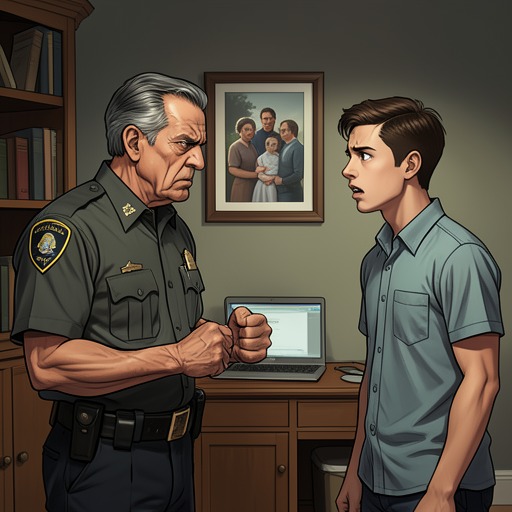
Holding Out for a Hero ▸ Stiles Stilinski (2)The Stiles Stilinski–Sheriff Stilinski relationship is a conflict-laden father-son bond in which affection is expressed through supervision, interrogation, and attempts to keep Stiles safe. Sheriff Stilinski represents official procedure in a town overtaken by unexplained deaths, while Stiles responds by withholding information, entering dangerous scenes, and trying to solve the violence before his father can understand its supernatural cause. Their relationship therefore joins family intimacy to an unresolved struggle over evidence, trust, and who has the right to define what is happening in Beacon Hills.
Authority, Suspicion, and the Hidden Case
Stiles’ relationship with his father is repeatedly filtered through the sheriff’s professional instincts. After the attack at the mechanics garage, Stiles, Carson Bradley, and Sheriff Stilinski sit on the ambulance tailgate in the rain while police and ambulance lights flash around the parking lot. Stiles has been paralyzed by the lizard creature’s attack and has only just regained feeling, yet he and Carson repeat the limited story that they entered the scene and found the Jeep on top of the mechanic. Sheriff Stilinski questions his son and plainly does not accept the account. His authority is not abstract: he treats Stiles’ Jeep as evidence and tells him that it will be impounded, leaving Stiles to complain that it should at least be washed.
The scene makes the emotional cost of that authority visible. Stiles is desperate to leave before Carson begins to panic, while Carson remains latched onto him and appears almost catatonic, unable to speak or look directly at anyone. Sheriff Stilinski eventually allows them to go, but only after imposing a practical restriction: they cannot leave in the impounded Jeep. The father’s procedure protects the integrity of the investigation, yet it also places him on the opposite side of the secret his son is trying to preserve.
Earlier, Stiles’ difficulties with authority are linked to the adults’ competing investigations. After Mr. Harris releases him from detention, Stiles drives Carson toward the cemetery. Carson explains that Harris kept Stiles late because Sheriff Stilinski maintained a twenty-four-hour hold and because Stiles had chosen not to tell the police that he had told Kate Argent how to escape after the arson. Stiles describes Harris calling him a new semester project and promising him exposure to the greatest discipline. The episode establishes a pattern in which Stiles is disciplined by school and police authorities at the same time that his private knowledge forces him into investigative action.
Protection Under Pressure
Despite the suspicion between them, Sheriff Stilinski’s conduct is also protective. When a police car stops only inches from Carson as she walks toward Stiles’ Jeep, the driver turns out to be Sheriff Stilinski rather than one of his deputies. He begins apologizing before recognizing Carson, an encounter that immediately makes her fear that she is in serious trouble. His sudden arrival carries both paternal surveillance and the possibility of intervention: he is the person most capable of controlling the danger, but also the person from whom Stiles and Carson have been concealing the truth.
Stiles’ own responses show that the bond has not become indifferent or hostile in a simple sense. At the garage, he reaches for his phone while the venom leaves him barely able to move and rasps out an emergency number. Carson understands the request and calls the police. Later, when Sheriff Stilinski questions him at the ambulance, Stiles insists that he saw nothing, and Carson supports him. His lie is not a rejection of his father so much as an attempt to prevent an impossible explanation from reaching an authority figure who has not yet been given a way to believe it.
The relationship also carries a physical language of reassurance. Carson squeezes Stiles’ arm while he denies seeing anything, and Stiles later asks whether she is all right. Sheriff Stilinski’s concern is less openly intimate, but it appears through his attention to the scene, his questioning, and his refusal to let Stiles simply drive away in a vehicle contaminated by a murder investigation. The adults and teenagers are all trying to protect someone, yet each form of protection produces another concealment.
The Police Station Confrontation
Stiles eventually decides that concealment cannot continue. He asks the desk worker at the Beacon Hills Police Department to let the group in because he needs to see his father. Carson asks repeatedly whether he is certain, since Stiles intends to tell Sheriff Stilinski what happened—everything. The decision marks a crucial attempt to convert the father-son relationship from evasion into disclosure. It is also a moment of dependence: even while challenging his father’s authority, Stiles seeks the sheriff as the proper recipient of the truth.
Fate blocks that direct confession. Near Sheriff Stilinski’s office, Stiles, Carson, and Scott McCall find Jackson Whittemore seated in a spare police uniform while David Martin leans against the wall. Jackson’s father, known to Carson since childhood, is a lawyer, and Jackson smugly translates the title for them. Sheriff Stilinski then greets Scott, Carson, and Stiles with evident agitation and introduces David as Jackson’s father. The anticipated private conversation becomes a public legal confrontation, making Stiles feel that the group has received the worst possible outcome before he can explain anything.
The station therefore becomes a compressed image of their relationship. Stiles wants his father’s help but arrives carrying a story that would challenge ordinary police assumptions. Sheriff Stilinski encounters him not as a son with a frightening confession, but as one participant in a volatile case involving Jackson, legal representation, and possible criminal liability. Family recognition remains present in the greeting, yet institutional procedure determines what can be said and heard.
Evidence, Investigation, and Shared Purpose
Their connection becomes more functional and collaborative when the investigation turns toward material evidence. At two in the morning, Stiles, Carson, and Scott enter the police station with Sheriff Stilinski’s assistance. Ten minutes later, they gather around his old desk to examine hospital surveillance from the night Jessica was murdered. The footage is crowded with wheelchairs, gurneys, and the aftermath of a six-car pileup, making the search for Matt Daehler difficult. Sheriff Stilinski explains that the hospital was jammed, while the teenagers insist that Matt must have passed a camera on the way to Jessica.
The investigation then shifts from uncertainty to a developing chain of proof. Sheriff Stilinski searches through folders and identifies shoeprints alongside tire tracks at the trailer park. If those prints match, Matt will be placed at three murder scenes: the trailer, the hospital, and the rave. A credit-card receipt signed by Matt at the garage, where the mechanic was killed, may establish a fourth connection. This work gives the father and son a shared objective even though they approach it from different directions. Sheriff Stilinski supplies official records, surveillance, and forensic reasoning; Stiles supplies urgency and the insistence that the scattered incidents form a single case.
The contrast is central to the relationship’s development. Stiles’ informal investigations begin in secrecy because the supernatural evidence is difficult to present, but the police station sequence shows his knowledge entering an institutional framework. Sheriff Stilinski does not simply rescue Stiles from consequences; he helps construct a case through evidence. Their bond is strongest when personal loyalty and professional investigation briefly point toward the same conclusion.
Meaning and Development
The relationship’s defining tension is not a lack of love but a failure of shared interpretive ground. Stiles sees werewolves, a paralyzing creature, and connected murders; Sheriff Stilinski sees contradictory statements, damaged property, surveillance footage, tire tracks, shoeprints, and receipts. The father’s skepticism is therefore both an obstacle and a safeguard. It prevents him from accepting every frightened explanation, but it also leaves Stiles convinced that ordinary procedure cannot move quickly enough.
Within the broader narrative, Stiles and Sheriff Stilinski embody the conflict between secret teenage solidarity and accountable adult authority. Stiles repeatedly risks himself alongside Carson and Scott McCall, while Sheriff Stilinski tries to reconstruct events through police questioning and documented evidence. Their relationship is consequently a recurring negotiation: Stiles conceals facts to protect people and pursue the truth, and his father presses him for the account that might make protection lawful and effective. The bond remains strained by that cycle, but the police-station investigation suggests its possible direction—away from mere interrogation and toward a difficult partnership in which Stiles’ intuition and Sheriff Stilinski’s evidence can finally meet.