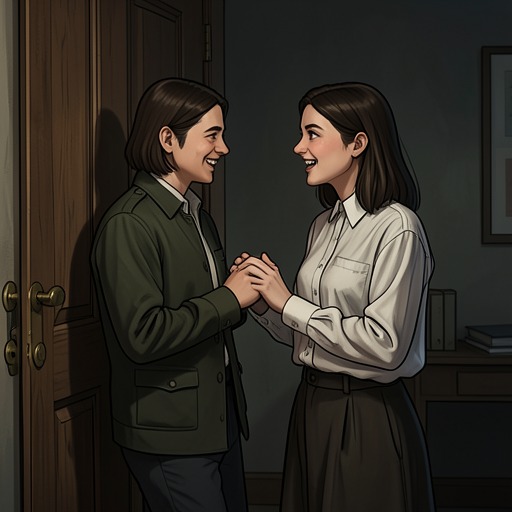
Stiles' Jeep
Holding Out for a Hero ▸ Stiles Stilinski (2)Stiles' Jeep, identified in the narrative as the familiar powder-blue vehicle, is more than transportation: it is a practical refuge, a source of friction, and a recurring point where the ordinary world collides with the supernatural. Its damaged machinery makes it conspicuously unreliable, yet its presence repeatedly gives Carson and Stiles somewhere to go, hide, grieve, and continue investigating when safer structures have failed.
Definition and Condition
Stiles' Jeep is physically worn and mechanically compromised. At the auto body shop, a young mechanic works beneath it while Stiles and Carson inspect the repairs. The Jeep cannot drive in second gear without grinding, lacks a catalytic converter, and is assessed first at twelve hundred dollars for parts and labor before the estimate rises to fifteen hundred. Carson protests the cost because the vehicle is already difficult to drive, while Stiles, visibly angered by the mechanic's judgment, ultimately tells him to finish the work. The exchange presents the Jeep as an object whose material condition imposes immediate financial and practical pressure on its owners.
The repair scene also makes the Jeep unexpectedly vulnerable. While the mechanic works underneath it, the giant lizard creature reaches down with a clawed, scaly hand and cuts the back of his neck with its tail. The mechanic falls, and the attack leaves Stiles paralyzed nearby. The descending lift continues moving while the repair worker remains beneath it, turning a routine service into a lethal mechanism. The Jeep therefore becomes part of an assemblage of machinery, bodily danger, and supernatural violence: its broken condition draws the characters into the shop, while the shop's equipment intensifies the threat.
Recurring Plot Function
The auto shop establishes the vehicle as a recurring marker of the creature's movements. After the attack, clear ooze coats the waiting-room doorknob. Later, when Carson and Allison flee through the school, the same clear ooze is found dripping from a window sill, explicitly linking the school intrusion to the earlier auto-shop encounter. The Jeep itself does not identify the creature, but the scene associated with its repair supplies a physical trace that can be recognized when the danger returns elsewhere.
The vehicle also serves as an emergency refuge for Carson. After a traumatic confrontation, Carson cannot return home and finds Stiles' keys in a pocket. She goes to the Jeep not because she intends to drive away, but because sitting inside it offers a private place to endure her distress. Once inside, she throws the keys onto the dashboard, begins crying, and strikes the steering wheel hard enough to set off the horn. The Jeep's interior becomes a temporary emotional shelter, but the blaring horn also makes Carson's grief materially audible. In this moment, the vehicle is not an instrument of escape so much as a container for collapse.
Its importance is consequently defined by availability rather than reliability. The Jeep may grind, require expensive repairs, or remain stationary, yet it is close at hand when Carson needs protection from the open street and when the group needs to move through an increasingly dangerous town. The contrast between its mechanical weakness and its narrative usefulness gives the object a distinctive role: it cannot guarantee safety, but it repeatedly makes continued action possible.
Investigation and Material Evidence
Stiles' Jeep belongs to the same evidentiary world as surveillance footage, tire tracks, shoeprints, and financial records. In the investigation into Jessica's murder and the related attacks, the former sheriff reviews hospital surveillance footage while the investigators search for Matt. They identify shoeprints alongside tire tracks at the trailer park and a credit-card receipt signed by Matt at the garage when the mechanic was killed. The Jeep's association with the garage scene thus places ordinary automotive evidence beside supernatural testimony and helps widen the chain of suspected crimes.
The narrative repeatedly shifts between what people perceive and what objects record. At the auto shop, Carson and Stiles witness the creature and its paralysis attack directly; at the hospital, they must reconstruct another crime through crowded surveillance footage; at the trailer park and garage, investigators compare tracks and receipts. Stiles' Jeep occupies the middle of these modes. It is a personal possession with emotional meaning, but it is also a vehicle whose repair site, tire traces, and surrounding circumstances can become part of a criminal case.
Relationships and Symbolic Significance
The Jeep is closely tied to Stiles' identity and to his relationship with Carson. Stiles brings Carson into the repair dispute, keeps hold of her hand as they move toward the waiting room, and later leaves the keys that allow her to reach the vehicle when she is overwhelmed. The Jeep therefore carries traces of shared movement and intimacy even when the characters are frightened or separated. Its familiar presence contrasts with the unfamiliarity of the lizard creature, whose attack makes the same everyday setting suddenly unreadable.
As an object, the Jeep becomes visible precisely when it ceases to function transparently. Mechanical grinding, missing parts, escalating repair costs, the dangerous lift, and the horn all force attention onto its materiality. It is not a sleek heroic machine; it is damaged, noisy, expensive, and vulnerable. Yet those defects do not make it narratively useless. Instead, they keep the characters grounded in the stubborn physical world of parts, labor, keys, dashboards, and enclosed space while they confront paralysis, murder, and supernatural pursuit.
The vehicle's recurring significance lies in that tension. Stiles' Jeep cannot resolve the mystery or defeat the creature, but it preserves a human scale within the crisis. It is where practical problems are argued over, where danger first erupts from a routine repair, and where Carson can briefly fall apart without being exposed on the street. Its worn body becomes a quiet record of dependence: the characters do not survive by transcending ordinary objects, but by continuing to use them despite their failures.