Stiles-Carson reconciliation
Holding Out for a Hero ▸ Stiles Stilinski (2)Stiles-Carson reconciliation marks the point at which Carson Bradley and Stiles Stilinski recover their relationship after violence has made both of them feel powerless. Carson has been held hostage, rendered unconscious by Kanima venom, and left with a mild concussion; Stiles has watched her being taken down while unable to intervene. Their repair therefore addresses more than a disagreement between lovers. It confronts the belief that protection must mean physical dominance and replaces it with a shared understanding of care, endurance, and choice.
Causes and Background
The reconciliation grows out of a sequence of threats that has made ordinary intimacy inseparable from danger. Earlier, Carson discovered that Lydia Martin had vanished from a hospital bathroom while the shower was still running, with no visible route of escape and no sign of where she had gone. The disappearance intensified the sense that Beacon Hills was no longer governed by ordinary explanations. Soon afterward, Carson and Stiles were caught in the aftermath of another supernatural attack: rain fell around an ambulance, police lights flashed across a small parking lot, and Scott McCall’s bicycle stood alone in a corner while Stiles repeatedly insisted that they had merely found a Jeep on top of a victim. Carson could not dismiss what she had seen. The creature’s eyes and its recognition of her and Stiles made the danger feel personal, while people were dying around them and the pair had no reliable means of stopping it.
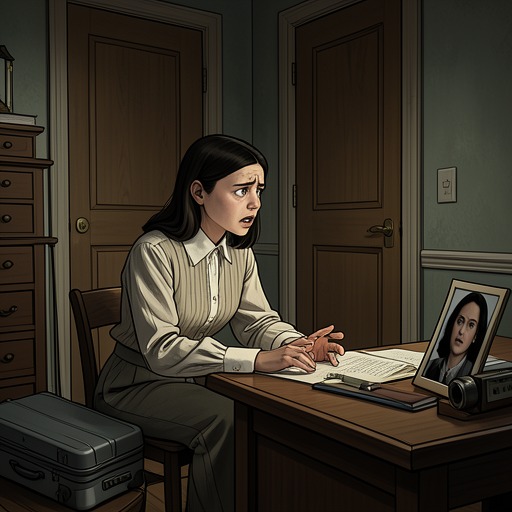
The immediate wound in the relationship is Carson’s abduction during the police-station hostage crisis. Matt Daehler took Stiles and Carson out, leaving both of them unconscious on the floor for at least half an hour. Carson later learned from Sheriff Stilinski that a paramedic had checked her for a concussion; the injury was mild enough that she did not require an overnight hospital stay, but the blackout left her without any knowledge of what had happened during the missing time. The event combined physical vulnerability with narrative uncertainty: Carson survived, yet she could not witness the danger that had nearly killed her, and Stiles was forced to live with the memory of being unable to stop it.
The aftermath remains bodily before it becomes verbal. On the next morning, Carson wakes in her own room with her hands entwined with Stiles’s and his arms wrapped around her. His fingers are described as abnormally long and skinny, his body pressed against hers, and his heartbeat perceptible against her back. The embrace supplies immediate social support after the hostage event, but it does not by itself settle the fear beneath it. Stiles is physically present while still carrying the conviction that he failed her, and Carson is held close while still needing to understand what that failure means to him.
What Happens
The decisive conversation begins when Carson asks Stiles to explain what happened between them. His response reveals that the crisis has altered his sense of himself inside the relationship. Seeing Matt take Carson down, he says he could do nothing, could not help or save her, and lay there thinking he was going to lose her. His distress is not presented as a lack of love but as the consequence of loving someone while being unable to control the violence directed against her.
Carson recognizes that the helplessness has not belonged to her alone. She has usually regarded herself as the dependent or vulnerable partner, while Stiles has been the one with ideas, jokes, and the ability to help her endure difficult circumstances. Yet Kanima venom can disable even someone as formidable as Derek Hale, so Stiles’s failure to intervene cannot reasonably be treated as a personal deficiency. Carson understands that anyone could have been taken out by the venom, and this recognition separates responsibility from outcome: surviving an attack does not prove that the person who could not prevent it was negligent.
Stiles cannot accept that distinction at first. He tells Carson that she has never really needed him because she is confident and independent, reducing himself to the insecure phrase that he is merely Stiles. His fear is therefore relational as well as heroic. If Carson can stand on her own, he worries that his presence has no indispensable value; if he cannot protect her like Scott or Derek, he imagines that he has failed the role he is supposed to occupy. His wish to care for Carson becomes distorted into an obligation to guarantee that nothing bad happens to her, an impossible standard in a town threatened by werewolves, Kanima venom, abductions, and armed violence.
Carson rejects that standard without rejecting Stiles. She tells him that her confidence does not mean she has no need for him, and that needing someone does not require expecting that person to take a gunshot on her behalf. She does not want a supernatural rescuer to swoop in and remove danger. What she needs is someone who will talk with her and love her as she loves him. The distinction is the event’s central turn: protection moves from bodily interception to emotional presence, and dependence is redefined as mutual attachment rather than helpless submission.
The reconciliation reaches its symbolic center when Carson calls Stiles a hero because he cares and tries to help everyone. She recalls their Batman comparison, but then strips heroism of invulnerability. A hero, in her account, can bleed and struggle; heroism consists in doing what is right rather than possessing supernatural strength, speed, a cape, or an implausible invisible vehicle. Stiles’s injuries and limitations do not disqualify him. They make visible the moral effort that Carson values.
Apology and Renewal
Stiles apologizes, but Carson refuses to let the apology become another form of self-condemnation. She answers that there is nothing for him to be sorry for, then states plainly that she loves him. The direct declaration resolves the uncertainty that has accumulated around the hostage crisis: Carson’s love is not conditional on his ability to defeat the attacker, and Stiles’s place in her life is not dependent on performing the kind of physical rescue associated with Scott McCall or Derek Hale.
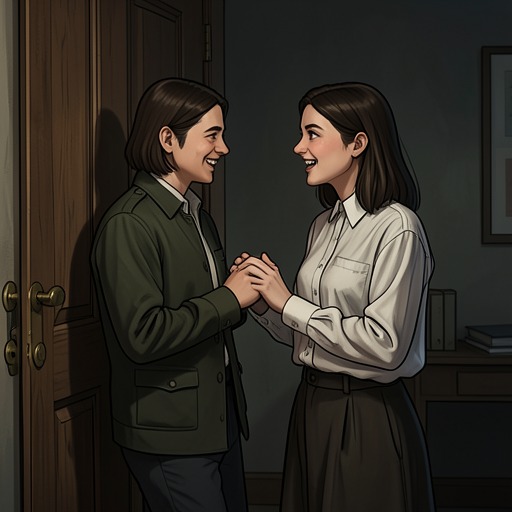
Stiles answers with a promise of permanence, presses a kiss to Carson’s forehead, and asks whether they are all right. Carson confirms that they are, then kisses his uninjured cheek. The physical tenderness is carefully scaled to the scene’s circumstances. Stiles is still visibly hurt, and the kiss avoids the bloody side of his face, turning affection into an attentive act rather than a dramatic erasure of injury. Their movement toward a fuller kiss suggests that reconciliation is not merely verbal, but the moment is interrupted when Carson’s phone buzzes with Scott’s name. The interruption leaves the couple restored while returning them immediately to the larger supernatural emergency.
Consequences and Significance
The reconciliation changes the meaning of Carson and Stiles’s bond within the wider conflict. Their relationship has been tested by captivity, paralysis, missing time, and the fear of death, yet the solution is not to pretend that those dangers were harmless. Instead, Carson and Stiles name the damage and revise the expectation that one partner must be powerful enough to prevent every catastrophe. Their agreement is consequently a form of resilience: the crisis remains real, but it no longer determines how they judge one another.
The event also establishes a contrast between supernatural capability and human courage. Werewolf strength and speed may be useful in combat, but they do not automatically supply the qualities Carson identifies as heroic. Stiles’s value lies in caring, attempting to help, remaining emotionally engaged, and refusing indifference even when he cannot win a physical confrontation. Carson’s argument gives those actions narrative weight equal to the more visible feats of Scott and Derek, while her own response demonstrates that independence and intimacy are compatible.
As a scene, the reconciliation turns a negative value state into a positive one without denying the losses that produced it. Helplessness becomes mutual recognition; guilt becomes forgiveness; fear of abandonment becomes a spoken promise of continued love. The return of Scott’s call prevents the scene from becoming a sealed romantic ending. Carson and Stiles are “okay,” but the world that injured them is still demanding their attention. Their private repair thus functions as a pause within the continuing crisis, a moment in which surviving together becomes as important as fighting the threat outside them.