Werewolf hunters
Holding Out for a Hero ▸ Stiles Stilinski (2)Werewolf hunters are presented as a hereditary human institution whose purpose is to eliminate supernatural threats, especially werewolves. The tradition gives the Argent family its collective identity and supplies the central external pressure surrounding Scott McCall’s transformation, yet the story steadily complicates its moral certainty by placing hunters beside teenagers who are trying to protect one another, and by revealing that a visibly monstrous figure can also be a traumatized human being.
Definition and Origins
The tradition emerges when the characters reason that any unknown force capable of harming humans will attract people determined to destroy it. Those people are not an anonymous mob but a single hunter family, the Argents. Their presence establishes a conflict between supernatural beings and a human lineage organized around threat elimination. The family’s hunting is treated as an inherited practice rather than an isolated personal choice, and the younger generation is born into its expectations whether or not each member accepts them.
The Argent tradition is therefore both a practical response to danger and a social identity. The family’s reputation precedes individual encounters, and its history is preserved through specialized knowledge. The Argent bestiary is written in Latin, while the apparent bestiary at one stage proves to be only a collection of recipes; the actual creature information is stored on Gerard Argent’s flash drive. This division between books, coded language, and guarded archives makes hunting knowledge feel controlled and initiatory. It is not ordinary folklore available to everyone, but a body of information kept within a family network and used when the family decides that a creature must be identified or destroyed.
The Argents and the Threat of Werewolves
Scott McCall’s bite turns the hunting tradition from background lore into an immediate danger. After Scott becomes stronger, faster, and more sensitive, Carson Bradley, Stiles Stilinski, and Scott McCall initially imagine that the transformation might be managed by chaining him during full moons. The Argent response is harsher: the existence of a werewolf is enough to place Scott within the category of a threat. The danger is intensified by Scott McCall’s relationship with Allison Argent, because Allison is the youngest member of the family that hunts the very kind of being Scott has become.
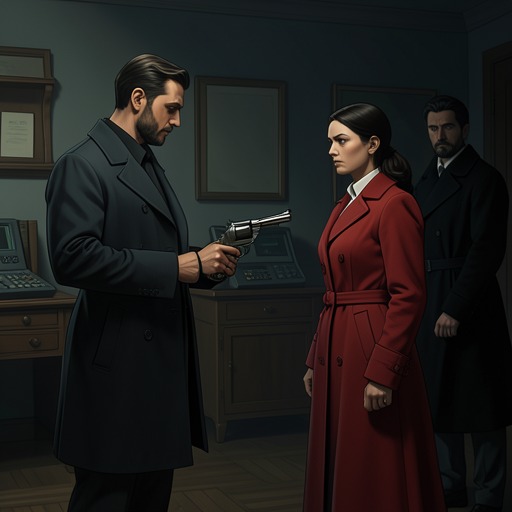
This relationship produces a forbidden romance that exposes the contradiction at the center of the tradition. Allison Argent is both a girl in love and a member of a hunter family, while Scott McCall is both a newly changed werewolf and Carson Bradley’s best friend. The conflict cannot be kept private once the Argents begin watching them. Mr. Argent follows the pair, points a gun at Scott McCall’s head, and forces Allison Argent to break up with him. Rather than ending the relationship, the pressure drives Scott McCall and Allison Argent to continue seeing each other secretly, with only Carson Bradley and Stiles Stilinski trusted enough to know. Hunting thus reaches beyond combat: it enters the intimate lives of the people it classifies as enemies.
Family Mobilization and Escalation
The funeral of Kate Argent makes the hereditary scale of the tradition visible. At the cemetery, the Argent family gathers before Kate Argent’s grave amid hundreds of photographers and journalists. Allison Argent sits with her family, Mrs. Argent wears a fur coat, Mr. Argent stands nearby, and an elderly white-haired man appears with two men resembling members of a protective detail. His presence changes the perceived stakes. The characters do not regard the gathering as a private mourning ritual alone; they understand it as the arrival of reinforcements.
Scott McCall identifies the newcomers as reinforcements, and Carson Bradley recognizes what that means: their lives are about to become substantially harder. The family’s expansion transforms the threat from a local dispute into a coordinated network. Allison Argent has already been unable to obtain clear answers from her relatives about what is happening to Erica Reyes or what will be explained after Kate Argent’s funeral. The secrecy surrounding the family’s plans reinforces its authority while leaving Allison Argent isolated inside the very tradition she represents.
The Argents’ arrival also clarifies the family’s presumed continuity. Carson Bradley expects that the people coming to the funeral will be Argents and assumes that they will preserve the hunting tradition. In this sense, the funeral is a family assembly with operational consequences: grief, inheritance, information, and preparation for conflict become inseparable. The family does not merely remember its dead; it gathers the living around a continuing mission.
Knowledge, Identification, and the Monster Boundary
The hunting tradition depends on naming and classification, but the creature threatening Beacon Hills resists easy identification. When Carson Bradley encounters a towering reptilian creature in the hallway, the first available description is physical: an overgrown lizard with a long tail, reptilian eyes, scaly skin, and rows of sharp teeth. Later, the creature climbs an indoor balcony, emits a shrill cry, leaps down, and strikes with its tail, knocking Erica Reyes unconscious. Its body appears to confirm the hunters’ worldview by presenting itself as an unmistakable nonhuman danger.
Yet the search for knowledge repeatedly fails to produce a stable category. The characters find nothing useful about a kanima even though the Argents possess records old enough to be written in Latin. Online searches for kanima legends, shape-shifters, and a giant lizard that cannot swim yield almost nothing. The bestiary’s inaccessible language and the internet’s silence place the teenagers outside the established channels of supernatural expertise. They must translate, compare, and improvise rather than simply receive a hunter’s authoritative answer.
The eventual confrontation further unsettles the boundary between hunter and hunted. The figure claiming responsibility for the killings explains that the victims were murderers and that they had murdered him. As Jackson Whittemore’s eyes change into fiery orange reptilian eyes, his hands develop scales and claws, and paralytic venom drips from him, the apparent monster speaks from the position of a victim seeking retribution. The creature’s violence remains real, but its identity is no longer exhausted by its appearance. The hunting tradition’s simple division between human prey and supernatural predator is challenged by a being whose monstrosity is bound to memory, injury, and revenge.
Methods, Opponents, and Consequences
The Argent tradition shapes the practical response to supernatural crises even when the immediate rescuers are not hunters. Deaton, a veterinarian whom the group trusts as a supernatural guide, prepares a small bottle and a spring-loaded syringe to help with the kanima problem. The teenagers’ reliance on him shows that knowledge and countermeasures once associated with specialized supernatural networks can circulate through other forms of expertise. At the same time, the presence of the Argent bestiary and Gerard Argent’s flash drive keeps the family’s authority over information central to the investigation.
The tradition’s moral logic is explicitly voiced by the kanima’s master, who states that the killers are killing murderers and insists that every person killed deserved it. This does not make the violence just, but it creates a sharp contrast with the hunters’ own claim to remove threats. Both systems present violence as corrective: the Argents eliminate creatures they regard as dangerous, while the kanima’s killings punish people identified as guilty. The story places these doctrines beside the teenagers’ more difficult position, in which protection requires resisting both supernatural violence and human systems that make extermination seem righteous.
The consequences are felt across the group. The Argents force secrecy onto Scott McCall and Allison Argent, mobilize family members after Kate Argent’s funeral, and make every encounter with an unknown creature potentially lethal. Their tradition also pressures Allison Argent to choose between inherited allegiance and personal attachment. At the same time, the teenagers’ investigation reveals the limits of inherited certainty: the creature must be studied before it can be understood, and the person inside the creature cannot be recovered through force alone.
Narrative Significance
Werewolf hunters function as the story’s clearest image of institutionalized fear. They give supernatural danger a human face, a family structure, weapons, archives, and continuity across generations. That organization makes them more threatening than an isolated attacker, because the conflict can renew itself whenever another Argent arrives with the authority and knowledge to continue it.
Their decisive narrative importance lies in the way they expose the instability of the word threat. Scott McCall begins as a human friend whose body changes, while the kanima appears as a reptilian attacker before Jackson Whittemore is seen beneath the scales. Between those two cases, the story refuses to let appearance settle moral identity. The Argent tradition remains a powerful force, but its inherited categories are repeatedly tested by love, secrecy, incomplete knowledge, and the discovery that a monster may also be someone who has been harmed.
The tradition therefore represents both survival and danger. It preserves information that can help identify supernatural beings, yet it also encourages the family to treat identification as a prelude to destruction. Its legacy drives the conflict from the woods to the hospital parking lot, from the cemetery funeral to the school, and from secret research into direct confrontation. By the time Jackson Whittemore’s transformation begins to recede in response to Lydia Martin’s key, the story has made clear that the most meaningful alternative to hunting is not ignorance, but recognition: seeing the human history inside the creature before deciding what must be done.