Wolfsbane plant
Holding Out for a Hero ▸ Stiles Stilinski (2)Wolfsbane plant is presented as a practical and symbolic weapon against werewolves: a piece of supernatural knowledge that can be identified, carried, and turned into lethal intent. Its clearest function is revealed when Allison Argent recognizes the plant associated with a carved box and Carson Bradley concludes that Isaac Lahey is being taken to the station so that someone can kill him. From that point onward, Wolfsbane plant marks the boundary between learning about the supernatural and acting violently within it.
Identification and Appearance
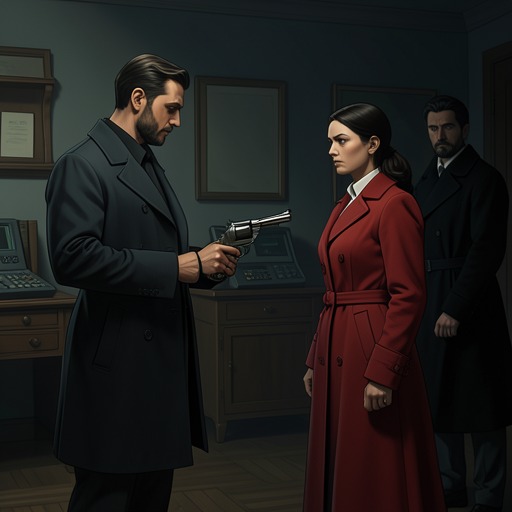
Wolfsbane plant first enters the relevant investigation through an object carried by a man dressed as a sheriff's deputy. Allison Argent reports that the man also has a box bearing something resembling a carving. She photographs the mark after searching through books, and the image reaches Carson Bradley's phone. The discovery is abrupt: the strange symbol is identified as Wolfsbane plant rather than as an obscure decorative design. The plant therefore functions as a decipherable sign, translating an apparently ordinary law-enforcement movement into evidence of an impending supernatural attack.
The surrounding research is marked by uncertainty. The group has recovered Gerard Argent's flash drive and learned that the text they initially believed to be the bestiary is actually a log of recipes, while the real bestiary is stored on the drive. The recovered material is written in Latin, leaving Carson Bradley and Scott McCall to confront a body of knowledge that is both authoritative and difficult to read. Wolfsbane plant belongs to that same system of coded information: its significance depends on recognizing a symbol, consulting inherited knowledge, and understanding what the knowledge permits someone to do.
Weapon Against Werewolves
Carson Bradley immediately interprets the plant's presence as a killing threat. After confirming that the image represents Wolfsbane plant, Carson Bradley tells Allison Argent that the people transporting Isaac Lahey intend to kill him. The conclusion is reinforced by the moonlit wait across from the station, where Carson Bradley, Stiles Stilinski, Scott McCall, and Derek Hale prepare to intervene. Wolfsbane plant thus changes the scene from suspicion to rescue: it supplies the concrete reason that the group must act before Isaac Lahey is delivered into the hands of those carrying the weapon.
The danger is not limited to a single transport. When Carson Bradley explains that Lydia Martin is not a werewolf, the distinction is framed through the threat of Argent weapons, specifically the possibility of being targeted with Wolfsbane bullets. Lydia Martin's unusual condition means that she has not become a conventional werewolf after Peter Hale's bite, but remaining outside that category does not remove the danger surrounding the supernatural. Wolfsbane plant and Wolfsbane bullets represent the hunters' ability to convert classification into violence: once a person is marked as a werewolf or suspected of belonging to that world, the weapon becomes an instrument of enforcement.
Knowledge, Research, and Control
The investigation of Wolfsbane plant occurs alongside the group's attempt to identify the Kanima. Carson Bradley and Stiles Stilinski search websites, mythology books, and the bestiary, but find almost nothing that directly explains the giant lizard creature. The online search produces only scattered analogies, including material about a were-jaguar, while the Latin records on the bestiary remain largely inaccessible. Against this informational confusion, Wolfsbane plant is comparatively legible. It is one of the few signs whose meaning can be recognized quickly and whose practical consequence is immediately clear.
That contrast gives the plant a structural importance beyond its physical use. The supernatural world is governed by fragments of recipes, Latin entries, symbols, stories, and specialized expertise. Deaton serves as a trusted guide within that system, helping Scott McCall and his allies prepare for the Kanima problem with a small bottle and a spring-loaded syringe. Although the immediate materials in that scene are described as tools for controlling the Kanima rather than as Wolfsbane plant, the scene establishes the same logic: supernatural knowledge is valuable because it can be transformed into an intervention. Wolfsbane plant belongs to this wider repertoire of substances and methods through which vulnerable bodies are identified, immobilized, or destroyed.
Ethical and Narrative Significance
Wolfsbane plant carries an unresolved moral tension. It can be understood as defensive knowledge in a world where werewolves and other creatures pose real dangers, yet its presence in the station plot also exposes the violence of hunter doctrine. The plant does not merely identify a threat; it announces that a person has been reduced to a supernatural category and made eligible for extermination. This tension is sharpened by the competing claim that the killers are targeting murderers and believe that every person they have killed deserved it. In that context, Wolfsbane plant becomes part of a self-authorizing justice system in which supernatural weapons replace ordinary legal judgment.
The plant also helps connect the novel's apparently separate levels of school life, police procedure, athletic routine, and supernatural conflict. The surrounding story continues to include lockers, lunch tables, grades, and Coach Finstock's insistence that Scott McCall remain eligible for the lacrosse team, even as the same characters decode symbols and prevent a werewolf's execution. Wolfsbane plant embodies that collision. It is a botanical object that becomes a coded message, a weapon, and a test of whether knowledge will be used to protect someone or to kill him. Its decisive narrative role lies in making hidden supernatural violence visible before the group can arrive at the station.