
The Limits of Scientific Control
HomunculusThe inventions and experiments promise mastery, but weather, sabotage, and living will repeatedly frustrate the characters’ attempts to control outcomes.
increasing Bearing strength in each event
 decreasing
Bearing strength in each eventdecreasingDesign Against Uncertainty

A Scientific Risk
Preparation and caution
St. Ives tests his oxygenator and prepares an unmanned launch because the spacecraft is unproven. His method recognizes that careful design cannot eliminate every danger.
Nature remains active
The craft depends on plants, gases, engines, and weather, while the novel’s unpredictable winds and storms resist any neat timetable. Science can prepare for uncertainty without abolishing it.
The Sabotaged Launch
Control Slips Away
A deliberate disruption
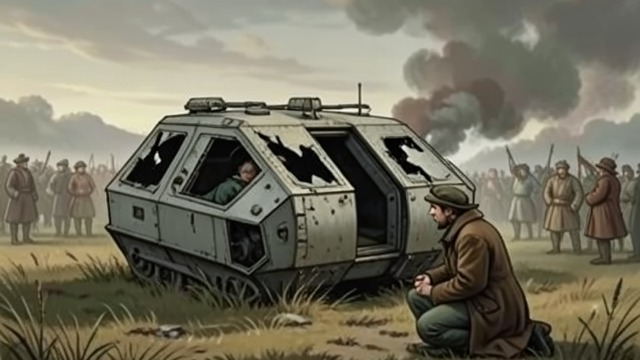
Deener breaks into the spacecraft and damages its contents, then sets off the launch unintentionally. The machinery responds to interference rather than to St. Ives’s plans.
Consequences multiply
The craft crashes near Lord Kelvin’s property, and St. Ives must manage local fear as well as the wreckage. The episode turns technical failure into a social crisis that cannot be solved by engineering alone.
A Controlled Landing

Skill Without Certainty
Learning by response
Inside the alien spacecraft, St. Ives initially tumbles and nearly loses control. He learns that small movements of the levers produce large changes in direction.
The achievement remains contingent
St. Ives lands safely through attention and restraint, but the Homunculus and Birdlip soon take the vessel away. His success is real without becoming ownership or mastery of the larger mystery.
During the planning of St. Ives’s Harrogate launch
The evening Deener enters the silo
Late in the Heath climax
