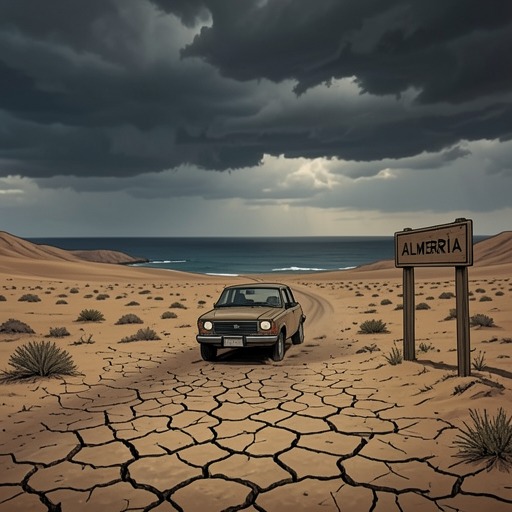
Almería
Hot MilkAlmería is the southern Spanish setting of the novel’s August 2015 narrative and more than a backdrop to its family and personal conflicts. Its arid terrain, crowded coastline, intensive agriculture, and industrial development repeatedly enter the characters’ choices and bodily experience. For Sofia Papastergiadis, the region is at once a place of temporary refuge and unstable belonging, where care for her mother, Rose Papastergiadis, unfolds amid heat, difficult water, and a landscape visibly altered to serve human needs.
Setting and physical character
The narrative establishes Almería through contrasts between the green parks Sofia associates with Britain and the dry hills and plains around her. In the August heat, the land appears parched, with little grass outside golf courses; the exposed terrain has even served as a location for Western films. The coast offers a different but not uncomplicated environment: beaches, open sea, and distant horizons sit beside cement works, construction, and the infrastructure of water production.
The region’s water is not a simple source of relief. Sofia thinks repeatedly about finding water that will be acceptable to Rose, while the heat makes hydration an immediate concern. The sea, meanwhile, can be dangerous: beach visitors are warned about jellyfish, and the water’s apparent clarity does not settle questions about its safety. These distinct forms of water—the sea, drinking water, and the water used to sustain agriculture—connect local bodily needs to the region’s environmental pressures.
Agriculture, labor, and environmental change
One of Almería’s most striking features in the narrative is the extensive covering of white plastic across its plains and valleys. A student at the beach’s first-aid hut identifies the structures as greenhouses, explaining that temperatures inside can reach forty-five degrees and that undocumented migrant workers pick tomatoes and peppers for supermarkets under conditions he describes as close to slavery. The farms are therefore not merely a visual feature of the setting: they connect the region’s food production to the exploitation of workers who bear its costs.
From a taxi window, Sofia sees the plastic-covered valley as a continuous surface spreading across the land. The image gives agricultural expansion a physical scale and makes the transformation difficult to separate from the landscape itself. Later, a lorry carrying tomatoes grown under the plastic-covered farms passes along a road where Sofia has left Rose. The produce links the region’s cultivated interior to the novel’s most consequential act of abandonment: agriculture is present not only as scenery, but as a system moving through the characters’ lives.
The account also situates present development within an older history of resource use. On the drive toward the Gómez Clinic near Carboneras, the taxi driver says that Carboneras means coal bunkers and that its mountains were once forested before trees were cut for charcoal. His explanation frames the landscape as something repeatedly stripped and repurposed. The clinic’s setting near a cement factory, and the broader presence of greenhouse production, make that history resonate with contemporary forms of extraction and development.
Coast, industry, and built environment
The coast opposite the cement factory is a working and developing landscape as well as a place of leisure. At one beach, cranes associated with a desalination plant rise above the sand, while cement powder is stored in dunes and unfinished hotels and apartments cut into the mountains. A cargo ship flying a Greek flag is visible offshore. The scene places industrial infrastructure, tourism construction, and international movement within one view, rather than presenting the Mediterranean shore as untouched nature.
The beach environment also carries immediate risks and interruptions. A café waiter warns Sofia against swimming after several people have been badly stung by jellyfish that morning. On another occasion, Sofia swims far from shore and is stung repeatedly before returning to the beach for treatment. The sea can draw her outward, offering distance from her circumstances, but it also imposes physical limits and sends her back to the shore.
Water quality becomes a public dispute as well as a private concern. While Sofia is away in Athens, sea police test the local water, identify a gasoline spill, and order swimmers out. Ingmar disputes their result, then drinks water from the sea when challenged and becomes ill. The episode shows how competing claims about whether water is clean or contaminated can have direct consequences for people who work beside it and depend on it.
Care, movement, and the clinic
Almería is also the setting for Rose’s treatment at the Gómez Clinic, reached by taxi on a thirty-minute journey from the coast. The drive exposes the contrast between the desert heat outside and the taxi’s excessively cold air conditioning, while the view through the window brings the greenhouse-covered valley into focus. Rose rests her head on Sofia’s shoulder, and Sofia remains still because she understands that her mother is frightened. The landscape is thus encountered through the practical demands of care, not solely as an object of observation.
The clinic itself is set into scorched mountains near Carboneras. Its cream-colored marble dome, glass entrance, gardens, and surrounding plantings distinguish it from the bare terrain and industrial development around it. The journey there marks a new stage in the history of Rose’s unexplained mobility problems; the treatment costs twenty-five thousand euros, financed by remortgaging Rose’s house. The promise of a healer is therefore bound to financial risk as well as hope.
The climate continues to shape care after the clinic visit. Rose refuses water and becomes dehydrated, while Sofia explains that finding the right water for her mother is difficult in the southern Spanish summer. Rose later strains a knee ligament and receives a new set of prescriptions at the General Hospital in Almería. These episodes make the region’s heat and water conditions part of the ongoing management of illness, without reducing Rose’s mobility problems to the environment alone.
Narrative significance
Almería repeatedly unsettles the idea that landscape is a passive setting for human drama. Its sea can attract and injure; its water can be necessary, rejected, or contested; its farms produce food while exposing migrant laborers to extreme heat; and its development alters mountains and coastlines. The narrative connects these conditions without suggesting that they all have the same cause or affect everyone equally.
For Sofia, the region also concentrates personal uncertainty. She arrives in a semi-desert landscape to pursue treatment for Rose, but finds no simple division between refuge and danger, beauty and damage, or care and constraint. The temporary home, the beaches, the clinic, and the road through the plastic-covered farms each offer different forms of movement while keeping her close to Rose’s needs. Almería’s significance lies in this convergence: its transformed environment makes visible the pressures under which the characters seek health, work, intimacy, and a place of their own.