Carboneras
Hot MilkCarboneras is a town near the Almería coast where Sofia Papastergiadis’s family life intersects with clinical care, artistic work, and an industrially altered landscape. The place is introduced through contrasts: desert heat and an overcooled taxi, a beach beside cement works, and a studio tucked among warehouses. These settings make Carboneras more than a backdrop; they connect the practical demands of care and mobility to a region transformed by industry and agriculture.
Setting and industrial history
The clinic attended by Rose Papastergiadis is near Carboneras, a town known for its cement factory and reached by a taxi ride of about thirty minutes. During the journey, the air conditioner makes the desert heat feel like a Russian winter. The driver explains that Carboneras means coal bunkers and that the surrounding mountains were once forested before trees were cut for charcoal. His account presents the landscape as something repeatedly stripped and put to work, a history that anticipates the visible industrial development around the coast.
The taxi ride also brings environmental change into the family’s medical journey. The driver says he cannot control the automatic air conditioning, but offers advice about beaches with clear, clean water. That promise of clean water sits uneasily beside the cement factory, the desalination plant, and the evidence of development that Sofia sees near the shore. The town’s surroundings are thus described through competing needs and transformations: heat, water, industry, and the search for places still imagined as clear and safe.
The beach and the industrial coast
At a deserted beach opposite the cement factory, Sofia stops at a small café near a row of gas canisters and orders a gin and tonic. The waiter warns her not to swim: three people have been badly stung by Jellyfish that morning, their welts turning first white and then purple. As he describes the injuries, he grimaces, shuts his eyes, and waves his hands as though trying to repel the sea and what lives in it. His warning makes the beach a place of immediate bodily risk, not simply a scenic escape.
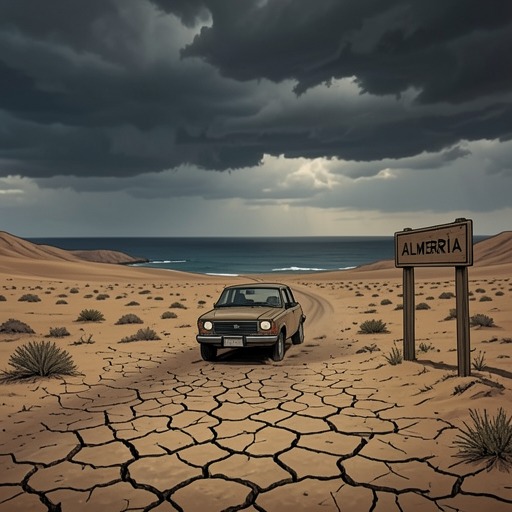
The shore’s other details sharpen the contrast. A Greek-flagged cargo ship floats near the horizon, while a rusty child’s swing, made from a battered car tyre, sways in the coarse sand. Cranes from the desalination plant cut across the sky. Nearby, greenish-grey cement powder lies in dunes at a depot, and unfinished hotels and apartments have been cut into the mountains. The industrial works, abandoned-looking play equipment, and incomplete construction give the coast a mixed character: it is at once a place of leisure, infrastructure, and ongoing alteration. The beach’s warning about Jellyfish is set against a landscape where human intervention is just as conspicuous.
The clinic and care
The clinic near Carboneras is where Rose’s symptoms meet Dr Gómez’s examination and questions about treatment. During one consultation, he feels the sole of her right foot and identifies two ulcers. Although the affected area is small, it is slightly infected, and he says it needs immediate attention. He asks whether she has been tested for diabetes; Rose says she has. The examination gives a specific bodily finding to a history in which new symptoms and prescriptions have repeatedly complicated Sofia’s effort to understand her mother’s condition.
Dr Gómez’s work there extends beyond examining Rose. He asks her to identify which medications she feels attached to and which she can let go, while also proposing that he and Rose compare information to look for abnormalities. In the same consultation, he briefly turns on a radio to hear news about the austerity programme and identifies the Spanish financial analyst being broadcast. Clinical decision-making consequently shares the room with national economic news. His attention to Rose’s medication and his practical response when she asks for water—he fills a plastic cup at the basin and brings it to her—make care appear as both an interpretive process and a sequence of immediate tasks.
Later, Dr Gómez describes Rose’s two-night admission to a clinic, where she was dehydrated and received intravenous saline. He emphasizes that she cannot easily swallow water, and therefore cannot easily swallow medication. This account places hydration and medication in direct relation: a treatment plan depends on the patient’s ability to take in the water needed to swallow her prescriptions. The hospital in Almería also enters the account, as Rose reports that its doctor was concerned and that she is back on her medication. Carboneras is therefore part of a broader chain of care, where clinical explanations and practical limitations do not always resolve Rose’s unexplained impairment.
The studio and the town’s working spaces
Carboneras is also where Julieta Gómez lives and keeps her studio. She invites Sofia to visit, giving her a business card; later, Julieta’s directions lead Sofia to a small park, where she leaves the car on a side street and walks the remaining distance. The studio occupies an industrial building at the end of a cobblestoned mews, the last of three small warehouses. Purple bougainvillea grows over its wall, softening the approach to a metal door marked with Julieta’s name.
Inside, the studio is spare and visibly used for making art. The room smells of oil paint and turpentine; its floor is concrete and its walls bare brick. Six paintings and several blank linen canvases lean against the walls. A leather sofa, three wooden chairs, and a fridge provide the main furniture, while books crowd the shelves. Glasses, cups, and two breadboards sit on a table, but the room lacks the household objects Sofia had seen at the market stall. Its arrangement distinguishes a working space from a settled domestic interior. In Carboneras, the studio offers a different kind of purposeful occupation from the factory and construction works that dominate the coastal view.
Mobility and narrative significance
Sofia’s visits also make Carboneras a setting for tentative independence. By the time she drives to Julieta’s studio, she is using a rented Citroën Berlingo regularly. Driving is manageable apart from getting the gear into neutral, but she fears being stopped by the police without the right documents. After parking between a car and three bins, she knocks the bins over. The episode sets the ordinary mishaps of learning to drive beside a more serious anxiety about documentation and belonging.
That anxiety draws an explicit parallel with unpaid Mexican workers sacked by Pablo and immigrants working in the desert farms. Sofia imagines the possibility of being questioned by the traffic police in the style of colonial anthropologists offering beads, shells, fish hooks, or eggs as payment, then recognizes that she does not know what she would actually do. Carboneras and its surroundings consequently join personal uncertainty to the region’s labor inequalities: the same landscape that furnishes a route to a studio and a clinic is also sustained by precarious work. Across its consultation rooms, warehouses, beach, and industrial horizon, the town gathers the book’s concerns with bodily vulnerability, economic pressure, and the difficult work of moving toward a life beyond caregiving.