Citroën Berlingo
Hot MilkThe Citroën Berlingo is the vehicle through which Sofia Papastergiadis’s practical responsibility for Rose Papastergiadis becomes inseparable from questions of control and danger. Its troublesome neutral gear first appears as a comparison for a man’s forced attempt at a neutral expression; later, Sofia’s effort to manage the car accompanies a night journey that ends with her leaving Rose in the road. The Berlingo is more than transport in these scenes: its controls, movement and limits give concrete form to the precariousness of their journey together.
The car and its controls
The Berlingo enters the narrative through Sofia’s attention to neutral. When Matthew tries to arrange his face into an expression of neutrality, Sofia compares his difficulty to the gear in the Berlingo that gives her the most trouble. The comparison makes the car part of her habitual frame of reference: a mechanical problem is readily available to describe a strained human performance. It also establishes the vehicle not as an effortless extension of its driver, but as something whose operation can resist her.
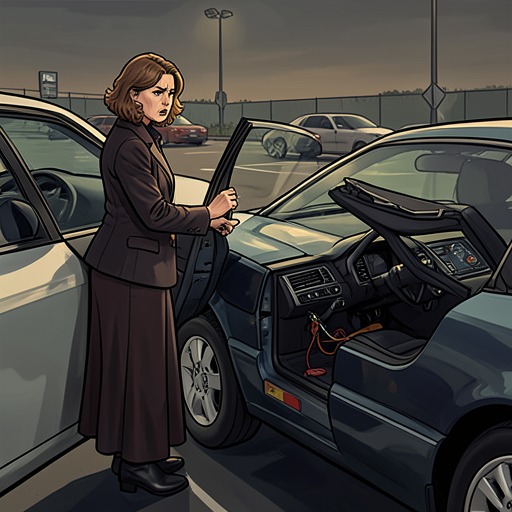
That difficulty returns when Rose is seated in the car and Sofia is still puzzling over the neutral gear. The detail is small but consequential: the journey begins with Sofia managing a control she has not mastered, while Rose declines to put on her seat belt. Their positions expose different kinds of vulnerability. Rose is the passenger whose safety equipment she can refuse; Sofia is the driver responsible for the vehicle and its movement, despite her uncertainty about its controls.
A journey through the night landscape
Sofia takes a rough road across the mountains before joining the motorway. The Berlingo carries the two women through a landscape marked by ruins with sale signs, hard earth and a garden beside the road, where a fruit-heavy cactus has toppled over. Holes and small rocks make the surface hazardous and send dust over the windscreen. These are not simply passing views: the road’s condition makes driving a physical, effortful negotiation with the terrain, and the dust narrows Sofia’s view as she drives fast and blind toward the motorway.
The car’s measurements make the speed and conditions unusually specific. Once they are back on the road, its clock reads 8.05, the temperature is 25 degrees Celsius and Sofia is travelling at 120 kilometres per hour. Those figures sit beside the image of a decaying Ferris wheel abandoned in the desert, described as an open mouth and a last, cheap laugh. The dashboard registers the journey as numbers; the landscape gives it an eerie, deteriorated character. The contrast makes the Berlingo both a moving enclosure from which Sofia watches the roadside and the instrument of a pace she is not fully able to see or control.
The vehicle at the edge of abandonment
The journey’s danger sharpens when Rose asks for water. Sofia pulls into a service station and runs inside to buy a bottle; soon afterward she stops on the hard shoulder and suggests looking at the sunset, although there is no sunset to see. The sequence places ordinary acts of care—buying water, stopping the car—beside disorientation and exhaustion. The Berlingo makes these pauses possible, but it cannot make the roadside safe or restore a clear direction to the journey.
A white lorry approaches in the distance, carrying tomatoes grown under plastic on the desert’s slave farms. Sofia wheels her mother into the middle of the road and leaves her there. The account does not describe the Berlingo’s precise position at that moment, so the car should not be mistaken for the action itself. Yet the abandonment follows the drive it has carried: a journey through rough terrain, at high speed, under conditions that leave Sofia driving blindly. The vehicle’s recurring presence consequently gathers a disturbing double meaning. It is an instrument of mobility and caregiving, but movement alone does not amount to safety, and the driver’s control of the car cannot guarantee care for its passenger.
Narrative significance
Across these scenes, the Berlingo links a comic comparison about neutral gear to a journey in which neutrality and control become increasingly untenable. At first, its mechanical difficulty supplies Sofia with an everyday image for Matthew’s awkward self-presentation. Later, the same gear troubles her while Rose waits in the passenger seat, and the vehicle carries them onto roads whose hazards culminate in an act of abandonment. The car does not explain Sofia’s decision; its significance lies in the concrete conditions surrounding it. It places driver and passenger in a shared, dependent space, then becomes part of the route by which that dependence breaks down.